


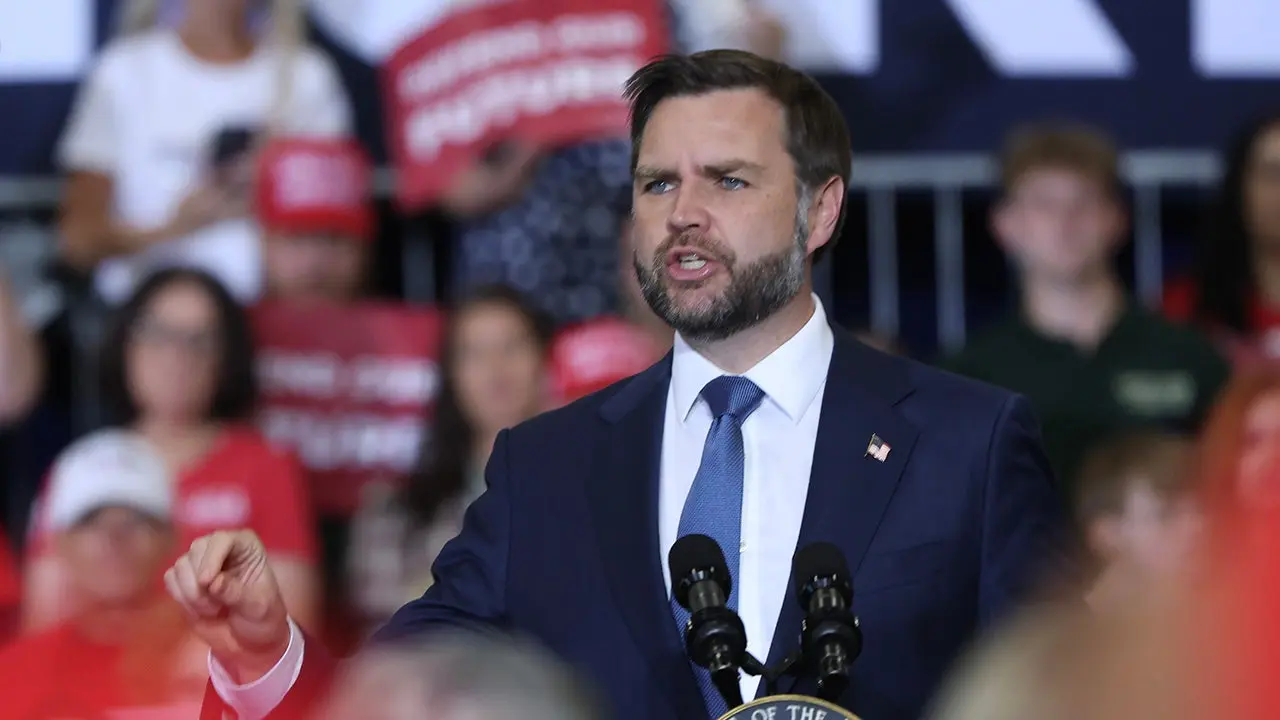
The air in the Iowa rally hall was thick with anticipation as Vice President JD Vance stepped up to the microphone, his posture relaxed but his words sharp as a blade. The crowd, a sea of red hats and eager faces, had come to see a fighter, and Vance did not disappoint. On this particular Friday, the Vice President wasn’t just there to stump for local candidates; he was there to draw a line in the sand, framing the upcoming midterm elections as nothing less than a battle for the very soul of the nation. With a knowing smirk, Vance declared that the choice before voters wasn’t about tax policy or foreign affairs, but something far more fundamental. He looked out at the crowd and framed the election as a stark verdict between two competing worldviews, promising that the ballot box would soon decide which path America would take.
To make his point resonate, Vance reached deep into his own family history, a story that felt both personal and profoundly political. He spoke of his upbringing, the grandson and son of working-class Americans, raised by a union steelworker who instilled in him a deep respect for the Democratic Party of old. Vance recalled his father’s reverence for the political icons of the past, reminding the audience that his dad believed FDR’s Democrats and JFK’s Democrats were the true champions of the workingman, the party that gave a voice to the voiceless in the factories and steel mills. But Vance’s tone shifted from nostalgia to lament as he asserted that this historic party was gone, leaving the audience with a haunting realization that the political landscape they once knew had been utterly bulldozed.
He painted a picture of a modern Democratic Party unrecognizable to its own ancestors, arguing that the party of Roosevelt and Kennedy had been replaced by something far more radical. Vance insisted that this new party didn’t believe America needed to be improved or fixed, but that it needed to be fundamentally restructured from the ground up, a notion he dismissed as dangerous fantasy. To illustrate his point, he brought up a startling claim about a congressional candidate in New York, a moment that drew audible boos from the crowd. He repeated the claim with a sense of disbelief, telling the crowd that this candidate had suggested that the Fourth of July was actually about the liberation of Palestine and Puerto Rico, a proposition so absurd to him that he had to assure the audience he wasn’t joking.
The crowd’s reaction was visceral, and Vance played into that raw emotion, channeling their outrage into a rallying cry. He juxtaposed the absurdity of that idea with the historical weight of Thomas Jefferson penning the Declaration of Independence, a moment meant for the birth of a nation, not the political causes of distant lands. While he conceded that the idea was almost comical, Vance soberly warned that the people proposing such ideas were completely serious, which made them not funny but terrifying. He shouted to the crowd that this election was a referendum on “common sense versus pure unadulterated crazy,” urging them to send those they deemed crazy packing and clear them out of Washington. The cheers that followed were deafening, a release of frustration and a commitment to action.
Vance continued his verbal assault, categorizing the opposition into distinct groups of what he described as extremists. He mentioned, with a sense of pity, that some candidates were simply “out-and-out lunatics” who had “lost their ever-loving minds,” suggesting these were individuals who preached that American history was inherently evil. He argued that their solution wasn’t to learn from the past but to bulldoze the entire country and start over from scratch, a proposition he rejected as an insult to the nation’s founders. But then, with the insight of a seasoned strategist, Vance acknowledged a second, more dangerous type of candidate, those who were “smart enough” to hide their true agenda. He pointed to Democrat Adam Hamilton of Kansas, claiming the man projected a “gee whiz, I’m a nice pastor” persona, yet used his pulpit to preach not the gospel of Jesus Christ but a gospel of racial guilt.
The Vice President’s focus on Kansas was no accident, as recent polls showed a tightening race between Hamilton and GOP incumbent Senator Roger Marshall, making it a prime testing ground for the national narrative. Vance implied that this subtle approach was the greatest threat, because it sought to deceive moderate voters into supporting a radical agenda under the guise of gentility. He painted Hamilton as someone who asked his congregation to repent for their “White privilege,” a clear dog-whistle to conservative voters about what they perceive as the radicalization of the left. This message, delivered from the heartland of Iowa, served as a warning not just about the immediate election but about the broader cultural war, insisting that the integrity of the nation depended on rejecting these subtle shifts in ideology.
As the event wound down, Vance took the opportunity to officially throw his full support behind the Iowa Republican slate, endorsing gubernatorial nominee Zach Lane, Rep. Ashley Hinson, and congressional candidate Chris McGowan, framing them as the antidote to the insanity he had just described. He presented these candidates as grounded, common-sense individuals who understood the struggles of the working class because they were part of it. His closing message was a call to action, reminding the audience that this wasn’t just about party loyalty but about reclaiming a country that he believed was slipping away. By connecting the midterms to FDR’s legacy and utilizing the raw energy of the crowd, Vance’s speech was a masterclass in modern political rhetoric, humanizing a critical election through family history and visceral emotion, leaving the voters with a clear, unforgettable charge to go out and defend the nation’s future.