

Behind the polished diplomatic veneer of the July NATO summit in Turkey lay a quiet, suffocating atmosphere of geopolitical dread, driven by intelligence reports of an imminent and highly sophisticated threat against the life of President Donald Trump. In the weeks leading up to the summit, the strategic landscape had grown increasingly volatile following decisive U.S. military strikes on Iranian assets, leaving Tehran seeking high-profile retribution. U.S. intelligence agencies had intercepted credible, specific communications indicating that Iran’s hostile focus was locked directly onto the American president’s international movements, turning a routine state visit into a high-stakes game of survival. When Trump first touched down at Ankara’s airport on July 8, he did so in grand fashion, arriving aboard a brand-new, ultra-luxurious Boeing 747-8—a massive aircraft recently donated to the U.S. government by the state of Qatar. Yet, beneath the glittering exterior of this state-of-the-art flying palace, a team of top-tier Secret Service agents and military strategists were quietly orchestrating a covert defense plan that would require absolute secrecy, impeccable timing, and a profound degree of theatrical deception. The psychological weight of the situation was immense; for the security detail, the mission was no longer just about maintaining a prestigious image of global leadership, but about navigating an active, lethal hunting ground where the President of the United States was openly designated as a hostile foreign power’s top target.
To shield the president from the eyes of potential assassins, security officials transformed the Turkish tarmac into a stage for an elaborate illusion, exploiting the media’s constant appetite for familiar presidential imagery. Under the glaring afternoon sun, the iconic blue-and-white Boeing 747—the long-serving, classic Air Force One jet that has symbolized American executive power for decades—sat ready for departure, serving as the central prop in this high-stakes drama. With news cameras rolling and a press pool documenting his every move, Trump walked up the external metal stairs of the legacy aircraft, turned back at the threshold of the cabin, and gave his signature wave to the crowd before disappearing inside. To any observer on the ground, or any hostile actor monitoring the airport from afar, the message was clear and undeniable: the President of the United States was safely aboard his primary flagship, preparing to fly home. This moment of public theater was designed to project absolute normalcy, anchoring the attention of the media and potential threats alike to the massive, highly visible 747, while the real, far more vulnerable escape plan was quietly initiated just out of sight on the opposite side of the fuselage.
The illusion of luxury vanished the moment the cabin doors closed, replaced by a tense, rapid-fire scramble in the plane’s shadow where the president’s life depended on a humble piece of airport utility equipment. Tucked away on the far side of the massive legacy jet, shielded entirely from the sightlines of the press and airport onlookers, a standard airport catering truck was raised high into the air, its cargo box aligning flush with an obscure exit door. In a jarring departure from typical presidential protocol, Trump and a skeletal crew of his closest aides stepped out of the luxury cabin and into the cramped, metal interior of the catering vehicle. The truck’s hydraulic lifts slowly lowered the group back down to the tarmac level, where the vehicle began a slow, unassuming crawl across the busy asphalt toward a far less conspicuous military plane parked nearby—an Air Force C-32A, which is a modified, twin-engine Boeing 757. This sudden transition from the sprawling, gilded comfort of Air Force One to the noisy, utilitarian belly of a service truck highlighted the raw, unglamorous reality of modern executive protection, where vanity is instantly traded for survival and the most powerful man in the world must travel disguised as airline food services to evade a potential missile strike.
Meanwhile, the classic Boeing 747 took on its role as a decoy with chilling precision, carrying an unsuspecting cargo of journalists, administration staff, and flight crew into the darkening skies. Shortly before takeoff, reporters settled into their seats, completely oblivious to the fact that the president they were tasked with covering was actually sitting on a much smaller, gray jet parked a mile away. Security personnel suddenly issued a stern and unusual command to the passengers, instructing everyone on board to pull down their window shades and keep them closed for the initial leg of the flight—a directive aimed at preventing anyone from noticing the decoy’s true nature or spotting the C-32A taking off nearby. Once in the air, the legacy jet initially flew as a ghost, showing up on international civilian radar screens without any identification or call sign, before suddenly broadcasting the famous “Air Force One” call sign mid-flight to complete the digital deception. This electronic ruse was designed to draw any tracking systems, satellite surveillance, or hostile air defenses toward the empty 747, while the smaller C-32A carrying Trump slipped quietly and unnoticed through the clouds, heading toward Western Europe under a blanket of total operational silence.
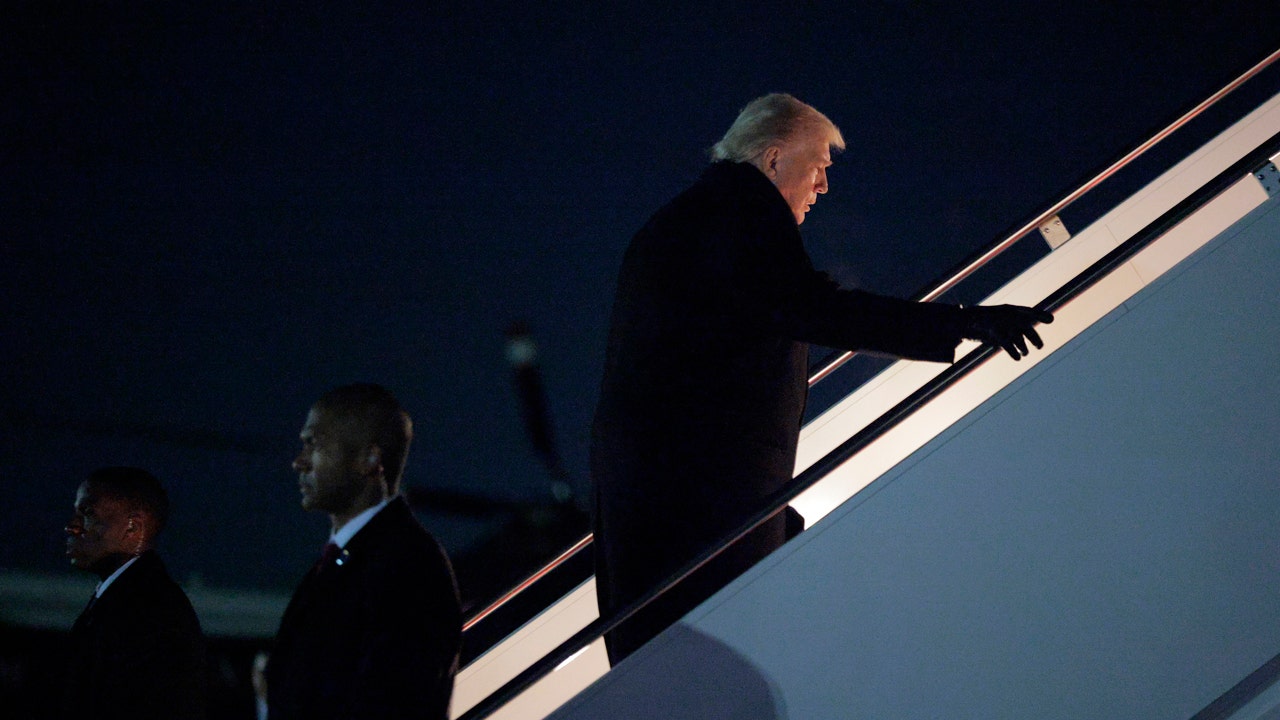
The complex choreography of the mission culminated under the cover of night at RAF Mildenhall, a bustling U.S. airbase in the east of England, where the split pieces of the presidential puzzle had to be seamlessly reassembled. The smaller, stealthy C-32A carrying the president touched down on the British runway first, slipping into a secure, darkened hangar just minutes before the massive, loud decoy 747 roared to a halt nearby. Behind closed hangar doors and away from any prying eyes, the logistics team executed another rapid, silent transfer to return Trump to the main aircraft, ensuring that his eventual public appearance would match the illusion of a continuous, uninterrupted journey. At approximately 10:56 p.m., the doors of the legacy Air Force One finally opened to the awaiting British television cameras, and Trump descended the external stairs with his usual confidence, performing for the media as if he had been riding in the main cabin the entire time. The theater of the presidency resumed without a hitch, and by 11:01 p.m., Trump, his staff, and the exhausted press corps transferred one last time, boarding the brand-new, Qatari-donated Boeing 747-8 to begin the final, secure leg of the journey back across the Atlantic to Washington, D.C.
The dramatic escape serves as a sobering reminder of the extreme, invisible threats that dictate the daily lives of global leaders, shifting the conversation from political posturing to the grim realities of physical survival. When curious reporters later pressed Trump about the bizarre order to lower the window shades over Turkey, he did not mince words, cryptically warning them that they had been on a highly dangerous flight due to the “sleaze bags” that threaten the nation. He openly acknowledged the constant peril of his position, reinforcing the chilling reality that he remains the primary target for hostile foreign regimes like Iran. In the aftermath of the revelations, White House Communications Director Steven Cheung and the U.S. Air Force defended the unprecedented operation, emphasizing that the modern presidential fleet is engineered to prioritize survival and advanced security protocols over comfort and aesthetics. As the political landscape grows more fractured and technology makes tracking global leaders easier than ever, this daring tarmac swap reveals the lengths to which the state must go to defend the presidency, proving that behind the grand symbols of American power lies a fragile, constant battle against the shadows of international violence.