

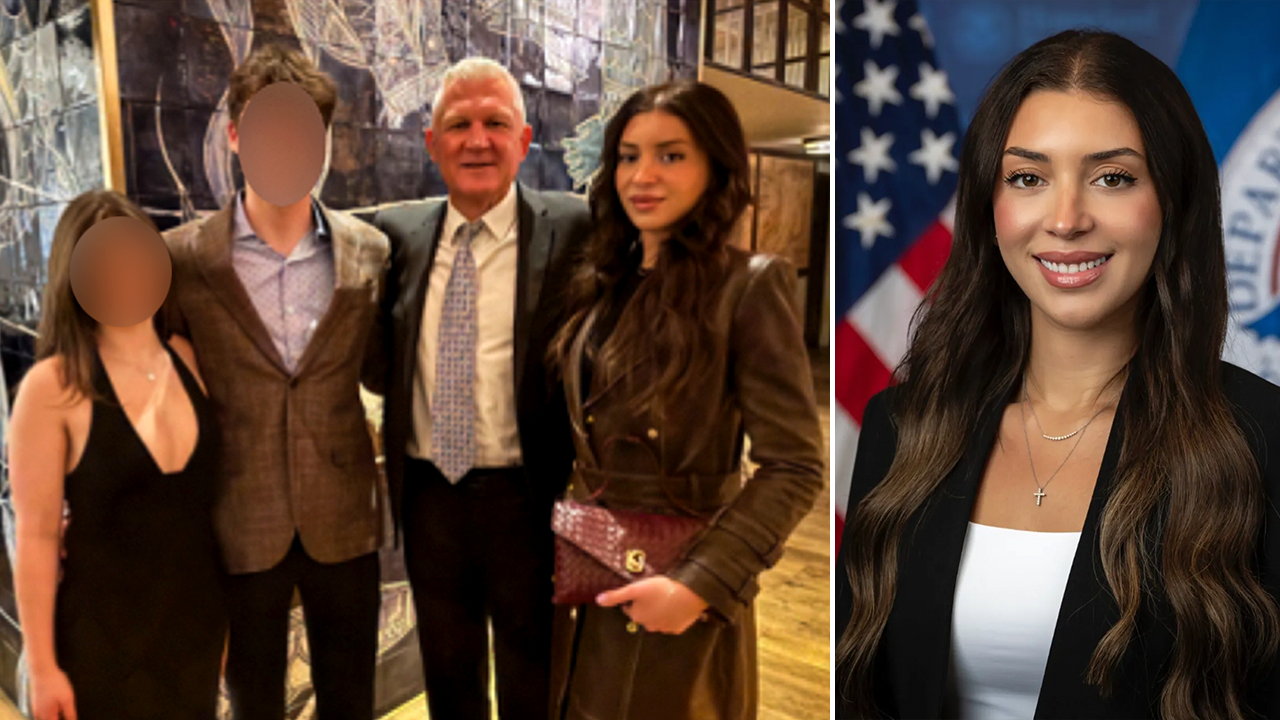
In the high-stakes, historically insular world of national security and counterterrorism, reputation is not merely a personal asset; it is the absolute currency of one’s survival. For Julia Varvaro, a brilliant and ambitious 29-year-old rising star, that currency was systematically liquidated in a brutal, highly coordinated public media storm target-designed to incinerate her life’s work. Having achieved the remarkable milestone of serving as the Deputy Assistant Secretary for Counterterrorism at the Department of Homeland Security (DHS) at an envied young age, Varvaro’s professional ascent was abruptly halted when a sensationalized “sugar baby” tabloid narrative broke across international media. Today, however, Varvaro is refusing to remain a passive victim of a digitized character assassination. In a powerful, high-stakes federal lawsuit filed in the Eastern District of Virginia, the former high-ranking official is fighting back against the architect of her public ruin: her multi-millionaire ex-boyfriend, Robert “Bob” Bianchi. The 57-year-old CEO of federal defense contractor SDVO Solutions is accused of executing a calculated, vindictive campaign that weaponized patriarchal tropes and institutional vulnerabilities to systematically dismantle Varvaro’s career. By reframing their intimate, age-gap romantic partnership as a sordid, transactional arrangement, Bianchi allegedly sought to punish Varvaro for her fiercely independent spirit and her refusal to yield to his personal ultimatums. This legal battle represents far more than a standard post-breakup dispute; it exposes a terrifyingly modern form of gender-based electronic warfare, wherein intimate-partner retaliation is outsourced to federal regulatory watchdogs and global tabloid media to achieve maximum, permanent professional annihilation. Through this audacious lawsuit, Varvaro is not only seeking financial restitution but is also attempting to reclaim her narrative, strip away the sensationalized headlines, and humanize the profound suffering of a young woman whose dedication to national security was overshadowed by a jealous partner’s desire for complete domination.
The mechanics of the alleged smear campaign, as detailed in the federal complaint, reveal a chillingly systemic blueprint for personal and professional sabotage. According to the lawsuit, which alleges defamation per se and defamation by implication, Bianchi crafted a highly malicious, entirely fabricated complaint to the DHS Office of Inspector General (OIG), strategically designed to trigger institutional panic within the national security apparatus. In this confidential bureaucratic weapon, Bianchi allegedly asserted that Varvaro’s college education had been funded by wealthy “sugar daddies” and that her collection of fine jewelry was essentially a series of “trophies” harvested from transactional sexual encounters. Not content with merely poisoning the well at her place of employment, Bianchi then allegedly took the extraordinary step of leaking this highly confidential OIG complaint, alongside highly selective, out-of-context private text messages and intimate photographs, to the British tabloid newspaper The Daily Mail. This leak was carefully engineered to ignite a feeding frenzy of public prurience, transforming a complex, private interpersonal relationship into a highly marketable, clickbaity tabloid drama that would ensure Varvaro was deemed radioactive by any government agency or high-level security clearance investigator. The lawsuit argues that Bianchi engaged in a masterclass of “defamation by implication,” strategically curating and manipulating their digital correspondence to strip away the warmth, mutual care, and normal financial dynamics of a committed, long-term romantic relationship, repackaging them instead as damning proof of sex work and financial extraction.
To understand the sheer scale of the manipulation, one must look at the actual human reality of the couple’s daily life, which the lawsuit painstakingly reconstructs through unfiltered communication logs. The sensationalized media narrative had seized upon highly suggestive text messages, such as Bianchi playfully writing, “Don’t f— with Daddy on fashion,” and Varvaro responding, “Daddy knows all,” presenting them to the public as smoking-gun evidence of a transactional, sugar-baby dynamic. In reality, Varvaro’s legal team demonstrates that these exchanges were nothing more than lighthearted, flirtatious banter regarding their significant age difference, a common linguistic play in modern relationships that was deliberately decontextualized to fit a predatory stereotype. Furthermore, the electronic funds transferred via Apple Cash—which Bianchi later dishonestly framed to the media as “consideration for sex”—were, in truth, the standard, reciprocal financial flows of a deeply committed domestic partnership. Far from being a passive financial drain on the multi-millionaire CEO, Varvaro was a supportive, highly active partner who frequently stepped in to care for Bianchi during moments of profound vulnerability. When Bianchi suffered a sudden, agonizing kidney stone emergency while traveling in Europe, it was Varvaro who managed his crises from afar and selflessly covered his emergency European medical expenses, earning messages of profound gratitude from Bianchi, who texted, “I’m sorry lover… Thanks for your help today. I was struggling,” to which she responded with unwavering tenderness, prioritizing his well-being over any financial concern. Her dedication was further illustrated when she drove him through hazardous, snow-swept winter roads, prompting a deeply affectionate text from Bianchi stating, “I love you Julia. Thanks for being You,” accompanied by the keycode to his residence and the declaration, “I’m yours lover… you are always welcome, any time or day.” He was a man who introduced her to his children, repeatedly texted her “I love you,” and expressed immense pride in her vital government work, telling her, “You’re making a difference”—sentiments that stand in stark, irreconcilable contrast to the cartoonish, transactional caricature he would later sell to the press.
The catalyst for the relationship’s tragic devolution occurred during the historic, grinding 76-day federal government shutdown, a period of immense systemic stress that left Varvaro, like thousands of other federal employees, furloughed and without a paycheck. Facing the immediate, compounding anxiety of being unable to pay her rent, Varvaro took the pragmatically independent step of planning to secure a temporary, part-time bartending job to keep herself afloat financially. Upon learning of her plans, Bianchi allegedly interceded, insisting that she bypass the labor market and instead rely entirely on him for her financial survival during the crisis. Reluctantly accepting his assistance in a moment of extreme vulnerability, Varvaro soon discovered that this apparent act of generosity was a Trojan horse designed to establish absolute emotional and financial leverage over her. The lawsuit alleges that Bianchi immediately began utilizing her temporary financial dependency as a blunt instrument of coercive control, escalating his demands until he delivered a stark, deeply manipulative ultimatum. In a revealing text exchange, Bianchi bluntly asserted his terms: “I told you I am not paying your bills until we are engaged.” Recognizing the trap of financial subjugation masquerading as romantic commitment, Varvaro displayed immense personal fortitude; she refused to capitulate to the ultimatum, immediately terminated the relationship, and defiantly informed Bianchi that she did not require “an ATM” if it came at the cost of her autonomy and self-respect. This act of defiance, the lawsuit contends, wounded Bianchi’s ego so deeply that he resolved to utilize his immense wealth, media connections, and political influence to utterly destroy the professional standing of the woman who dared to walk away from him.
The human and professional fallout of the subsequent, highly coordinated smear campaign has been nothing short of catastrophic for the young national security expert. In an exclusive interview, Varvaro’s attorney, Vel Freedman, painted a devastating portrait of a young woman whose life has been thoroughly upended by a calculated act of digital and institutional terror. Freedman revealed that Varvaro has suffered profound public humiliation, constant anxiety, and deep psychological trauma, requiring intensive clinical therapy under the care of specialized physicians to cope with the sudden, violent erasure of her identity and career. The legal team has highlighted the deeply insidious, uniquely gendered nature of this attack, noting that Bianchi’s fabrications were meticulously calibrated to exploit double standards that persist in the professional world. By attacking her sexual integrity and painting her professional achievements as the byproduct of transactional relationships with wealthy men, Bianchi deployed a weapon that is uniquely, devastatingly effective against ambitious women in male-dominated fields. The immediate consequence of this patriarchal warfare was as swift as it was heartbreaking: Varvaro was terminated from her prestigious role at the Department of Homeland Security, and her hard-earned, highly coveted employment offer to serve as a targeting officer with the Central Intelligence Agency (CIA)—a lifelong dream—was abruptly rescinded. The silent, bureaucratic machinery of national security, which operates on the principle of extreme risk aversion, reacted precisely as Bianchi had allegedly intended, discarding a highly capable counterterrorism asset rather than navigating the complex human reality behind a manufactured tabloid scandal.
As the legal proceedings move forward, the narrative constructed by the anonymous OIG complainant has begun to completely unravel under the bright light of judicial scrutiny, exposing the fragile foundation of the entire smear campaign. Despite the initial, sensationalized headlines claiming that Varvaro was an active user of transactional websites like Seeking, forensic digital evidence and dating company records have established that the couple actually met on Hinge, a highly mainstream, relationship-oriented dating application that utilizes Nobel-Prize-winning matching algorithms rather than financial exchanges. Crucially, once the protective veil of anonymity was lifted and Bianchi’s identity as the source of the devastating leaks was exposed, his public position shifted dramatically. In a telling act of damage control, Bianchi recanted the very narrative he had weaponized, admitting to People magazine that their relationship was actually “brief and personal” and openly confessing that it was “not a ‘sugar’ relationship.” While these belated admissions lay bare the falsehoods that fueled the media circus, the institutional damage to Varvaro’s security clearance and career remains a bleeding wound, with agencies like the CIA and DHS remaining silent on the specific infractions that prompted their knee-jerk dismissals. Ultimately, Julia Varvaro’s landmark lawsuit in Virginia is more than an effort to salvage her career; it is a vital, precedent-setting demand for systemic accountability. It stands as a powerful warning against the ease with which our vital federal institutions can be weaponized by wealthy, vindictive actors to destroy public servants, and it represents a brave, necessary step toward ensuring that a woman’s professional intellect and dedication to her country can never again be so cheaply liquidated by a discarded partner’s bruised ego.