


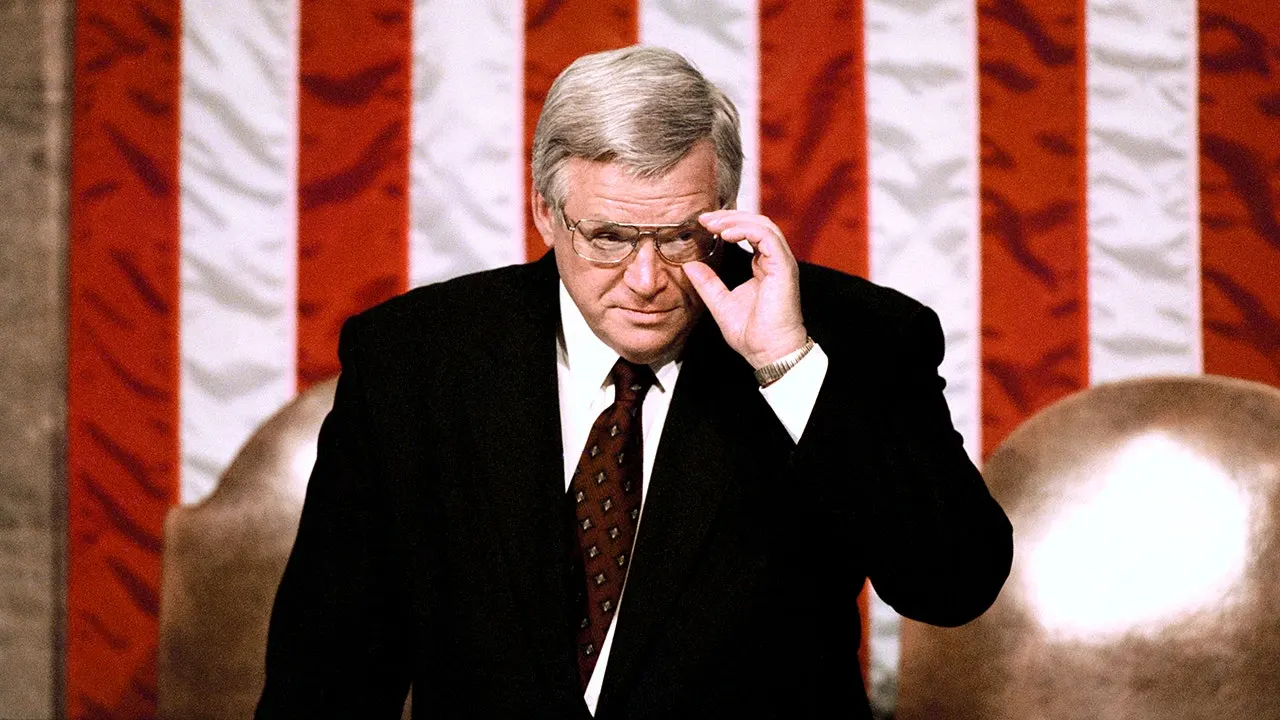
Dennis Hastert was never supposed to be Speaker of the House. He stumbled into the role by accident, a quiet, backslapping former high school wrestling coach from Illinois who seemed content to count votes in the shadows of the Republican leadership. When he finally took the gavel in January 1999, few Americans could pick him out of a lineup, and even fewer reporters knew his name. But for eight years, he held one of the most powerful positions in Washington, outlasting every Republican Speaker before him. When he died at 84 over the weekend, the official cause was natural causes. Yet no one could pretend that his life ended naturally, or that his legacy was anything less than grotesque. Hastert became the highest-ranking U.S. official ever to serve jail time, a distinction that erased whatever historical courtesy might have been afforded to a man who once stood third in line to the presidency. His death closes a chapter not just of political power, but of a double life so carefully hidden that even the most seasoned Capitol Hill insiders never saw it coming.
His rise to power was itself a strange accident of timing and chaos. In December 1998, House Republicans were reeling. Speaker Newt Gingrich had become so toxic after disappointing midterm results that his own conference pushed him out. In his place, they chose Rep. Bob Livingston of Louisiana, a powerful Appropriations Committee chairman who was supposed to lead them into the next Congress. But on December 19, 1998—the Saturday before Christmas—everything collapsed. The House was meeting to impeach President Bill Clinton over the Monica Lewinsky scandal, and Livingston, in a stunning speech, demanded that Clinton resign. Democrats shouted back, “You resign! You resign!” Livingston paused, raised his hand, and then announced that he too would resign—both as Speaker-designee and from Congress—after admitting to an affair. The Capitol plunged into bedlam. Republicans needed a Speaker by nightfall, and in the chaos, they grabbed J. Dennis Hastert, the Chief Deputy Whip, a man whose job was simply to help count votes. He was not a visionary, not a master strategist, not a commanding presence. He was just available. The press barely vetted him. The public barely knew him. He was, by every measure, an accidental Speaker, and that accident would prove catastrophic in ways no one could have imagined.
For years, Hastert presided over the House with a low-key, almost invisible style. He was known as “Coach,” not “Mr. Speaker,” a nod to his years teaching and coaching wrestling at Yorkville High School in Illinois. He avoided the spotlight, rarely gave interviews, and described himself as a “listener.” But in 2006, the accidental Speaker met his accidental downfall. Republicans were on the verge of losing the House, weighed down by President George W. Bush’s unpopularity and the war in Iraq. Then word broke that Rep. Mark Foley of Florida had sent inappropriate messages to teenage boys serving as House pages. The scandal exploded just as Republicans were trying to leave town to campaign. In one telling scene, reporters cornered Hastert in Statuary Hall as he lumbered toward his office. Asked what he planned to do about Foley, he mumbled, “We’ll talk about that shortly.” At a press conference later that day, Senate Majority Leader Bill Frist tried to limit questions to a national security bill, but a reporter pressed anyway. Hastert muttered something about not being “very happy” about Foley—a soundbite so weak it was barely usable. It was the response of a man who either didn’t understand the gravity of the moment or had something to hide. Democrats swept back into power that November, and Hastert’s Speakership ended not with a bang, but with a whimper. He lingered in Congress for a few months as a rank-and-file member, then resigned in late 2007.
The world might have remembered Hastert as just another failed Speaker, a footnote in the turbulent history of the Bush years. But in 2015, the dark secret that had been buried for decades finally surfaced. Federal banking regulators noticed that Hastert was withdrawing staggering amounts of cash in a suspicious pattern, the kind of behavior that often signals blackmail. They investigated, and what they uncovered was far worse. Hastert had been paying hush money to conceal his sexual abuse of teenage boys when he was a high school teacher and coach in the 1960s and 1970s. He was indicted on charges of lying to investigators and evading banking laws designed to catch large cash transactions. He pleaded guilty to the banking crimes, and prosecutors dropped the false statements charge. But in court, federal Judge Thomas Durkin did not mince words, declaring that Hastert was “a serial child molester.” Hastert himself admitted that he “mistreated athletes” and “took advantage” of the very young men he was supposed to mentor. He was never charged with sex crimes, because the statute of limitations had long expired. But he served 13 months in federal prison in Rochester, Minnesota—a sentence that made him the highest-ranking official in American history to ever serve time behind bars.
The revelation forced a painful reexamination of everything about Hastert’s career. How could a man with such a monstrous secret rise to the third-highest office in the land? Part of the answer lies in his accidental ascent. Because he was never seriously vetted, because he was never a frontrunner, because he was never the kind of politician who attracted scrutiny, his past went unexamined. He was known as “Coach,” a folksy, avuncular figure who seemed harmless. He shunned interviews and hid behind a veil of quietness, and the press corps, busy covering wars and impeachments and leadership battles, never looked too closely. The Foley scandal, in retrospect, should have been a warning. Hastert, a former teacher and coach, was inexplicably passive in protecting the teenage pages who served the House. He fumbled the response, delayed action, and seemed almost indifferent to the idea that adults in power had a duty to protect children. The House page program, nearly as old as the republic itself, was abolished soon afterward. But at the time, no one connected the dots. It was only years later that his bizarre handling of the scandal made a horrifying kind of sense.
In the end, Dennis Hastert did not take his loathsome secrets to the grave. He died disgraced, a man whose public life was built on a foundation of hidden crimes. His story is not just a tale of political rise and fall, but a cautionary one about the dangers of power, the ease with which predators can hide in plain sight, and the cost of looking away. For the victims who suffered in silence for decades, his death brings no justice, only the cold comfort that the man who hurt them is gone. For the country, his legacy is a reminder that the highest offices in the land are not always held by the most honorable people. Hastert was an accidental Speaker in every sense—accidentally elevated, accidentally exposed, and accidentally remembered not as a legislative giant, but as a cautionary figure. He was a man who spent his life hiding in the shadows of power, and in the end, the shadows could not protect him. The truth, once uncovered, was relentless. It followed him to prison, followed him to his final days, and will follow his name long after his death. Dennis Hastert is gone, but the dark lesson of his life remains.