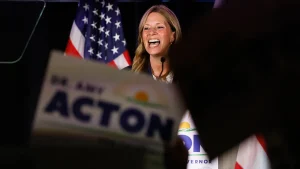



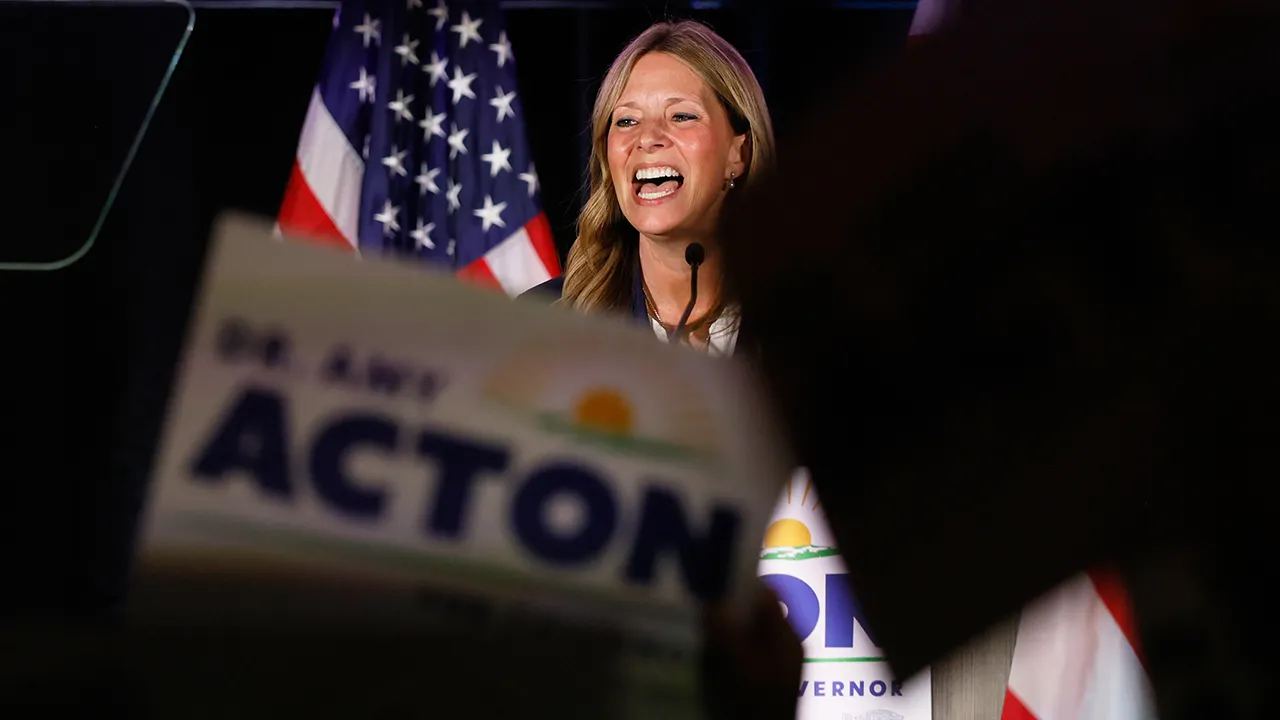
The afternoon sun in Harrison, Ohio, cast long shadows across the small crowd gathered for a meet-and-greet, the kind of intimate, hand-shaking event that defines grassroots campaigns. Amy Acton, the Democratic nominee for governor, moved through the space with a practiced but weary grace, her smile a little strained, her eyes constantly scanning the periphery. It’s a habit forged in the fires of public life, a survival instinct that tells her where the exits are and who might be lurking with a hidden agenda. Then, the camera appeared. A Republican activist, armed with a lens, closed the distance quickly, his question cutting through the pleasant small talk like a sharp knife: “Dr. Acton, why do you refuse to debate your opponent?” The change in Acton was immediate, almost visceral. The warmth drained from her face, replaced by a tight, guarded mask. Her staff members reacted with the swift, coordinated urgency of a Secret Service detail, physically interposing themselves between their candidate and the intruder. “No photos, no videos,” they repeated, a nervous litany, their bodies brushing against the cameraman, jostling his equipment and startling him into a plea to “be careful.” In that chaotic, awkward moment, the idealized vision of democracy clashed with the gritty, defensive reality of modern campaigning. Acton did not answer the question; she simply turned and walked away, leaving her staff to handle the messy aftermath. This sixty-second confrontation, captured on video, has become a devastating political symbol for her rival, Vivek Ramaswamy, encapsulating the central controversy of her entire campaign: her persistent, puzzling refusal to meet him on a debate stage.
To understand Acton’s flight from that camera, one must peel back the layers of trauma and public battering that have defined her political life. She is not just a policy wonk; she is a survivor who has been dragged through the mud in the most intimate and vicious ways possible. The persona of the calm, physician-educator who resigned as Ohio’s health director during the COVID-19 pandemic masks a deep well of anxiety that has been tapped repeatedly by her opponents. For Acton, a debate is not merely a chance to parry policy proposals; in her view, based on her campaign’s statements, it is a gauntlet where her character, her past, and her very humanity are weaponized against her. Her staff’s fiery response to Ramaswamy’s initial debate invitation painted a picture of a candidate overwhelmed by a coordinated slander campaign. They accused Ramaswamy of spreading baseless lies about her, of using artificial intelligence to create repugnant images suggesting she has a substance abuse problem, and of cruelly shaming her for being sexually abused as a child. Imagine carrying that burden—the knowledge that your worst, most painful secrets are being exploited for political gain, twisted through digital manipulation to make you look like a lunatic or a drunk. For a woman who has spoken openly about her struggles with anxiety and the emotional weight of her work, the prospect of facing an aggressive interrogator in a high-stakes, live-television environment must feel less like a civic duty and more like walking into a gladiatorial arena where the crowd is encouraged to boo your scars. In that moment in Harrison, when the camera clicked, it wasn’t just a reporter asking a question; it was a trigger, a reminder of the relentless assault on her dignity. The staff’s hasty physical blockade was a desperate attempt to shield her from yet another psychic wound, a human instinct to protect a person they see as deeply wounded, not just a political candidate.
Zoom out from that tense parking lot, and you see the broader, dirtier landscape of this Ohio gubernatorial race. Ramaswamy, a wealthy entrepreneur and former presidential candidate, has positioned himself as the aggressive, no-holds-barred challenger, eager to dismantle his opponent on the biggest stage possible. He quickly accepted an invitation from CNN for a debate, a move that painted him as fearless and transparent. When Acton balked, his camp pounced, portraying her avoidance as proof of her inadequacy. The criticisms are not subtle. They point to her “failing” as health director, referencing a 2019 police report involving a verbal domestic dispute while she was intoxicated, and generally paint her as unstable and unfit for the state’s highest office. Ramaswamy’s retort on social media was blunt and condescending, listing her shortcomings: “won’t take voter questions, won’t debate, quit after failing as Ohio’s health director, and has some serious issues now surfaced in multiple police reports.” For Ramaswamy, the debate is the ultimate job interview for a CEO-like governor. He sees Acton’s refusal not as a strategic choice, but as an outright surrender—a sign that she lacks the grit, the intellectual agility, and the sheer guts to handle the pressures of governing a major state. His campaign operates on the belief that voters want to see a fight, a clash of ideas, and that any candidate who avoids that clash is hiding something. The narrative is potent: a powerful man calling out a woman for being too scared to face him. It taps into a primal sense of fairness—if you want the top job, you should be willing to look the other candidate in the eye and defend your record.
But to merely frame this as a simple case of a coward hiding from a hero would be to ignore the humanity of the situation—and the deeply asymmetrical nature of the conflict. Ramaswamy is a machine built for the unrelenting pressure of the national spotlight. He thrives in the cut-throat world of TV punditry, where gotcha questions and rapid-fire insults are the currency. His entire political persona is built on confidence, aggression, and a startling willingness to say almost anything. He is the bull, and Acton is the matador who has decided, very rationally, that she does not want to enter the ring. While Ramaswamy sees the debate as an opportunity to showcase his dominance, Acton views it as a trap designed to retraumatize her. The human reality is that political stamina is not evenly distributed; some candidates are mentally built for this constant state of war, while others are drawn to politics for more idealistic, softer reasons. Acton’s campaign repeatedly states that she wants to “talk with Ohioans,” focusing on door-knocking and engaging with voters in intimate settings. In a way, her refusal to debate is a declaration of a different style of leadership—one based on empathy and connection rather than combat. But in a media landscape that thrives on conflict, her preference for quiet conversation is easily painted as cowardice. She is caught in a double bind: if she debates, she risks being humiliated and triggered by attacks on her trauma; if she refuses, she is branded as a shirker by her opponent and the press. The video of her walking away shows a human being exercising her only available agency—the choice to disengage—and yet that same act is now being used as evidence of her disqualifying weakness. It is a cruel paradox of the modern political arena: you are punished for playing, but equally punished for not playing.
What about the Ohioans in the middle of this? The ones Acton claims she wants to hear. The voters at that Harrison event likely wanted to shake her hand, ask about the economy, or voice their concerns about education. In the brief encounter, they saw a candidate who looked cornered, a staff scrambling, and an opponent’s operative doing his job. For the average citizen, this spectacle might feel deeply disheartening. They watch as a potential governor is chased down a parking lot, and they might feel a pang of sympathy for her, or they might feel a surge of frustration at her unwillingness to give a straight answer. The human need is for authenticity and transparency. Yet, the electoral system itself encourages opacity. The “conversations with Ohioans” that Acton prefers are safe, curated, and filtered by her handlers. The beauty of a debate is that it strips away the handlers; it forces a candidate to think on their feet, to look vulnerable in real time. Perhaps Acton’s fundamental error is underestimating the voters’ capacity to see through attacks. She assumes that a debate will be a cruel revenge fantasy by Ramaswamy, but it could also be an opportunity for her to display resilience and grace under fire. In the absence of a debate, the only image voters have is that video clip of her walking away—a visual metaphor that suggests a governor who will fail to show up during a crisis. The human connection she so craves in those small meet-and-greets is undermined by her strategic absence from the one forum that promises the widest audience. It is like a singer who insists on practicing in the shower but refuses to perform on the main stage, leaving the audience to judge them solely on the muffled sound coming through the bathroom door.
As the clock ticks down to the November 3rd general election, the shadow of that Harrison parking lot encounter looms large over the campaign. Acton’s campaign remained silent to Fox News Digital about the confrontation, a telling silence that suggests both embarrassment and a stubborn refusal to engage with the narrative. For Ramaswamy, the video is a political goldmine, a visceral piece of evidence proving his opponent is unfit for the rigors of leadership. But beyond the strategic calculations, there is a deeper, more human story here about the immense toll of running for high office. We are watching a human being—a doctor, a mother, a trauma survivor—grapple with the brutal machinery of a modern campaign that thrives on tearing people down. Acton’s guarded demeanor and reliance on her staff’s physical shell speaks volumes about her state of mind; she is a person in survival mode, boxing out every threat, real or perceived. Conversely, Ramaswamy, with his $25 million personal investment and aggressive posture, represents the new breed of politics where wealth buys volume and volume drowns out nuance. The choice before Ohioans is not just between a Republican and a Democrat, but between two vastly different approaches to handling pressure: one that relies on attack and confrontation, and another that seeks retreat and protection. In the end, democracy requires us to look at each other. Whether that happens on a debate stage or in a parking lot, the human instinct to both protect oneself and demand accountability will continue to clash. For Acton, the challenge is to find a way to wade back into the fray without losing the very humanity that makes her relatable; for Ramaswamy, the challenge is to recognize that tenacity without empathy is merely noise. As the voters head to the polls, they will hold in their minds the image of a woman walking away from a question, and they will decide if that image represents a wise disengagement or a fatal flaw—a judgment that only underscores how deeply human, and deeply messy, our political process remains.