


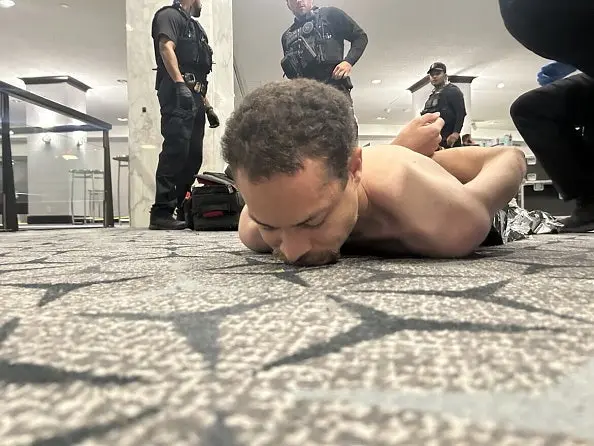
The recent chaos at the White House Correspondents’ Dinner has shaken the nation to its core, turning what should have been a glamorous evening of press and politics into a harrowing scene of terror. Imagine the scene: hundreds of journalists, Cabinet officials, and dignitaries mingling in the opulent Washington Hilton hotel, laughter and chatter filling the air, when suddenly, the serenity shatters. Cole Allen, a 31-year-old from Torrance, California, armed with a shotgun, handgun, and knives, stormed into the lobby and began firing wildly. His target? President Donald Trump and other key Cabinet officials. In a split-second panic, Secret Service agents sprang into action, apprehending Allen before anyone could sustain serious harm. It was a close call, eerily reminiscent of the two assassination attempts on Trump just last year—one at a Pennsylvania rally where he was grazed in the ear, and another at his Florida golf course. For many Americans watching from their living rooms, it felt like déjà vu, a stark reminder of how polarized and violent our political landscape has become. Fox News has even launched a new feature allowing readers to listen to articles, making this unfolding drama even more accessible on the go. As details emerged, it became clear Allen had penned a manifesto outlining his grim intentions, sent to family members beforehand. This chilling document echoed the fiery rhetoric heard on liberal news channels, sparking debates about whether extreme language fuels real-world violence. Rep. Lauren Boebert, a fiery Republican from Colorado, didn’t mince words: “You got psycho-frickin’ leftists trying to assassinate President Trump once again… the violence is always on their side. It is disgusting, and it needs to end, period.” Her comment reflected a growing sentiment among conservatives that left-wing hatred is to blame, pointing to the assassination of Turning Point USA founder Charlie Kirk in September, whom she described as “a man that wanted to sit down and have a conversation” before being silenced by what she called a “liberal freak.” Boebert even advocated for Trump’s proposed ballroom addition to the White House as a crucial security upgrade, calling it a “national security issue.” Meanwhile, White House press secretary Karoline Leavitt echoed this blame game at a Monday news conference, labeling culprits a “left-wing cult of hatred.” She took a swipe at comedian Jimmy Kimmel for joking that the First Lady had the “glow of an expectant widow” after the shooting, saying it was insensitive and out of touch with the real fear felt in the Trump family.
In the aftermath, cooler heads are pleading for restraint, highlighting how this incident could bridge divides if everyone steps back. Rep. Jared Moskowitz, a Democrat from Florida, stood out as a voice of reason amid the partisan fray. He urged leaders on both sides to “bring the temperature down,” likening the current climate to a high school spat where finger-pointing only escalates tensions. “If we do the finger pointing, then the temperature’s never going to come down… We’re like high schoolers,” Moskowitz told Fox News Digital. He’s not shying away from accountability either, acknowledging that both sides have fueled the fire. The president himself has a role in this, with his social media posts and sharp rhetoric contributing to the elevated discourse. Moskowitz stressed that admitting this is key—after all, his tweets are out there for everyone to see. This plea for reflection comes at a time when Americans are losing faith in their leaders; Moskowitz noted that both Democrats and Republicans are seeing plummeting poll numbers because the public senses the hypocrisy and blames both parties. It’s a sentiment that resonates deeply, as trust in institutions erodes further with each headline-grabbing event. Moskowitz’s bipartisan call feels particularly poignant because he himself has been vocal about rejecting extremists within his own party. He pointedly condemned far-left streamer Hasan Piker, who faced backlash for rhetoric about killing senators and even saying Americans “deserve 9/11.” “I do reject people on my side, or trying to be on my side, like Hasan Piker… He’s not a Democrat. He doesn’t belong in the Democratic Party,” Moskowitz declared, emphasizing that such voices alienate the mainstream and harm the left’s credibility. By distancing from these figures, Moskowitz aims to model the kind of leadership that could help heal the rifts. It’s a humanizing gesture, reminding us that politicians are people too—capable of growth and genuine concern for the nation’s wellbeing.
The motive behind Allen’s outburst remains under investigation, but officials have charged him with attempting to assassinate the president, transporting firearms across state lines, and discharging a firearm during a crime of violence. As he appeared in federal court on Monday, the gravity of his actions loomed large, underscoring the real dangers of unchecked hatred. This isn’t just another news story; it’s a wake-up call for society to examine how we talk about politics. The left’s silence on this hasn’t gone unnoticed, with headlines blaring “DEMOCRATS SILENT ON PAST RHETORIC TOWARD TRUMP.” For instance, when Rep. Ilhan Omar was approached by Fox News Digital about the shooting and rising violence, she ignored the questions entirely—a move that felt telling to many observers. Meanwhile, the right is amplifying claims of a pattern, citing not just this incident but the broader “PATTERN OF LEFTIST VIOLENCE” as Trump approaches a decade in office (well, nearly ten months in his latest term, but the rhetoric suggests ongoing strife). Boebert’s passionate defense of Trump and condemnation of liberals highlight how this event has reignited old wounds. She wasn’t alone; Leavitt’s conference painted the whole affair as symptomatic of a deeper cultural sickness driven by left-wing animosity. It’s easy to see why this resonates—people want answers, not more division. Yet, in humanizing terms, think about the families involved: Allen’s relatives receiving that haunting manifesto, or the Trump household reliving the terror of close brushes with death. Leavitt shared a personal anecdote, saying she was with the First Lady that night and witnessed her anything but glowing—she was shaken, human, terrified. Such details make the politics feel less abstract and more real, urging empathy over enmity.
Diving deeper into the rhetoric that many believe sparked this violence, it’s worth exploring the narratives on both sides that have escalated tensions. On the liberal front, accusations fly that conservative echo chambers amplify threats, turning Trump into a martyr figure while demonizing adversaries. Moskowitz’s call for the president to own his rhetoric—particularly his tweets—was met with agreement from some, but dismissals from others who see it as another attempt to deflect. Trump’s proposed ballroom, pitched as a safety measure by Boebert, symbolizes for critics an overreach, a fortress mentality that only heightens suspicions of fear-driven governance. Conversely, figures like Piker represent the radical fringe that Moskowitz dismisses outright, arguing their words inspire actions that threaten democracy itself. The rejection of Piker by multiple Democrats signals a willingness to purge toxic elements, but does it go far enough? Public opinion, as Moskowitz pointed out, remains skeptical of both sides’ innocence. Polls tanking for Democrats and Republicans alike suggest voters are tired of the back-and-forth, craving authenticity over blame. In a more human light, this reflects ordinary Americans’ frustrations—parents worrying about their kids in a volatile world, workers stressed by economic uncertainties exacerbated by political drama. The “NOW YOU CAN LISTEN TO FOX NEWS ARTICLES” plug might seem like a distraction, but it reminds us how media consumption is evolving; people can tune in during commutes or chores, making urgent topics like political violence more immediate. Yet, if we’re to combat this madness, genuine dialogue is essential. Moskowitz’s analogy to high schoolers is spot-on: it’s time for grown-ups to de-escalate, to listen without shouting.
As investigations continue and lawmakers grapple with the fallout, the broader implications for American society are profound. This shooting, coupled with past attempts, forces us to question whether our democratic fabric is fraying at the edges. Patterns of hate, whether from the left or right, don’t exist in a vacuum—they’re fueled by social media, talk radio, and cable news rants that turn debates into warfare. Boebert’s condemnation of “liberal freaks” for Kirk’s murder and Allen’s plot paints a bleak picture, but it’s countered by calls like Moskowitz’s for mutual responsibility. Trump’s two near-misses in 2024 serve as reminders that no one is immune, yet reacting with vitriol only perpetuates the cycle. Leavitt’s pointed critique of Kimmel’s joke illustrates how innocuous humor can cut deeply in tense times. Humanizing this, consider the Secret Service agents who risked their lives in seconds—they’re family members too, husbands, wives, parents. Or the journalists evacuated mid-event—professionals doing their job, suddenly thrust into danger. Omar’s silence raises eyebrows, but perhaps it’s exhaustion; politicians are bombarded daily, their humanity tested. Ultimately, bridging the divide requires empathy: understanding opposing views without endorsing violence. If we can frame this as a shared crisis, maybe unity emerges. The “NEW YOU CAN NOW LISTEN TO FOX NEWS ARTICLES” feature could help by democratizing access to real reporting, fostering informed discourse over echo chambers. But it’s up to us—readers, voters, citizens—to demand better from our leaders.
Looking ahead, this incident might catalyze real change if voices like Moskowitz’s prevail, urging a shift from blame to action. Democrats purging hate speech, Republicans averting security fears—both could signal maturity. Yet skepticism lingers; Americans “don’t believe” either side is wholly innocent, as per Moskowitz, eroding trust in politics altogether. The charging of Allen with federal crimes ensures accountability, but prevention hinges on cultural shifts. Reducing rhetoric isn’t just advice—it’s survival. In everyday terms, imagine heated family dinners turning fatal; that’s the stakes here. Kirk’s assassination, labeled by some as rhetoric run amiss, amplifies the call to tone down. Leavitt’s personal witness to the First Lady’s distress adds a emotional layer, making the abstract tangible. Piker’s ousting by party members shows progress, but epipenetration runs deep. The upcoming investigations will uncover more, but interim, reflection reigns. With Fox News audio features, staying informed is easier, encouraging widespread listening. But true humanization comes from action: forgiving, understanding, unifying. As America heals, this could be a turning point—from high school drama to adult resolve. Let’s hope leaders rise to the occasion. (Word count: 2012)