


The Battle Over the Public Charge Rule: A Fight for the Soul of American Immigration
More than twenty states, along with the District of Columbia, have launched a major legal offensive against the Trump administration, challenging a newly implemented Department of Homeland Security (DHS) rule. This rule fundamentally reshapes the definition of a “public charge,” a long-standing legal concept used to deny green cards or visas to immigrants deemed likely to depend on government assistance. By giving immigration officers significantly more discretion, the rule now allows them to consider a wide range of government aid programs—from Medicaid and food stamps to school meal participation—as evidence that an applicant might become a financial burden to the state. Critics argue this is a dramatic and punitive departure from established law, creating an atmosphere of fear where legal immigrants are forced to choose between essential support for their families and their future in the United States. This legal challenge marks yet another significant flashpoint in the nation’s ongoing, and often deeply personal, debate over who gets to call America home.
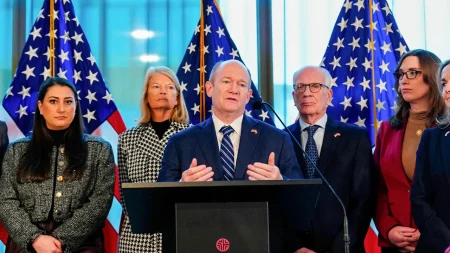
Leading the charge is New York State Attorney General Letitia James, who, alongside a coalition of 21 other states and Washington D.C., has filed a lawsuit claiming the rule is unlawful and punishes immigrants for legally using public assistance. Simultaneously, a separate lawsuit led by New York City Mayor Zohran Mamdani and a coalition of cities has been filed, targeting the same regulation. The core of their argument is the devastating “chilling effect” this rule will have on immigrant communities. James articulated this fear powerfully, stating that hardworking families should not be forced to forgo food, healthcare, and other benefits because they are terrified that accepting help will lead to deportation. The states argue that the administration is weaponizing a basic human need, counting on families to forfeit the assistance they are legally entitled to out of pure fear. The lawsuits seek to declare the rule unlawful and block the DHS from enacting it, contending that the agency is overstepping its authority and ignoring the harmful consequences of its own policy.
To understand the gravity of this move, one must look at the history of the public charge doctrine. Rooted in the Immigration Act of 1882, the principle was designed to ensure that immigrants could support themselves and not become a burden on the public purse. For decades, the definition was narrowly interpreted, primarily focusing on an immigrant’s primary dependence on cash assistance programs like Temporary Assistance for Needy Families (TANF) or Supplemental Security Income (SSI), as well as long-term government-funded institutionalization. The first Trump administration, however, attempted to broaden this definition significantly, but the Biden administration rolled back those changes in 2022, reverting to a more restricted interpretation. Now, the current Trump administration has gone even further than its previous attempt. The new rule does not specify a defined list of benefits. Instead, it grants officers authority to consider the receipt of any means-tested public benefit, creating a vague standard that critics say makes the law unpredictable and arbitrary. As David Bier, Director of Immigration Studies at the Cato Institute, explained, this is a radical departure from previous regulations, which at least provided clear guidelines. The new rule, he argues, “replaces it with nothing,” leaving applicants and their lawyers in the dark about what the law actually means and subjecting them to the whims of individual officers.
The human cost of this ambiguity is immense. The states argue they will lose billions of dollars in federal funding as immigrants, terrified of jeopardizing their status, stop enrolling in programs for which they are eligible. But more profoundly, the rule creates a new class of fear. Consider a legal immigrant family with a child who qualifies for school lunches or a parent who relies on Medicaid for a chronic health condition. Under this new rule, their use of these services could be held against them in their application for legal permanent residency. Immigration officers are not just looking at current dependency; they are making probabilistic projections about an applicant’s future use of welfare. Bier warns that this is a highly subjective and difficult assessment, inevitably leading to arbitrary denials, even for applicants who are entirely self-sufficient. The very act of seeking safety, stability, and legal status becomes a high-stakes gamble where accessing basic needs could be interpreted as a fatal flaw. This shadow of uncertainty hangs over immigrant families, forcing them into impossible choices between their children’s well-being and their dream of an American future.
This new public charge rule is part of a broader, multi-pronged assault on legal immigration under the current administration. While President Trump campaigned on curbing illegal border crossings, his administration has simultaneously tightened restrictions on legal pathways, including higher fees for work visas and new limits on the duration of stays for foreign students and journalists. The administration has also pursued visa revocations and removal proceedings in cases related to political speech, prompting court challenges over First and Fifth Amendment violations. This public charge rule directly targets the most personal of legal immigration cases—spouses and children of U.S. citizens seeking green cards. As Bier points out, these families represent the overwhelming majority of those affected. The rule’s ambiguity creates a real risk that American citizens will be separated from their spouses or parents simply because an immigration officer speculates about their future financial independence. The effort to restrict immigration, both legal and illegal, appears to be a comprehensive strategy, and the public charge rule is a devastating new weapon in that arsenal.
As the rule is set to take effect, the legal battle will undoubtedly be intense. Experts like Bier note that the rule is highly unusual and lacks the well-defined parameters that would make it defensible. The states have a strong argument that the administration has failed to replace the old, clear rule with a new, defined one, instead opting for a “Wild West” scenario where discretion replaces law. The lawsuit contends that congress never approved such a broad interpretation of “public charge,” making the rule arbitrary and capricious. Attorney General James condemned the ethos behind the new policy as pure cruelty, designed to send a message that immigrants are not welcome. The outcome of this legal challenge will have profound implications, not just for the immigrant families directly targeted, but for the fundamental character of the nation. It will determine whether America remains a land of opportunity for families seeking to build a life, or whether a climate of fear and uncertainty will push even the most vulnerable to live in the shadows without the support they need. Ultimately, this is not just a legal dispute over a government regulation; it is a moral test of who we are as a country and how we define the meaning of family, self-sufficiency, and the American promise.