





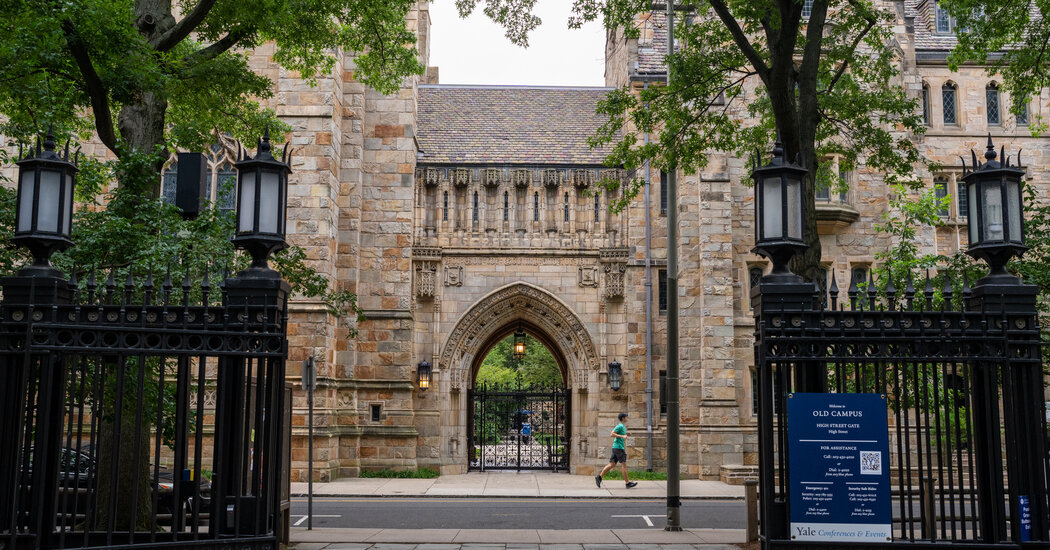
The quiet, Gothic-style campus of Yale University, long accustomed to being a sanctuary of intellectual prestige and historical privilege, has recently found itself at the epicenter of a high-stakes federal storm. In a sweeping move that has sent shockwaves through the upper echelons of American academia, the Trump administration’s Justice Department has launched an expansive, multi-pronged civil rights investigation into the university’s admissions practices. What began as a focused inquiry into the medical school’s admissions policies has now metastasized into a comprehensive audit of Yale’s undergraduate and law school programs, threatening the very core of how this Ivy League giant constructs its student body. Behind the closed doors of Woodbridge Hall, Yale’s leadership is engaged in tense, secretive negotiations with federal officials, desperately trying to hammer out a settlement that would avert a ruinous, highly public legal war. This quiet scramble to compromise reveals a deep-seated institutional anxiety; unlike other elite universities that have chosen to fight federal pressure in the courts, Yale seems keenly aware of the human and financial toll of a prolonged conflict, seeking a swift resolution even as its administrators grapple with the immense pressure of defending their educational values against a relentlessly hostile White House.
This dramatic confrontation is the latest, most aggressive front in a larger ideological battle over how race, merit, and opportunity are defined in modern America. At the heart of the dispute is the legacy of the Supreme Court’s landmark 2023 ruling, which effectively dismantled race-conscious admissions across the country. In that historic decision, Chief Justice John Roberts wrote that applicants must be evaluated as individuals rather than representatives of their racial groups, though he left a narrow, humanistic loophole allowing universities to consider how race has personally shaped an applicant’s life through individual experiences of discrimination or inspiration. However, the Trump administration has interpreted this ruling through an uncompromising, zero-tolerance lens, arguing that any consideration of race in the admissions process—no matter how subtle or holistically integrated into personal essays—constitutes unlawful discrimination. In a scathing six-page letter, the Justice Department accused Yale’s medical school of practicing systemic and intentional bias, leveraging testing data to argue that Black and Hispanic applicants were statistically far more likely to receive interviews than similarly qualified Asian and white candidates. For the young applicants waiting anxiously on the sidelines, these dry statistical debates carry a heavy emotional weight, representing either the long-overdue dismantling of systemic barriers or the unfair erasure of individual academic merit.
To navigate this existential crisis, Yale has abandoned any pretense of public defiance, choosing instead a path of pragmatic survival that highlights the complex moral compromises of higher education leadership. The university has quietly enlisted the services of McGuireWoods, a high-powered law firm that successfully shepherded the University of Virginia through a similar federal investigation with zero financial penalties. This tactical choice underscores a desire to avoid the exhausting, multi-million-dollar legal crusades that have consumed institutions like Harvard and the University of California, Los Angeles. For Yale’s leadership, the memory of the recent past is still fresh; during President Trump’s first term, the Justice Department sued the university over its undergraduate admissions, a bruising fight that was only resolved when the incoming Biden administration dropped the case. By seeking a comprehensive voluntary resolution agreement that covers its undergraduate, law, and medical schools, Yale is attempting to short-circuit a repeating cycle of political vulnerability. Yet this strategy of quiet appeasement acts as a double-edged sword, forcing the university to walk a precarious tightrope between the legal demands of a conservative federal government and the intense ethical expectations of its own progressive campus community.
The sudden intensity of this federal scrutiny has left many academic observers puzzled, as Yale had previously seemed to possess a unique, almost miraculous immunity to the cultural and financial warfare that has devastated its peers. Throughout the administration’s aggressive campaigns to reshape higher education, other elite universities like Columbia, Penn, and Brown faced crippling threats to their federal research funding, while Harvard was subjected to public vilification and demands for massive financial penalties. Yale, by contrast, had largely been spared the worst of Washington’s wrath, leaving administrators across the nation quietly debating how the university had managed to stay out of the crosshairs. Even Yale’s president, Maurie McInnis, publicly admitted to a sense of bafflement, musing to the student newspaper that there was “no obvious answer” for their peaceful coexistence with the administration, half-jokingly questioning whether it was due to their long tradition of fostering open, conservative-friendly debate through groups like the Buckley Institute, or simply because they were near the end of the alphabet. This brief period of relative peace, however, has proved to be nothing more than the quiet before the storm, proving that no elite institution can indefinitely escape the ideological polarization gripping the nation.
In the months leading up to the current crisis, Yale did not merely rely on luck; it engaged in a sophisticated charm offensive and a period of deep, painful self-reflection designed to bridge the chasm between New Haven and Washington. The university invested heavily in federal lobbying efforts and cultivated relationships with key conservative figures, including hosting Education Secretary Linda McMahon for a high-profile campus speech. Crucially, just a day before McMahon’s address, a task force of ten prominent Yale professors published an extraordinarily candid and self-critical report that echoed many of the criticisms leveled by the university’s conservative detractors. The report took aim at the highly subjective and secretive nature of “holistic admissions,” warning that when the gatekeeping process to America’s elite institutions seems inexplicable and tilted in favor of the already wealthy, it is entirely natural for ordinary citizens to lose faith in higher education. This remarkable moment of academic self-examination humanized the university’s struggle, acknowledging that the public’s mistrust was not merely a product of partisan hostility, but a reaction to a system that often felt profoundly undemocratic and closed to the average American.
Ultimately, the resolution of this conflict will shape the future landscape of American opportunity, serving as a template for how elite universities will operate in an era of intense political surveillance. For Yale, the cost of securing a quiet peace with the Trump administration may be incredibly high, threatening to alienate the very students, faculty, and alumni who believe that a diverse student body is essential to the university’s educational mission. If Yale capitulates entirely to the government’s strict interpretation of the law, it risks being accused of betrayal by its own community; if it fights, it faces institutional exhaustion and the potential loss of vital federal support. This struggle is not merely a dry debate over legal compliance and admissions algorithms, but a deeply human drama about who is allowed into the rooms of power and how we as a society define fairness, equity, and merit. As Yale’s negotiators continue their quiet discussions with federal lawyers, the eyes of the academic world remain fixed on New Haven, waiting to see whether one of the world’s greatest universities can preserve its core values of diversity and access while bowing to the realities of a changing political landscape.