




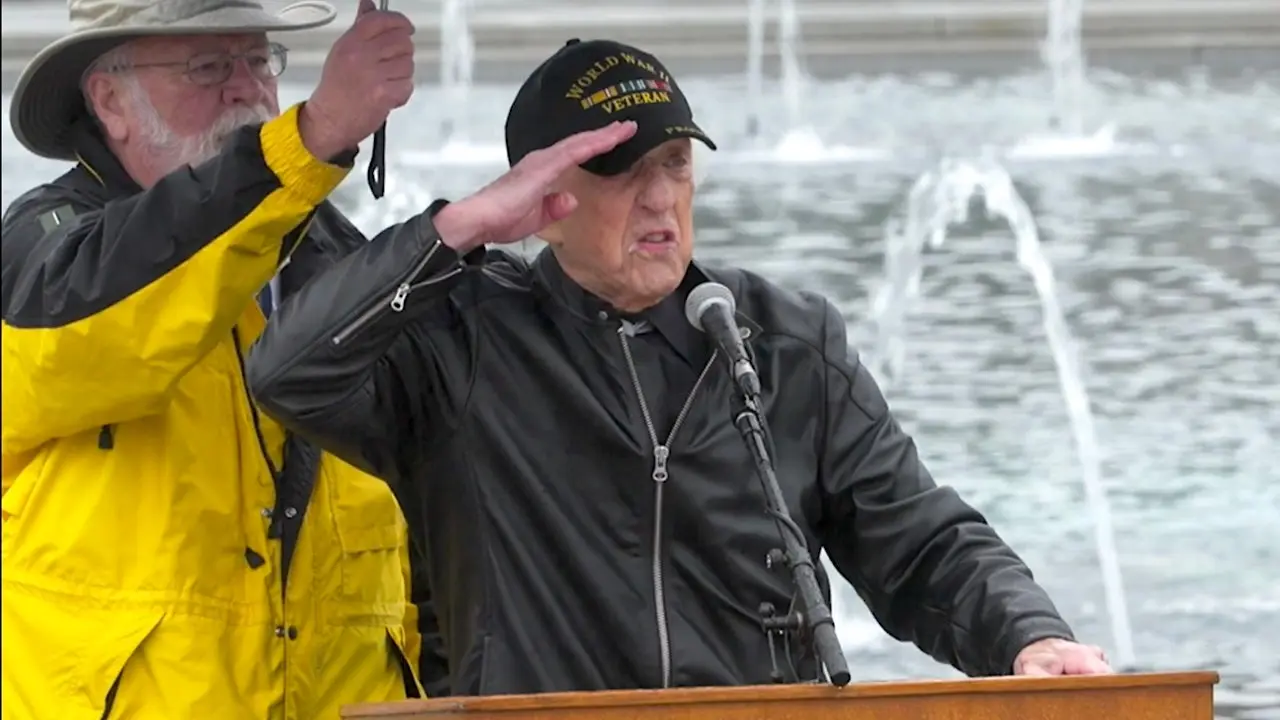
Standing amidst the quiet dignity of the National World War II Memorial in Washington, D.C., as a steady, cool rain fell over the Lincoln Memorial Reflecting Pool, 97-year-old veteran David Yoho delivered a powerful, raw message that quickly captured the heart of a nation over Memorial Day weekend. With his voice cracking under the weight of nearly a century of memories and the damp cold of the spring air, the former Merchant Marine stood before a captivated crowd to deliver a viral plea to younger generations. Holding back tears, he raised a trembling but resolute hand in a military salute and urged those listening to carry the legacy of his generation forward. “Tell them about veterans and say to them that we gave up our yesterdays for your tomorrows,” Yoho implored the onlookers, his words echoing off the wet granite. When asked who spoke those words, he requested a simple, haunting reply: “Tell them it was a 16-year-old boy in the heart and mind and body of a 98-year-old veteran of World War II.”
The emotional gravity of Yoho’s speech lies in the stark contrast between the child he was when he enlisted and the elderly patriarch standing at the lectern decades later. He was only sixteen years old when the empire of Japan attacked Pearl Harbor on December 7, 1941, thrusting a nation of 130 million people into a devastating global conflict. In response to the existential threat, the United States mobilized a staggering 16.2 million citizens into uniform, lowering enlistment ages to meet the desperate demand for military manpower. For Yoho, this meant his youth was instantly traded for the cold reality of wartime service. Emphatically pounding the lectern to emphasize his point, he reminded the audience that when you are sixteen, you are supposed to be playing freely in the streets, but the very day you enter the military, that childhood abruptly and permanently stops.
Through his rain-slicked address, Yoho cast a bright light on the largely unsung and devastating sacrifices of the U.S. Merchant Marines, the branch in which he served. He recalled how approximately 250,000 citizens were recruited into the Merchant Marines to perform the perilous task of transporting cargo, troops, and vital supplies across oceans teeming with hostile enemy forces. Writing a chapter of history in blood, these mariners faced some of the most treacherous conditions of the entire war, specifically pointing to the infamous Murmansk Run—a freezing, deadly Arctic convoy route used to supply Allied forces in Europe. Yoho noted with solemn pride that the Merchant Marines suffered the highest mortality rate of any branch in the war esfuerzo, losing 733 ships to enemy U-boats and devastating elements, with men of every race and creed bound together in a shared legacy of quiet, relentless sacrifice.
As Yoho looked out at the rain-streaked faces of the crowd, including those watching from the surrounding balconies, he connected the physical architecture of the memorial to the profound human cost it represents. The National World War II Memorial honors the millions of Americans who served, but it also serves as a final resting place in spirit for the more than 400,000 who never returned home. He urged the public to look beyond the cold numbers and look at the symbolic gold stars on the memorial walls, reminding them that each star represents 100 fallen Americans, and every single one of those individuals left behind a mother, a father, a spouse, a sibling, or a child. By braving the inclement weather to stand with him that day, Yoho expressed deep gratitude to the audience, noting that their presence on such hallowed ground was a beautiful, living testament that the deeply personal losses of World War II families are still remembered.
Yoho’s viral address was ultimately less of a historical lecture and more of an urgent, parting command to the living to keep the flame of memory alive before it is extinguished forever. Acknowledging that his peers are rapidly passing away, he solemnly remarked, “We are the last of a breed who you sponsored to represent you, your families.” He urged everyone in attendance to go home and tell their friends, their neighbors, and especially their children about the old men who stood in the pouring rain to speak of their long-lost brothers-in-arms. He called on the nation to figuratively “toll the bell” for every military unit and to actively teach the younger generation about the immeasurable price that was paid for the modern liberties they enjoy today, ensuring that the stories of those who died in the mud, on the beaches, and in the freezing oceans are never relegated to dusty history books.
As he closed his remarks, preparing to celebrate his 98th birthday in just a few short weeks, Yoho displayed a touch of humble humor, declaring that “God is great and God is good and he kept this old sucker alive” to share this vital testimony. He offered no apologies for speaking with such raw, unvarnished emotion, stating that his affection for the country, the memorial, and the people who stood in the rain was boundless. The enduring image of this elderly patriot, speaking with the fierce heart of the teenager he was in 1941, serves as a poignant, timeless reminder of the human cost of freedom. Through his cracking voice and steadfast eyes, David Yoho successfully bridged the gap between the past and the present, leaving a legacy of gratitude and remembrance that will continue to echo long after the last veteran of his great generation has gone home.