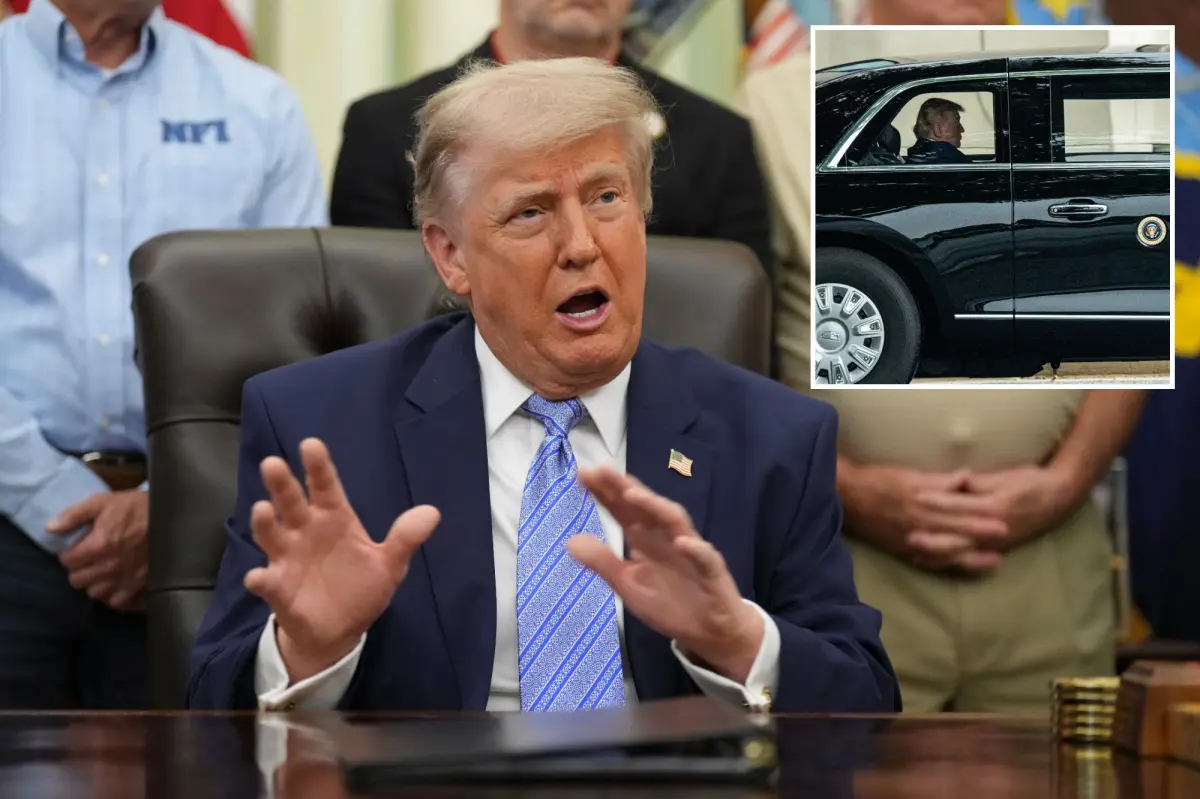
The presidency of the United States is widely regarded as one of the most physically demanding and mentally exhausting roles on the planet, a position that historically and visibly ages its occupants under the unrelenting pressure of global leadership, constant crisis management, and the unyielding spotlight of the public eye. It is against this backdrop of constant national scrutiny that the White House recently released a comprehensive medical memorandum regarding President Donald J. Trump’s health, authored by his personal physician, Dr. Sean Barbabella, following an intensive six-month physical examination at Walter Reed National Military Medical Center. According to the detailed report, President Trump remains in “excellent health” and is fully capable of executing the arduous, multifaceted responsibilities of his high office. Dr. Barbabella’s assessment emphasizes that despite keeping a grueling daily schedule that would tire individuals decades his junior, Trump continues to exhibit exceptionally strong cardiac, pulmonary, and neurological function. This latest medical update serves as more than just a routine clinical sign-off from a military hospital; it is a deeply humanizing testament to physical resilience, reassuring a watching nation that its commander-in-chief possesses the constitutional stamina required for high-stakes governance. The report shifts the focus from political debate to the raw biological reality of a leader who genuinely thrives under pressure, painting a picture of a man whose daily routine of high-level meetings, continuous public engagements, and constant travel is not a source of physical exhaustion, but rather a catalyst for his ongoing vitality and mental sharpness. By framing his demanding lifestyle as a positive contributor to his well-being, the medical team captures the essence of a leader whose personal identity is deeply intertwined with constant action, highlighting the symbiotic relationship between a rigorous work ethic and active physical health, suggesting that his relentless drive might actually be the secret to his longevity.
One of the most remarkable and widely discussed details emerging from Dr. Barbabella’s medical review is the determination of President Trump’s “cardiac age,” which was calculated to be approximately fourteen years younger than his chronological age. In a modern political era where the age, physical capabilities, and general endurance of national leaders are subject to intense, often polarized public conversation, this specific biological metric offers a fascinating and reassuring glimpse into the physical condition of the commander-in-chief. Chronological age tells only a fraction of a person’s biological story, whereas key clinical indicators like cardiovascular efficiency, blood pressure regulation, and lung capacity reveal the true capacity of the human body to withstand extreme daily stress. For Trump, whose penchant for fast-paced campaigns, transatlantic flights, and energetic hours-long rallies is well-documented, a strong, resilient cardiovascular system is the literal engine that powers his entire public life. This youthful cardiac profile is likely supported by his lifelong, well-known avoidance of alcohol, narcotics, and tobacco, alongside his preferred forms of recreation, such as walking golf courses, which keep him active and on his feet for hours at a time. By demonstrating that his heart functions with the efficiency of a significantly younger man, the medical assessment humanizes the president as an energetic figure who consistently defies the conventional expectations of aging. It highlights a biological resilience that allows him to absorb the immense, daily stress of the Oval Office without the physiological decline typically associated with his demographic, proving that physical vitality is a deeply personal asset that can remain robust even under the weight of global crises and constant public duties.
Beyond the standard clinical metrics of heart rates, pulmonary capacity, and cholesterol levels, the medical report touches upon a deeply personal and historic physical marker: the scarring on the president’s right ear. This scar is a permanent, visible reminder of the July 2024 assassination attempt in Butler, Pennsylvania, an event that shocked the global community and forever altered the trajectory of modern political history. To see this trauma mentioned in a formal medical memorandum humanizes the president in a profound way, stripping away the impenetrable armor of political theater to reveal a human being who survived a near-fatal brush with death. Dr. Barbabella’s note on the healing scar underscores the remarkable capacity of the human body to mend itself, transforming a chaotic moment of unprecedented violence into a quiet, post-therapeutic testament to physical survival. For the public, this scar is not merely a clinical observation of healed tissue; it represents a shared national memory of vulnerability, shock, and resilience. It serves as a tangible, somatic link between the president’s physical body and the historical trials of the office he holds, illustrating how political leadership in the modern era can carry intense physical risk and sacrifice. Ultimately, the healing of this wound reflects a deeper narrative of personal recovery, showing that while the physical scar remains, the president’s capacity to lead, engage with the public, and face his supporters has returned completely unimpeded, demonstrating a profound psychological and physical recovery that inspires his supporters.
The physician’s report also sheds valuable light on the more mundane, everyday aspects of the president’s healthcare regimen, detailing his routine use of two standard cholesterol-controlling medications and a daily low-dose aspirin. While these preventative treatments are incredibly common for millions of seniors worldwide, the medical memo links them to a uniquely presidential side effect: benign bruising on his hands. Dr. Barbabella explained that the combination of the blood-thinning properties of aspirin and the sheer volume of daily handshaking the president engages in leads to these common marks on his skin. This simple detail humanizes the president by connecting him directly to one of the most fundamental, grinding rituals of democratic leadership—connecting directly with the people through physical contact. The regular act of greeting and shaking hundreds of hands a day, from world leaders to everyday citizens at campaign stops, is a physical manifestation of political connection, yet it carries a physical toll on a body taking routine heart-health medication. This observation reminds us that beneath the grand stage of global diplomacy lies a human body subject to the exact same minor vulnerabilities as any ordinary citizen. It portrays Trump not as an untouchable, abstract figure of state, but as an approachable human being who actively participates in the physical demands of public interaction, bearing the literal marks of his engagement with the public, while managing his personal health with routine, sensible medical care.
In tandem with physical health, mental acuity has become a central focus of public discourse surrounding modern political leadership, making the results of President Trump’s cognitive testing a key highlight of the report. The president chose to undergo the Montreal Cognitive Assessment (MoCA), a widely recognized and rigorous screening tool designed by medical professionals to evaluate key cognitive domains such as memory, attention, language, visual-spatial skills, and executive function. Scoring a perfect 30 out of 30, Trump demonstrated flawless cognitive performance, a result that directly addresses the intense skepticism and criticism often directed at older politicians in the spotlight. Navigating the complex, high-velocity decision-making landscape of the presidency requires a mind that is exceptionally sharp, highly adaptable, and capable of processing vast amounts of intelligence data simultaneously. Achieving a perfect score on this specialized assessment is not just a personal victory for Trump; it is a strong statement of his readiness to manage the intellectual challenges of statecraft, from delicate foreign negotiations to intricate domestic policy-making. This cognitive validation humanizes the mental struggle of aging, offering a reassuring narrative of mental clarity and sharpness that disarms critics and bolsters public confidence. It showcases a leader whose intellectual faculties remain fully intact, proving that advanced age does not inherently equate to cognitive decline and that deep political experience can happily coexist with sharp, active, and responsive mental agility.
Ultimately, Dr. Barbabella’s comprehensive medical memorandum paints a holistic and deeply reassuring portrait of a leader who systematically defies standard expectations of aging through a combination of robust genetics, disciplined lifestyle choices, and sheer mental fortitude. The synthesis of a heart operating years younger than its biological age, a fully recovered physical frame after surviving a violent attack, and flawless cognitive test scores positions President Trump as exceptionally well-suited for the relentless, round-the-clock demands of his office. This report is far more than a dry collection of clinical measurements; it is a humanized look at a resilient individual who continues to meet the extraordinary challenges of the presidency with authentic vigor and determination. By addressing everything from high-level cognitive function to the simple bruising caused by greeting his warm supporters, the memo successfully bridges the gap between the monumental mythos of the presidency and the everyday reality of human biology. It reassures the nation of his complete physical and mental fitness to serve as commander-in-chief and head of state, projecting a powerful image of strength, resilience, and continuity. In an era marked by intense political volatility and swift global change, this clean bill of health stands as a foundational pillar of his leadership, illustrating that his absolute dedication to his duties is matched only by the remarkable vitality of his body and mind.