





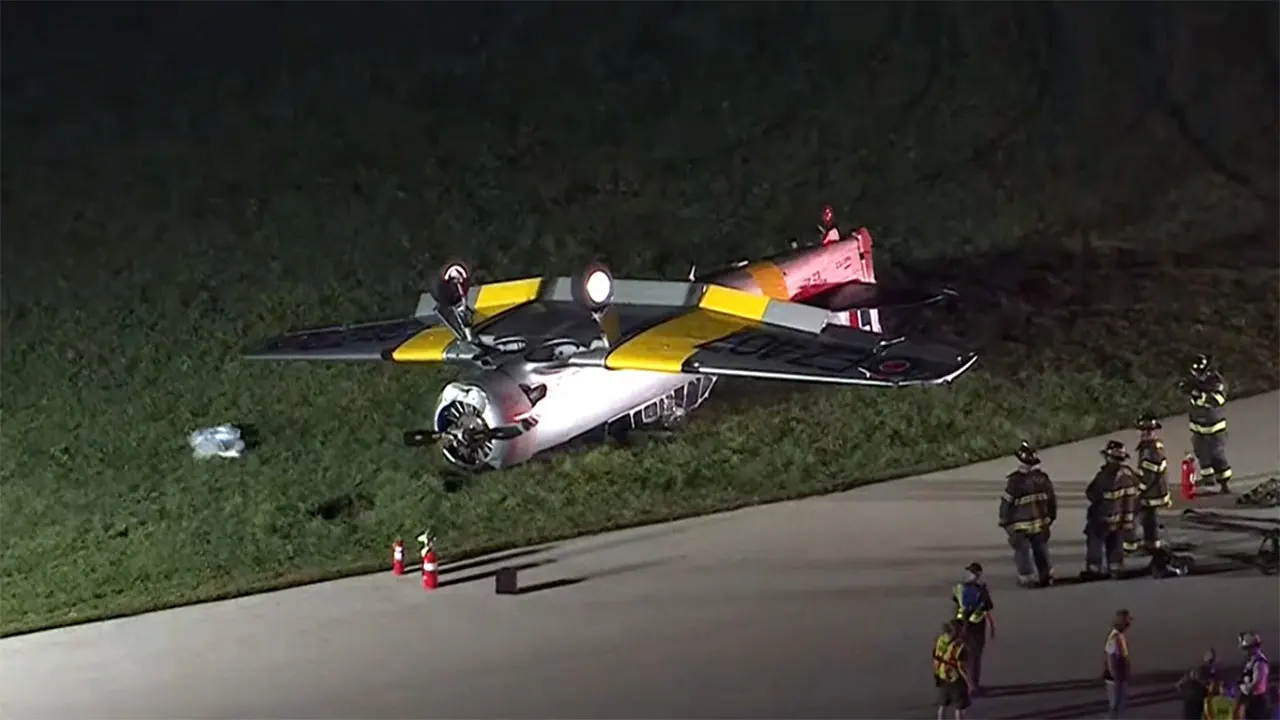
The evening air at Heritage Field Airport in Limerick Township, Pennsylvania, had settled into the quiet rhythm typical of a small municipal field serving private and recreational aircraft. Then, shortly after seven o’clock, that calm was shattered by the roar of a vintage World War II-era plane attempting to land. Something went horribly wrong. The aircraft, a piece of living history, came down hard and overturned on the runway, flipping onto its back in a brutal, jarring stop. Inside, the pilot—the plane’s only occupant—was trapped, suspended upside down in a tangle of metal, canvas, and the very parachute that might have saved him but now pinned him in place. The first calls for help went out just after 7:17 p.m., and within minutes, police officers from Limerick Township were converging on the scene. What they found was a small aircraft lying helplessly on the runway, its propeller bent, its fuselage crumpled, and a pilot fighting for his life inside. The sight was enough to quicken any pulse: an old warbird reduced to wreckage, with no immediate way to know whether the person inside was conscious, breathing, or even alive.
The rescue that followed was a testament to quick thinking and calm under pressure. According to officials, an airport employee who had likely witnessed the crash or arrived moments after it happened did not wait for specialized equipment. Together with responding police officers, this employee moved toward the overturned aircraft, assessing the wreckage and realizing that the pilot was still trapped. The pilot had been wearing a parachute—a standard piece of gear for flying a vintage plane, but in this moment, it had become a hindrance, wedging him inside the crumpled cockpit. Working quickly, the employee and officers freed the pilot from his parachute and pulled him from the wreckage. Fire crews, who had been dispatched with the urgency that all aviation incidents demand, arrived to find that the most critical part of the rescue was already complete. Limerick Township Fire Chief Ken Shuler later told FOX29 Philadelphia, “We got reports the pilot was trapped in the plane. On our arrival, they were pulling him out. So there was no extrication needed by the fire department.” The relief in those words is palpable; the difference between a fatality and a survival story often comes down to a few precious minutes. The pilot was conscious and alert, able to stand despite visible cuts and the shock of what he had just endured. Freedom Valley Medical Rescue treated him at the scene before transferring him to Reading Trauma Center, where he remained alert and talking after the crash ScottShuler. No immediate update on his condition was available, but the fact that he was communicating with medical personnel was a sign of hope—a moment of grace in what could easily have been a tragedy.
The flight itself appeared to be a short, routine journey between neighboring Pennsylvania communities. The single-engine plane had taken off from Pottstown and was headed to Quakertown, a trip that would normally cover only a few dozen miles and take perhaps twenty minutes by car, let alone by air. According to Limerick Township officials, the aircraft had been in the air for only about nine minutes when it went down. Nine minutes is not a long time to be aloft; it is barely enough time to climb to cruising altitude, adjust the instruments, and enjoy a brief panoramic view of the rolling countryside below. For the pilot, this was likely a familiar route, a hop between local airports made perhaps for pleasure, perhaps for a connection to a world long past. The decision to land at Heritage Field, formerly Pottstown Municipal Airport, may have been an emergency maneuver or an attempt to abort the flight for reasons not yet explained. The plane had clearly been struggling, and the pilot’s efforts to bring it down safely nearly succeeded but ended in the dramatic overturn that followed. Now, the very things that made this aircraft precious—its age, its construction, its historical significance—had become factors in an unfolding investigation. The vintage plane, once a symbol of American ingenuity and wartime courage, now lay broken on the runway, its pilot lucky to be alive.
In the immediate aftermath, the danger was far from over. The crash had caused a fuel leak, and fuel pooling beneath a wrecked aircraft is one of the most dangerous situations first responders can face. A single spark, a hot exhaust component, or an errant electrical charge could easily turn the scene into an inferno. Firefighters remained at the airport for hours, diligently addressing the spill and monitoring the wreckage for the possibility of fire. The airport itself was closed Wednesday night, with crews working to contain the leak and remove the damaged plane from its awkward inverted position on the runway. It was painstaking, methodical work, the kind that often goes unnoticed in news accounts but is essential to preventing a second tragedy. For the small community around Heritage Field, the closure was more than an inconvenience; it was a somber pause. Airports like this are not just strips of asphalt and hangars. They are gathering places for people who love aviation, who value the freedom of flight Russell, who restore and maintain old planes as a way of honoring the past. Watching one of those planes crash is like watching a piece of history die. Yet even in the wreckage, there was something to preserve: the pilot had survived, and the aircraft, though damaged, did not take anyone else with it. The fact that firefighters remained at the scene through the night, monitoring for the possibility of fire and ensuring that the fuel leak was fully contained, speaks to the seriousness of the situation. Every precaution mattered. The airport stayed closed until the plane could be removed, and the quiet rural airfield was transformed into a place of yellow tape, caution lights, and the hum of cleanup crews working in the darkness.
Now, with the immediate emergency over, the deeper questions begin. Limerick Township police said they notified the Federal Aviation Administration’s Eastern Region Operations Center after the crash, and aviation authorities have taken charge of the investigation. The cause of the crash was not immediately known, and at this stage, no one is willing to speculate. Was it a mechanical failure, an engine problem that emerged suddenly during those nine minutes in the air? Was it a misjudgment on approach, a gust of wind, a control issue exacerbated by the plane’s age and design? Or was it simply one of those tragic twists of fate that can turn a routine flight into a life-threatening emergency in seconds? Investigators will comb through the wreckage, examine maintenance logs, review the pilot’s experience, and reconstruct the final moments as best they can. The fact that this was a World War II-era plane adds another layer of complexity. These aircraft are not like modern general aviation planes; they require skill, attention, and an understanding of older systems and handling characteristics. They are often privately owned, meticulously maintained by passionate enthusiasts, and flown with a reverence for their place in history. But they are also machines, subject to the same wear, fatigue, and mechanical failures as any other vehicle, and when something goes wrong in an old aircraft, the margin for error can be razor-thin. For the pilot, now recovering in the hospital, the answers may come too slowly. For investigators, the process is methodical: looking at the wreckage, the runway, the weather, and the pilot’s own account, piecing together a narrative of what happened in those final moments before the landing went terribly wrong.
For the community around Heritage Field Airport, the crash is more than just a headline. This airport, which once bore the name Pottstown Municipal, is a hub for private and recreational aviation, a place where pilots come to chase the sky and where vintage planes are lovingly maintained as tributes to the past. It is the kind of airport where people know each other, where mechanics and pilots share hangar space and stories, where a WWII-era aircraft flying overhead is not unusual but always a source of wonder. The sight of that same plane lying upside down on the runway was a jarring reminder of the risks that come with flying old machines. Even the most experienced pilots can find themselves at the mercy of mechanical failure, weather shifts, or simple bad luck. The fact that the pilot was conscious and talking after the crash is a small miracle, one that likely owes much to the sturdy construction of the aircraft and the swift action of those who came to his aid. But the incident also leaves a shadow over the airfield, a reminder that aviation—no matter how routine it seems—demands constant respect. The pilot’s transport to Reading Trauma Center, alert and communicating, was the best possible outcome given the circumstances. There remains, however, a nagging uncertainty. What caused this plane to fall? And could it happen again?
For Heritage Field Airport, a place known for serving private and recreational aircraft, Wednesday night will be remembered as a close call. The airport, once known as Pottstown Municipal Airport, has likely seen its share of landings and takeoffs, but few as harrowing as this one. The runway, now reopened after cleanup, will bear the scars of the incident in more ways than one. The pilot, whose identity was not immediately released, will have a story to tell—a story of flying through the evening sky, of something going terribly wrong, and of the people on the ground who pulled him from his tangled plane before the worst could happen. For the officers, the airport worker, the firefighters, and the medical responders, the night was a reminder of their calling: to rush toward danger while everyone else rushes away. They arrived expecting the worst, found a pilot alive, and worked together to bring him out of the fragile shell of an old warplane. There will be formal investigations, FAA reports, and likely changes in how this particular aircraft was operated, but those are details for the future. For now, the overriding fact is that a life was saved against the odds. In an age where aviation accidents often end in tragedy, this one offers a measure of hope—proof that skill, compassion, and quick thinking can make all the difference. As the sun rises over Heritage Field and the airport quietly gets back to its routine, the memory of the overturned plane and the trapped pilot fades into the background, but not entirely. It lingers in the minds of everyone who watched, a reminder that even the smallest flights carry a weight of risk and resilience. And for the pilot, now recovering in the trauma center, it is a reminder that sometimes, in the split seconds between disaster and rescue, the best of humanity shines through.