





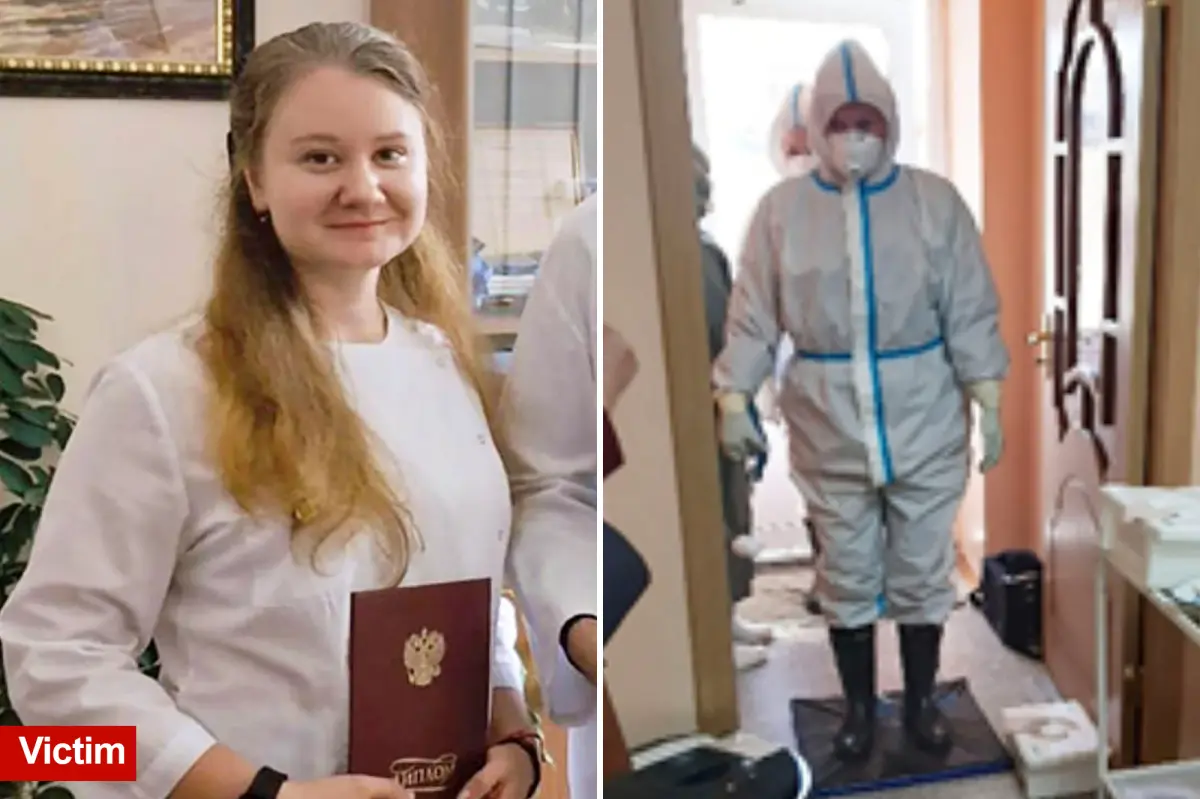
The White House has quietly acknowledged that it is aware of a suspected plague outbreak in Russia and is monitoring the situation, after a 28-year-old researcher died following a lab accident in the remote Siberian region of Irkutsk. Daria Shipilova, a young scientist at an anti-plague research institute, reportedly broke a test tube containing live plague bacteria while gathering samples near Russia’s eastern border with Mongolia. She fell ill within days, was hospitalized with severe pneumonia, placed on a ventilator, and died. Russian officials have refused to say whether she actually contracted the plague, and the official statements that have emerged are so vague and contradictory that they have done little to calm public anxiety. The Trump administration, according to an official quoted by Axios, is “aware, monitoring the outbreak, and assessing options.” That phrase, familiar from countless geopolitical crises, now carries a heavier weight in a world still traumatized by the COVID-19 pandemic. For many people, the story feels like a warning from another era, yet it is unfolding here and now, in a modern laboratory with a young woman who spent her career trying to protect humanity from ancient microbial killers. Her death has reopened old fears about the dangers hidden inside high-security research facilities, and about the fragile line between scientific progress and catastrophic accident. But what makes this story particularly unsettling is the silence around it, the refusal of Russian officials to name the illness, and the sense that the full truth may never be known.
Shipilova was hospitalized in the town of Shelekhov on Tuesday with symptoms of severe pneumonia. She was placed on a ventilator almost immediately, but her condition deteriorated and she died Thursday. According to reports, she had been working on an expedition with other researchers near the Russian-Mongolian border when she accidentally broke a test tube containing live bacteria. She reportedly told medical staff that the accident happened while she was collecting samples for testing. After her death, authorities quarantined an entire hospital and placed scores of people who had come into contact with her under medical observation. Some reports said as many as 200 people were forced into quarantine, though officials later suggested that the actual number was lower. The good news, insofar as there is any, is that none of the identified contacts have shown symptoms, and test results have come back negative. This suggests that, if this was indeed an outbreak, it has not yet spread beyond the initial patient. But the fact that a hospital had to be sealed off, and an entire public event schedule canceled, tells a different story. The region’s governor, Igor Kobzev, declined to identify the illness, referring to it only as “a dangerous infectious disease.” He canceled all public events in the region, a drastic measure that would not normally be taken for a routine pneumonia case. The people of Irkutsk are left to wonder why, and what exactly their leaders are afraid of. In a region that is home to an anti-plague institute, the possibility of a laboratory leak carries a visceral terror, even if the statistical risk of infection is low.
Russia’s public health agency has not provided much clarity. It said only that Shipilova had “pneumonia of unknown etiology” and that further testing found no microorganisms linked to her work. Agency officials insisted that the situation in the region is stable. At the same time, Anna Popova, the head of Russia’s public-health watchdog, rushed 2,600 miles from Moscow to the Irkutsk region after receiving news of the infection. Her presence alone speaks volumes, because high-ranking health officials do not usually make such journeys for an illness of unknown significance. The choice to travel, rather than to remain in Moscow and issue statements, suggests a level of concern that was not yet being publicly acknowledged. Popova has not publicly commented on the reported outbreak, and her silence has only increased speculation. Some wonder if she was sent to manage the problem behind closed doors, ensuring that information remains restricted and that any potential cover-up is handled properly. This scenario is painfully reminiscent of the early days of COVID-19, which is widely believed to have started at a disease research lab in Wuhan, China. After that experience, many people around the world have become deeply suspicious of official reassurances, especially when they come from authoritarian governments. The combination of a deadly pathogen, a laboratory accident, a young scientist’s death, and a government that refuses to give straight answers is almost too reminiscent of recent history to be dismissed as coincidence.
Senior Russian epidemiologist Mikhail Favorov has openly challenged the official version of events. According to The Moscow Times, he called the broken test tube story “laughable” and suggested it could be evidence of a cover-up. Favorov, who has deep experience in the field of infectious disease, pointed out that a researcher working at an anti-plague institute would normally wear a protective anti-plague suit. If such protective clothing had been worn, he argued, the likelihood of infection from a broken test tube would be very low. His words carry the authority of someone who knows precisely how these laboratories operate. He also noted that the general public might accept the “dropped test tube story” simply because it is easy to understand and hard to disprove. But scientists, he implied, know better. The former lead epidemiologist’s skepticism is significant because it suggests that even within Russia’s own scientific community, there is doubt about the transparency of the investigation. It raises the unsettling possibility that the accident did not happen exactly as described, or that it did, but other factors were also involved. Perhaps the true cause of Shipilova’s death was a different pathogen, a training failure, or a systemic problem in laboratory safety. Perhaps the test tube story is being used to simplify a more complex and dangerous reality. Without a full independent investigation, the public is left with speculation, rumor, and fear. And in the absence of truth, conspiracy theories flourish, especially among people who have learned not to trust their governments.
The broader context of this incident matters as much as the immediate details. Irkutsk is not just any Russian city; it is home to one of the country’s elite anti-plague institutes, part of a network of research centers built in the Soviet era to study Yersinia pestis, the bacterium that causes plague. These institutes are custodians of some of the most dangerous biological materials on Earth, and they operate under strict security protocols. But even the best protocols can fail, and a single moment of human error, such as a dropped test tube, can have devastating consequences. Plague, after all, is a disease that has killed millions of people throughout history, and it remains endemic in certain parts of Central Asia, including regions near the Russian-Mongolian border. Every year, there are small outbreaks in the area, usually involving wild rodents and the fleas that carry the bacterium. Occasionally, humans are infected, and local authorities respond by culling rodent populations and issuing warnings to the public. What is unusual in this case is not the existence of the plague, but the fact that a trained researcher appears to have been infected while working with the pathogen in a controlled setting. If true, that would be a serious biosafety breach. If false, as Favorov and others suspect, then the official story is masking something even more troubling. Either way, the incident exposes the vulnerability of modern health systems and the difficulty of containing pathogens that are designed to kill. It also highlights the geopolitical dimension of disease, because an outbreak in Russia is not merely a local problem; it can spread across borders, affect international travel, and trigger global panic.
Perhaps the most important thing to remember in this story is the human being at its center. Daria Shipilova was not just a case study in biosafety or a footnote in a geopolitical controversy. She was a young woman, a scientist, a daughter, a friend, who lost her life in the service of public health. She dedicated herself to studying dangerous pathogens so that others might be protected from them, and she paid the ultimate price. In the coming weeks, there may be more tests, more statements, and more investigations. Perhaps the truth will emerge, and perhaps it will not. But behind every official announcement and every conspiracy theory is a family in mourning, a community in fear, and a world on edge. The plague, the pathogen, the politics, and the cover-ups are all part of the story, but so is the simple tragedy of a life cut short before it could fully bloom. The best response to this uncertainty is not panic, but vigilance. We should demand transparency, support robust disease surveillance, and remember that viruses and bacteria do not respect national borders. We should also remember the courage of scientists like Shipilova, who work with deadly materials every day to keep us safe. Whatever the final verdict in this case, her death should not be in vain. It should remind us that biosecurity is not an abstract concept, but a matter of life and death. It should inspire us to ask uncomfortable questions, to insist on honest answers, and to honor the sacrifice of those who give their lives in the quiet, tireless fight against the world’s oldest killers.