




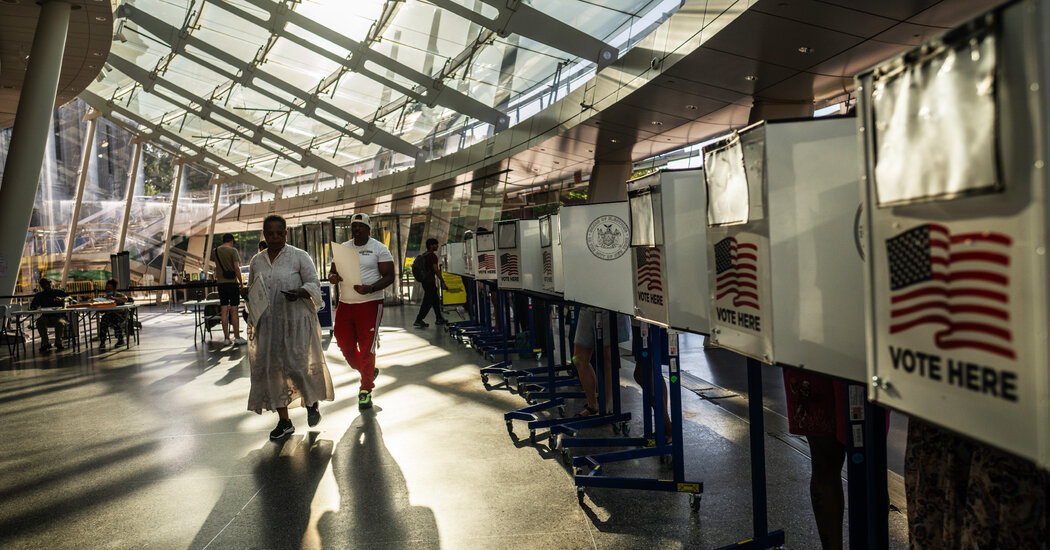
As the stifling summer heat begins to settle over the concrete expanses of New York, a parallel heat is rising through the state’s political landscape, culminating in a series of high-stakes congressional primaries on June 23 that are as much about personal identity and local friction as they are about the future of the nation. In these highly contested races, the state is transforming into a grand, chaotic theater where the deepest fractures of the American political soul are laid bare. From the gilded, tree-lined avenues of Manhattan’s Upper East Side to the quiet, economically anxious towns of the Canadian border, candidates are locked in a series of turf wars that pit billionaire-backed pragmatists against fiery grassroots socialists, and institutional veterans against media-savvy populist disruptors. At the heart of this storm is state leader Zohran Mamdani, a charismatic democratic socialist who is vigorously campaigning to expand his movement’s influence, while moderate establishment Democrats find themselves fighting on multiple fronts to defend their political survival. This primary represents far more than a routine sorting of party ballots; it is an intimate, raw, and deeply human battleground where the anxieties of everyday New Yorkers—struggling with exorbitant housing costs, processing the global trauma of international conflicts, and navigating a rapidly evolving technological age—determine who gets to speak for them in a fractured Congress.
Stepping into Manhattan’s legendary 12th Congressional District feels like entering a world of immense wealth, intellectual prestige, and historical legacy, stretching across the wide expanse of Central Park to encompass some of the country’s most educated and affluent voters. With the retirement of Jerrold Nadler, a titanic figure who spent over three decades anchoring the district’s liberal establishment, a fascinating power vacuum has opened, attracting a colorful cast of characters who represent the diverse, often self-contradictory facets of New York high society. In one corner stands Micah Lasher, a policy wonk whose deep connections to state leadership and a warm endorsement from Nadler have positioned him as the natural heir to the seat, bolstered by a staggering five million dollars in campaign support from former Mayor Michael Bloomberg. Lasher’s institutional gravity, however, is being fiercely challenged by East Side assemblyman Alex Bores, a tech-savvy analytical mind who previously worked for Palantir and has focused his campaign almost entirely on the modern, anxiety-inducing frontier of artificial intelligence regulation—a platform that has turned the race into a high-octane battleground for shadowy tech-industry super PACs. Adding a layer of pure American mythology to the race is Jack Schlossberg, the grandson of John F. Kennedy, who is attempting to resurrect the nostalgic magic of “Camelot” for a younger generation through a vibrant, occasionally eccentric social media presence that has captured national media attention but left his own campaign staff reeling from internal volatility. Meanwhile, George Conway, the conservative legal celebrity who famously turned against Donald Trump, has crossed party lines to run on a singular, unapologetic platform of stopping the former president, trying to convince skeptical Manhattan liberals that his conservative past is less important than his current crusade. Beneath this clash of giants, dedicated public health experts like Nina Schwalbe campaign quietly on the ground, struggling to get their voices heard in a spectacular, media-saturated arena dominated by immense wealth, family dynasties, and high-profile political conversions.
Further downtown and across the East River, the political battlegrounds of the 10th and 13th Districts reveal how the deeply personal, agonizing humanitarian crisis of the war in Gaza has fractured New York’s historic coalitions, turning local primaries into raw referendums on identity and foreign policy. In the 10th District, which snakes through the expensive lofts of Tribeca, the historic immigrant enclaves of Chinatown, and the deeply observant ultra-Orthodox Jewish neighborhoods of Brooklyn, incumbent Daniel Goldman is fighting a defensive battle that few would have predicted. Once celebrated as the wealthy, sharp-tongued prosecutor who led Donald Trump’s first impeachment inquiry, Goldman’s staunch alignment with Israel and his financial connections to pro-Israel groups like AIPAC have alienated a district increasingly horrified by the civilian toll of the war. Seizing on this profound emotional and political shift is Brad Lander, the former city comptroller, whose deep local roots and progressive, anti-war platform have propelled him to a commanding lead in local polls, rendering Goldman’s million-dollar personal campaign investments largely ineffective against a grassroots tidal wave. A similar generational mutiny is unfolding in the 13th District, which covers Upper Manhattan and parts of the Bronx, where the legendary Adriano Espaillat sits at the helm of a formidable political machine designed to champion Latino empowerment. Espaillat, the first formerly undocumented immigrant to serve in Congress, now faces a spirited challenge from Darializa Avila Chevalier, a young community organizer whose political worldview was forged leading anti-war protests on the campus of Columbia University. Chevalier’s campaign, fueled by the energy of the Democratic Socialists of America, received a massive, headline-grabbing boost when Zohran Mamdani officially withdrew his support from Espaillat to endorse her challenger, illustrating just how deeply the pain of global conflict has disrupted the traditional loyalties of the city’s working-class neighborhoods.
Nowhere is the architectural and cultural transformation of the city more visible than in the 7th Congressional District, a sprawling swath of Brooklyn and Queens affectionately dubbed the “Commie Corridor,” where the industrial warehouses of Williamsburg, the high-rises of Long Island City, and the colorful streets of Bushwick host some of the most progressive voters in the nation. With trailblazing progressive icon Nydia Velázquez retiring after thirty years, the district has become the ultimate testing ground for the identity of the American Left. Antonio Reynoso, the highly regarded Brooklyn Borough President who grew up in the district and carries both Velázquez’s blessing and the support of the Working Families Party, represents the accomplished, progressive establishment. Yet, he is locked in a fierce ideological civil war with Claire Valdez, a bold local organizer representing the urgent, uncompromising vision of the Democratic Socialists of America. Valdez’s campaign is powered by a relentless ground game facilitated by Mamdani, who has deployed his personal brand and organizational muscle to argue that Reynoso’s reformist policies are inadequate to address the district’s skyrocketing rents and systemic inequalities. As Valdez and Reynoso fight a high-stakes proxy war over who represents the true heart of the progressive movement, independent local leaders like Julie Won struggle to find oxygen for their platforms, showcasing the intense, polarizing nature of a primary where voters are forced to choose between the established progressive coalition and a radical socialist vanguard.
Leaving the sensory overload of the city behind, the political drama shifts to the leafy, affluent suburbs of the 17th Congressional District, where the quiet commuter towns of Westchester and Rockland counties harbor a high-stakes contest that could ultimately decide which party controls the House of Representatives. In this highly volatile district, which narrowly favored Kamala Harris, the political spotlight shines on Republican incumbent Mike Lawler, a master of political survival who has built a brand as a moderate, common-sense legislator willing to challenge his party’s far-right wing. However, as local voters grow increasingly anxious about the polarizing figure of Donald Trump, Lawler faces his most challenging re-election environment yet, setting off an intense Democratic primary to select the strongest challenger. The race has narrowed to a compelling human study of three very different women: Cait Conley, a disciplined Army veteran and cybersecurity expert who projects an aura of national service and security; Beth Davidson, a local county legislator who speaks directly to the daily, kitchen-table worries of suburban parents; and Effie Phillips-Staley, a progressive nonprofit executive who argues that the only way to defeat a moderate Republican is to offer a bold, uncompromised progressive vision. This race goes beyond mere party politics; it is a fascinating, deeply human test of strategy, where moderate suburbanites, progressive activists, and a highly organized Orthodox Jewish electorate must decide what kind of leadership they trust to bridge the deep divides of the American electorate.
Finally, in the rugged, expansive terrain of the 21st Congressional District, which stretches from the capital city of Albany all the way to the Canadian border, the Republican party is experiencing its own highly dramatic ideological struggle. Following the retirement of party heavyweight Elise Stefanik, the deep-red district has become the stage for a populist showdown that has devolved into a bitter, deeply personal soap opera. In one corner is Robert Smullen, a highly decorated, traditional Marine veteran who represents the state’s traditional conservative establishment and values disciplined public service. In the other stands Anthony Constantino, a flamboyant “sticker tycoon” who catapulted into the political spotlight by constructing a massive, legally controversial “VOTE FOR TRUMP” sign atop his company’s headquarters. Constantino’s combative, anti-establishment campaign, which secured a coveted endorsement from Trump, has grown incredibly toxic, culminating in a sensational defamation lawsuit after he publicly claimed that the state’s Conservative Party chairman had plotted to assassinate him. This surreal, high-stakes battle in the North Country captures the tumultuous state of the modern GOP, showing how traditional ideas of conservative governance are being rapidly replaced by a loud, media-driven populism—leaving state party leaders quietly terrified that Constantino’s wild behavior could alienate moderate voters and miraculously open the door for a Democratic upset in a deep-red stronghold.