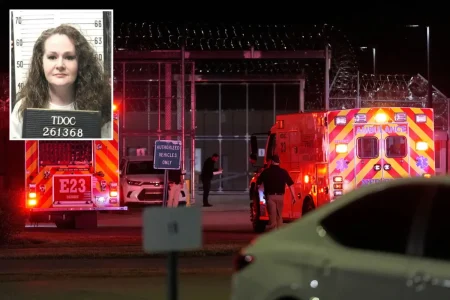






Death row is a strange waiting room. It is a place where time moves both too fast and too slowly, where every sunrise carries an unexpected weight, and where a person can spend decades not knowing whether the next hour will be their last. On the night set for her execution, Ms. Pike, 50, walked or was led into a sterile room where the state of Tennessee had prepared to end her life. She had been condemned for a crime committed in 1995, when she was barely out of her teens, and she had spent more than half her life in a cell no bigger than a bathroom. The lethal injection protocol was designed by doctors and lawyers to be humane, efficient, and irreversible. But when the key was turned and the drugs flowed, Ms. Pike’s body refused to cooperate. The first dose, likely an intravenous sedative meant to pull her into unconsciousness, failed to reach its mark or failed to exert its intended force. The second dose, perhaps another attempt to finish what the state had started, also fell short. Monitors kept showing a pulse. Her chest continued to rise. This is what survival means in the precise moment it happens: not a dramatic escape, not a last-minute reprieve from a governor, but a flat biological stubbornness. The execution was called off, and she was moved back to the unit. The men and women in the witness room had expected to see death; instead, they saw a woman lying in the aftermath of a failed attempt. It was not a miracle in the traditional sense. It was an administrative and moral catastrophe, one that left everyone in the room with the same impossible question: what do you do now with a person who was supposed to die and simply did not?
To understand Ms. Pike, you have to go back to a time before the gurney, before the two failed doses, before the word “survivor” could ever be attached to an execution chamber. She was born in 1975 and grew up in Tennessee in circumstances that were, by all accounts, unstable. Her childhood was marked by violence, neglect, mental illness, and addiction. She was not a stranger to pain; she was raised inside it. By the time she was nineteen, she was a young woman carrying more damage than most people could name. In 1995, she killed a classmate, a fellow young woman named Colleen Slemmer. The murder was not a moment of sudden violence. It was prolonged, cruel, and deeply disturbing. For the victim’s family, it was the end of everything. For the community, it was a crime that demanded the harshest punishment. Ms. Pike was arrested, charged, tried, and convicted. At twenty, she was sentenced to death. The law made sense of the case by reducing it to a single moral truth: she had taken a life, and now the state must take hers. But behind that truth was a person nobody had ever taught how to be whole, a person whose brain was still developing, whose trauma had never been treated, whose life had been a slow drift into darkness. That does not excuse what she did. Nothing can excuse it. But it does mean that the woman strapped to the gurney was not simply a monster. She was a human being, shattered in ways that began long before she ever picked up a weapon. Every chapter of her life, from the courtroom to the cellblock, has been an attempt to understand what happened and what she became.
The failed execution itself raises questions about the machinery of death that most of us never have to face. The execution room is designed to be a place of certainty. Every step is rehearsed, every dose measured, every vein checked. There is a protocol, a checklist, a series of witnesses, a chaplain, a phone with a direct line to the governor. In theory, the process should run like a clock. But bodies are not clocks. Veins roll, muscles tighten, medications behave differently in different people. When the first dose of lethal injection was administered to Ms. Pike, something went wrong. Perhaps the needle missed its target; perhaps her body metabolized the drug faster than expected; perhaps the system itself—so confident in its own infallibility—failed at the most critical moment. The second dose was another attempt to bring about the death that the court had ordered, and it also failed. Witnesses described confusion and a strange, heavy silence. Nobody had written a script for this. The execution team looked at one another, not knowing whether to continue, stop, or call for help. In the end, they stopped. Ms. Pike was taken off the gurney and returned to her cell. She was still breathing. She was still alive. That single fact has enormous legal, ethical, and emotional implications. The state had tried to kill her twice and could not. Is that a sign that her punishment should be carried out again, until the state finally succeeds? Or is it a sign that the entire enterprise is broken, too fallible to be trusted with the irreversible act of ending a human life? These are not abstract questions. They are the kind of questions that keep lawyers up at night and leave ordinary citizens feeling uneasy about the meaning of justice.
We must, at the same time, never lose sight of the person whose life was stolen in 1995. Colleen Slemmer was a young woman with her whole future ahead of her. She was a daughter, a friend, a student. Her family has spent more than two decades mourning a loss that cannot be repaired, watching the woman convicted of her murder live on, year after year. The failed execution of Ms. Pike is not a vindication. It is not a victory. It should not be presented as proof that the universe blessed Ms. Pike and forgotten Colleen. The pain of the victim’s family is real, and their search for justice is sacred. When Ms. Pike survives, they may feel that justice has been denied again, or that the wound has been reopened. That feeling is entirely legitimate. Humanizing Ms. Pike does not mean erasing Colleen. It does not mean asking anyone to forgive, or to pretend that a brutal murder and a failed execution are the same thing. It simply means telling the truth about the complexity of the situation. Ms. Pike was not an innocent woman. She was convicted of a monstrous act. Yet she was also a child once, and she is now a woman in her fifties who has spent decades in prison, who has watched other people die, who has had to think about what she did every day. The space between those truths is uncomfortable. But it is where real humanity lives. The same society that wants to protect the sanctity of life is now struggling with the fact that it cannot always take life cleanly, even when the law demands it.
After the failed execution, the legal system is left with an unprecedented situation. Ms. Pike has already been punished with a death sentence, but now the state must decide whether to schedule another execution, seek approval for a different method, commute her sentence to life without parole, or simply leave her on death row until she dies naturally. Each choice carries enormous weight. To try again would be to turn the execution chamber into a laboratory of trial and error, where a human being could be forced to face death again and again until the process finally works. To stop would be an admission that the system is unable to deliver what it promised. To commute her sentence might feel like mercy, but it might also feel like a betrayal of the victim’s family. And to do nothing would leave everyone in limbo for years, with the threat of death hanging over Ms. Pike in a way that is itself a form of punishment. Ms. Pike, now 50, has spent more than half her life in confinement. She has grown old inside the walls. Some reports suggest she has found ways to make meaning, through poetry, faith, or the quiet rituals of prison life. She has written letters, formed connections, and, in the eyes of some, transformed from the troubled girl who committed an awful crime into a woman who can speak honestly about what she did. That transformation does not erase the crime, but it cannot be ignored either. The question of what to do with her is not just a legal problem; it is a moral problem. It is about whether the state should keep trying to kill someone in spite of its own failure, or whether the botched execution is an opportunity to ask if this is really who we are.
In the end, the story of Ms. Pike surviving two doses of lethal injection is not only about one woman on a gurney in Tennessee. It is a story about us, about the things we tell ourselves in order to feel safe, about the way we imagine death as a clean and orderly conclusion when it is anything but. We like to believe that the state can end a life without cruelty, that the punishment can be carried out with precision and calm. But the human body is not a machine, and the human soul is not a thing that can be dialed away. Ms. Pike’s survival is a reminder that no matter how much we plan, we cannot fully control life or death. It is a reminder that every person on death row was once a child, and that every child is formed by forces they did not choose. It is a reminder that the families of murder victims live with an ache that no execution can heal, and that even when a sentence is carried out, the pain does not end. And it is a reminder that mercy is not the same as weakness, and justice is not the same as vengeance. Ms. Pike survived two doses of lethal injection. Whether that was an accident, a miracle, or something in between, the fact remains: she is still here, breathing, flawed, waiting. The rest of us are left to decide what that survival means. Perhaps it means that the death penalty is too broken to be trusted. Perhaps it means that even those who have done terrible things deserve if not pardon, then at least clarity about what justice really is. In the quietness of that failed execution, there was a strange, unspoken message: no one should die this way, and no system should be allowed to remain so certain of itself when it cannot even do what it was built to do.