





1. The Desert’s Deadly Rage
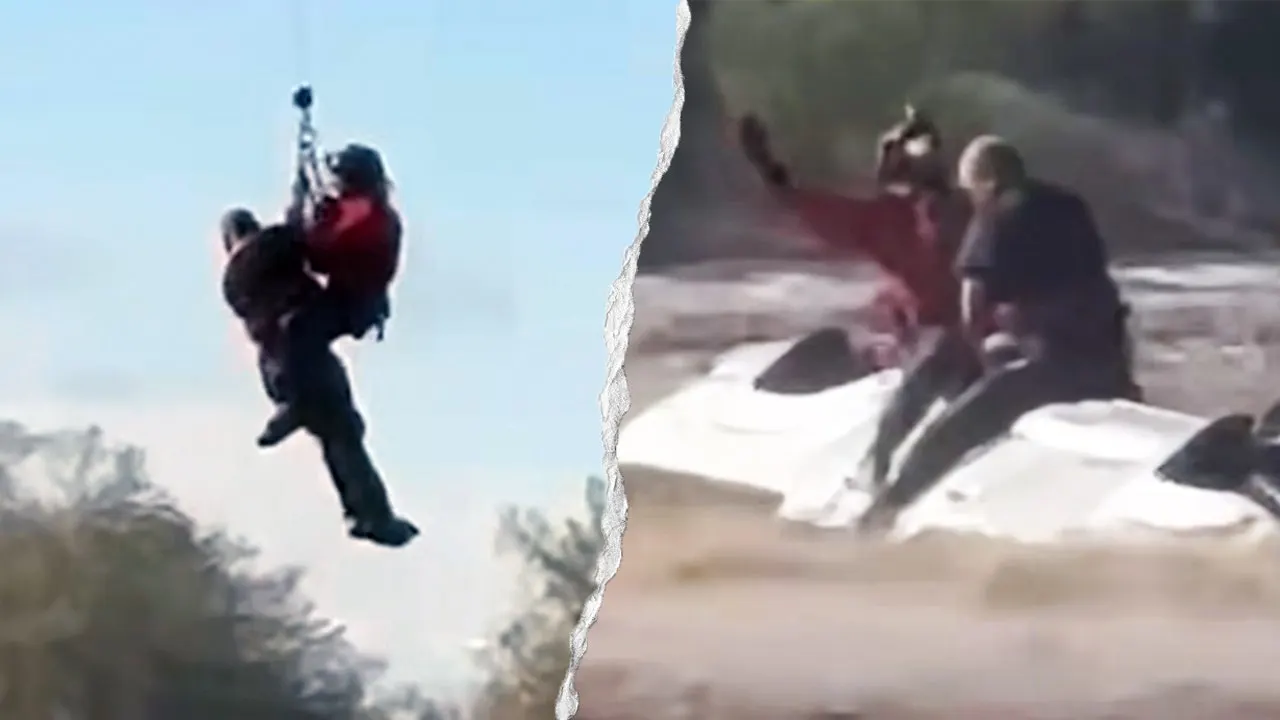
In the arid expanses of the American Southwest, a sudden, violent storm can transform a dry, dusty riverbed into a furious, churning monster in a matter of minutes. Such was the terrifying reality on a Tuesday morning in Tonopah, Arizona, when a man’s vehicle was caught in a raging flood, overturned, and left stranded amidst a chaotic swirl of muddy water and debris. The dramatic scene, captured by the Maricopa County Sheriff’s Office’s aerial unit, Fox 1, unfolded with breathtaking intensity. There, perched precariously on the side of his overturned truck, was the man, a lone figure against the relentless force of nature, surrounded by water that seemed to grow angrier by the second. The sight was a stark reminder that in the desert, the greatest danger often arrives not from the sun, but from the water that crashes down from the heavens. The man was completely cut off, his vehicle serving as a temporary, fragile island in a sea of liquid fury, and the situation demanded immediate, decisive action.
The rescue mission was not just a matter of saving a life; it was a race against time. The floodwaters were not static; they were actively rising, swirling with a destructive power that could easily sweep a person away in an instant. For the deputies and pilots of the Maricopa County Sheriff’s Office, the call to action was clear. They would not let this man become a statistic. The video footage shows the stark contrast between the dry, open landscape in the distance and the immediate, terrifying scene of the wash, a normally insignificant channel now turned into a deadly river. The helicopter blades thundered overhead, a symbol of hope in the midst of a natural disaster. The pilot, Rich Dickner, and his crew understood the gravity of the moment. The man on the truck was not just a person in trouble; he was a reminder of how quickly nature can strip away our illusions of control and force us to fight for our very survival. The rescue that followed would be a testament to skill, courage, and the unyielding human spirit.
2. A Perilous Decision and a Heroic Descent
As the helicopter hovered overhead, the crew assessed the scene with a practiced, critical eye. The floodwaters were far too volatile, the current too strong, and the obstacles too numerous to risk a direct ground rescue. Any attempt to wade or drive to the victim would have put the first responders in mortal danger, and it would have been foolish to add more victims to this desperate situation. The decision was made to employ a “hoist rescue,” a complex and highly technical maneuver that requires nerves of steel and flawless coordination. The crew would lower one of their own, a skilled deputy, down to the truck from the hovering aircraft, secure the victim, and then hoist them both to safety. It was a plan that left no room for error. Deputy Lindsey Smith, the chosen rescuer, prepared for her descent, her gaze fixed on the bobbing, unsteady surface of the overturned truck below. The helicopter pilot, Rich Dickner, fought to maintain a steady hover, his concentration absolute as he held the aircraft in a perfect position against the buffeting wind and the powerful downdraft of the rotor wash.
From the video, the tension is palpable. Deputy Smith was lowered approximately 80 feet on a single, slender cable, a tiny figure dangling above a violent, liquid landscape. As she neared the truck, she initially struggled to find a secure footing. The vehicle was wet and slick, the current pushing and pulling at her legs, threatening to tear her away. It was a moment of high anxiety, as the water lapped at the edges, and the entire rescue hung in the balance. But Smith, propelled by training and adrenaline, remained focused. She managed to secure herself to the vehicle, bracing against the onslaught of the water. The next task was the most critical: securing the stranded man. She had to guide him into the harness, ensuring he was safe before she could even think about her own safety. The entire operation, from the moment the crew arrived to the moment they lifted off with the man safely in tow, took less than five minutes. It was a lightning-fast response that made all the difference, a masterclass in split-second decision-making under extreme pressure.
3. Skill, Speed, and the Sheriff’s Commendation
The rescue was a textbook example of how effective and swift a well-trained team can be when faced with a life-or-death emergency. The Maricopa County Sheriff’s Office didn’t hesitate to praise the work of its aviation unit. In a statement that radiated pride, they credited the crew’s skill and quick response for bringing the man to safety, declaring, “Thanks to the skill and quick response of our Aviation crew, the subject was safely brought to shore. Excellent work, Fox 1!” This commendation was well-earned. The crew had not only performed a dangerous and complex rescue, but they had done so with an efficiency that likely saved the man’s life. Pilot Rich Dickner’s calm and steady handling of the aircraft was a crucial element, but he was quick to highlight the urgency of the situation. He told CBS News that the water was rising with alarming speed. “We didn’t waste much time,” he said, his words painting a vivid picture of a race against a ticking clock.
The urgency was evident in his observation: “As opposed to when we first got there, you can see the water line on the video — it’s below the window — and it had risen up to the top of the window. So there was that urgency.” That simple detail, the water climbing over the truck’s window, transforms the rescue from a simple rescue operation into a desperate last stand against an invisible, ever-rising threat. The crew was not just fighting the current; they were fighting against the clock. Deputy Smith’s initial struggle to find her footing, a moment of vulnerability caught on camera, makes the heroism all the more relatable. It shows that even the most well-trained professionals are human, and that courage is not the absence of fear or difficulty, but the will to push through it. The crew’s success was a testament to their training, their ability to adapt, and their unwavering commitment to the people they serve, embodying the very best of what it means to protect and serve a community.
4. A Deluge from the Heavens: The Storm’s Broader Wrath
This dramatic rescue was not an isolated incident but a dramatic symptom of a much larger weather event that had unleashed a torrent of rain upon the desert landscape. The Weather Channel reported that remnants of Hurricane Polo, a powerful tropical system, had moved into the region, bringing historic rainfall to parts of the Desert Southwest. This moisture-laden system collided with the region’s rugged terrain, triggering widespread and catastrophic flash flooding. The normally dry washes and arroyos, which crisscross the desert like ancient veins, swelled into raging rivers within minutes, catching many motorists off guard. The man in Tonopah was just one of many who found themselves in a life-threatening predicament, a stark illustration of the fact that you can never be too cautious when it comes to flash floods in the desert. The storm transformed the landscape, turning peaceful scenery into a treacherous obstacle course where the ground itself seemed to become a weapon.
The Flood Control District of Maricopa County, well aware of the deadly potential of these rains, issued a stark warning to drivers: “Remember: Conditions can change fast. If you encounter a flooded roadway, Turn Around, Don’t Drown.” This simple, yet crucial, message is a cornerstone of flood safety in the Southwest. Too often, people underestimate the power of moving water. They believe their car, often a large SUV or pickup truck, is strong enough to cross a shallow-looking wash. This is a fatal miscalculation. Just a foot of moving water can sweep a vehicle away, and just six inches can knock a person off their feet. The water in these washes is not just a gentle stream; it’s a churning slurry of mud, rocks, and debris that can crush and destroy. The fact that this man’s truck was overturned is a powerful testament to the sheer force of the water, a force that can easily overpower even the heaviest of vehicles, turning a simple commute into a desperate fight for survival.
5. The Human Tapestry of a Harrowing Escape
Beyond the technical details and the warning signs, there is a deeply human story to this rescue. Imagine the terror of the stranded man as he felt his vehicle begin to lose its grip on the earth, the sickening lurch as it was flipped over, and the dawning realization that he was trapped inside a metal box being battered by a relentless, muddy torrent. He managed to claw his way out, seeking the only safe haven available—the slick, overturned side of his own truck. There, clinging to life, he must have felt a profound sense of isolation, surrounded by a force of nature that cared nothing for his fate. The sound of the helicopter, faint at first, then growing louder, would have been the most beautiful sound he had ever heard—a mechanical angel of mercy descending from the sky. For Deputy Smith, dangling above that roiling water, the mission was intensely personal. She wasn’t just pulling a stranger to safety; she was seeing a member of her community, someone’s father, son, or brother, in dire need of a lifeline.
The rescue was not just a feat of aviation and athleticism; it was an act of profound human compassion. It showcases the incredible lengths that first responders will go to in order to save a single life, even when the odds are stacked against them. The cheering that likely erupted from the riverbank as the man was safely deposited into the waiting hands of fire personnel is a sound that would not soon be forgotten. The entire incident, from the initial distress call to the final, safe touchdown, is a stark reminder of the fragility of life and the importance of community. It highlights how a team of strangers, bound by a shared sense of duty, can come together in a moment of crisis to achieve something extraordinary. While the man will forever be marked by his harrowing experience, he will also be a living testament to the bravery and dedication of the men and women of the Maricopa County Sheriff’s Office, a story of rescue that transcends a simple news report.
6. A Sobering Reminder and a Call to Action
The story of this rescue in Tonopah, Arizona, should serve as a sobering reminder for us all, a narrative that extends far beyond the dusty confines of a desert wash. It is a cautionary tale about the unpredictable power of nature and the importance of heeding warnings. The decision to drive into a flooded roadway is not just a risk to your own life; it also endangers the lives of the first responders who must come to your rescue, forcing them into harm’s way. The Maricopa County Sheriff’s Office, the Flood Control District, and countless other emergency management agencies work tirelessly to educate the public about these dangers, but their message can only do so much if individuals don’t take it to heart. The “Turn Around, Don’t Drown” campaign is not just a catchy slogan; it is a life-saving directive. As the climate changes and weather patterns become more volatile, these types of extreme events will likely become more common. We must all become better stewards of our own safety, to respect the power of nature, and to understand that no trip, no appointment, and no deadline is worth risking a life.
In the end, the heroism of the Fox 1 crew is a story that inspires hope and gratitude. It reminds us that even in our darkest moments, there are always those who are willing to step (or fly) into the breach. The successful rescue of the man from atop his overturned truck is a narrative that will be told for years to come, a testament to the very best of human courage and skill. It is a story about the remarkable things that can be achieved when we work together, when we rely on our training, and when we refuse to give in to despair. For the man who was rescued, this day will forever be a demarcation point in his life, a day when he was given a second chance. And for the rest of us, it is a powerful invitation to reflect on our own choices, to respect the forces of nature, and to remember that in the face of a rushing flood, the only safe choice is to stop, turn around, and find another way home. The news of this rescue should not just be consumed and forgotten; it should be a catalyst for personal responsibility and a renewed appreciation for the brave men and women who put their lives on the line for us, every single day.