





After the Dust Settles: A Shattered Venezuela Relies on Diaspora Hopes and Bare-Handed Rescues
A Diaspora United in Grief: The Digital Search for Venezuela’s Missing
The devastating twin earthquakes that struck Venezuela on Wednesday have transformed social media feeds into a digital, global search-and-rescue platform, illuminating the profound pain of a country whose population has been scattered across the earth by years of economic exile. From Miami to Dallas, Madrid to Bogotá, members of the Venezuelan diaspora have spent sleepless nights staring at glowing screens, frantically uploading photographs of missing grandparents, young children, and siblings in the desperate hope that someone on the ground might recognize them amidst the ruins. The sudden disaster collapsed already fragile telecommunications networks along Venezuela’s northern coast, turning hours of silence into an agonizing lifetime of uncertainty for millions of emigrants watching from afar. While some online searchers received the bittersweet relief of learning their loved ones had survived—albeit injured and scattered across overwhelmed local medical facilities—others have had their worst fears confirmed through brief, cold notifications of death, while countless more remain suspended in an excruciating limbo. This collective digital vigil underscores a uniquely modern tragedy: a nation whose social fabric had already been torn apart by mass migration must now navigate the physical destruction of its homeland through the fractured lens of social media, relying on pixelated updates and desperate direct messages to bridge the gap between exile and a homeland in ruins.
              =========================================
              THE GEOGRAPHY OF TRAGEDY: NORTHERN COAST
              =========================================

               [ Caribbean Sea ]
                      |
              +-------+-------+
              |               |
         (La Guaira)     (Los Corales) <--- epicenter of damage
              |               |
              +-------+-------+
                      |
               [ Caracas Valley ] <--- urban high-rise damage
                      |
               (El Paraíso District)
              =========================================
Survival and Separation in the Rubble of Los Corales
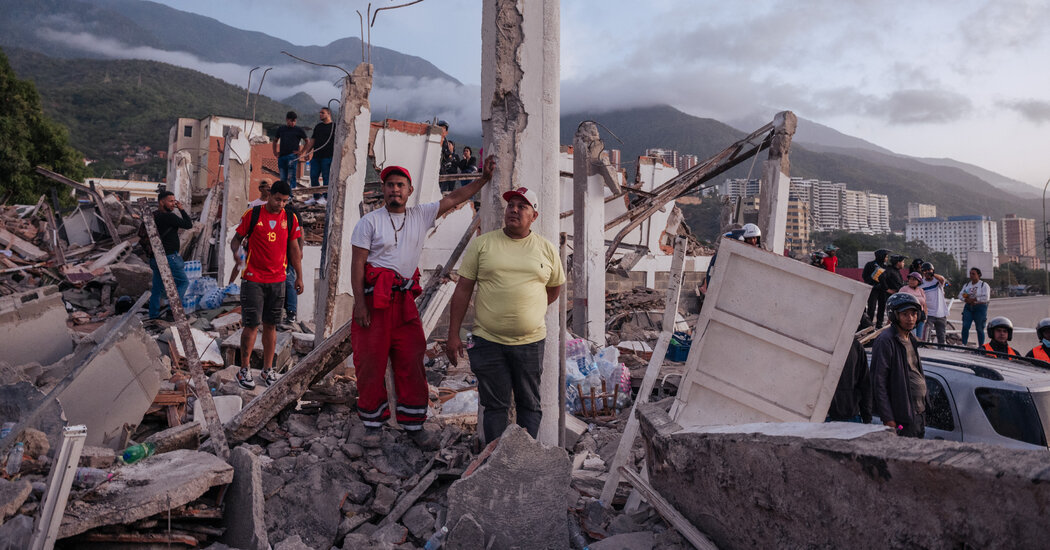
Among those caught in the terrifying immediate aftermath of the disaster is the Castaño family, whose experience in the coastal town of Los Corales reflects both the miracle of survival and the cruelty of separation. Okarina Castaño, a bank employee living in Miami, Florida, described the immense relief and subsequent dread of receiving an early Thursday morning phone call from her brother, Carlos Castaño, who had spent the night clawing his way out of the wreckage. Carlos lived in a hard-hit coastal enclave just east of the Caracas international airport, an area where the seismic shocks sheared multi-story brick and concrete buildings into chaotic heaps of debris. “I’m alive, we’re alive; we just got out of the rubble, we made it,” Carlos told his sister in a voice choked with dust and trauma, before delivering a devastating caveat: “But I think my mother-in-law didn’t.” Though Carlos, his forty-year-old wife, Eliana Palacios, and their twelve-year-old daughter, Danna, miraculously survived their burial beneath the collapsed structure, the family was immediately fractured in the chaos that followed, with the injured mother and child whisked away to unknown hospitals while Carlos was left behind to search. Adding a layer of psychological cruelty to their physical injuries, this family had previously survived the cataclysmic 1999 Vargas disaster—a series of landslides and flash floods that claimed tens of thousands of lives in this exact coastal strip—making this latest seismic upheaval a triggering repetition of past nightmares that has left Carlos in profound physical pain and deep psychological shock.
   CARLOS CASTAÑO'S FAMILY: PITUITARY OF A SURVIVAL STORY

            [Collapsed Home in Los Corales]
                          |
           +--------------+--------------+
           |                             |
  [Extracted Alive]             [Struck by Debris]
           |                             |
  +--------+--------+                    v
  |                 |            Mother-in-Law
Carlos            Eliana         (Presumed Deceased)
(Searching) & Danna (Child)
(Hospitalized/Location Unknown)
The Desperate Race Against Time in Macuto and the Cry for Heavy Machinery
Further east along the battered coastline, in the community of Macuto, the desperate struggle of survivors highlights a severe lack of heavy machinery and organized emergency response, forcing ordinary citizens to act as first responders with their bare hands. Brigeanner Soto, a Venezuelan migrant now residing near Dallas, Texas, has spent the hours following the earthquake in a state of high anxiety, pleading for information regarding her eighteen-year-old sister, Gabriela Orfao, who lived with other siblings in the Punta Brisas apartment complex, a fourteen-story building located roughly twelve miles from the main airport. While Soto managed to receive brief, static-laden audio messages from neighbors, the flow of information remained agonizingly slow, revealing that although her other sister, Camila, was successfully pulled from the wreckage and rushed into emergency hip surgery, Gabriela remains trapped deep within the lower levels of the collapsed high-rise. “Gabriela was too far underneath, and they needed heavy machinery to reach her,” Soto explained, her voice cracking with desperation as she described how neighbors and local youth are risking their lives to tunnel through unstable slabs of concrete without industrial jacks, cranes, or thermal imaging equipment. This grassroots rescue effort, while heroic, exposes a deadly reality: because official state rescue personnel have been slow to arrive or are severely unequipped, the lives of those still breathing beneath the heavy concrete of Macuto depend entirely on the physical endurance of traumatized survivors who refuse to stop digging through the dust.
Hallowed Ground and Hollowed Infrastructure: The State’s Fragile Emergency Response
The critical shortage of heavy rescue equipment and specialized disaster personnel is not an isolated issue, but rather the tragic consequence of a broader, systemic collapse of Venezuela’s municipal infrastructure and emergency response capabilities. In an emotional telephone interview from Venezuela, Angie Reyes expressed her growing terror as she tried to locate her forty-three-year-old colleague, Daniel Vivas, who resided on the sixth floor of a residential building in the port city of La Guaira and has not been heard from since the first seismic wave struck. Reyes noted that while neighbors confirmed severe structural failures throughout Vivas’s apartment complex, her hope of finding him alive is rapidly dimming because the country’s municipal fire and civil defense departments have been starved of resources for years, leaving them with highly limited operational capacity. Without a functional fleet of ambulances, fuel for emergency vehicles, or modern rescue tools, the local authorities are simply overwhelmed, forcing Reyes and many others to look beyond their country’s borders for salvation, concluding with a grim assessment: “We’re stuck like this until the international community arrives.” This stark reality illustrates how the intersection of natural disaster and long-term socio-political decay compounds the mortality rate of such events, transforming a severe geological occurrence into an unmitigated humanitarian catastrophe where the difference between life and death is determined by the availability of fuel and basic mechanical tools.
============= SYSTEMIC DEFICITS IN RESCUE INFRASTRUCTURE =============
- FUEL SHORTAGES: Prevents rapid deployment of emergency vehicles.
- AGING EQUIPMENT: Lack of hydraulic shears, pneumatic jacks, and concrete saws.
- HOSPITALS OVERWHELMED: No central database to track injured survivors.
-
TELECOM COLLAPSE: Prevents coordinated dispatch and family tracking.
Grim Realities in Caracas: The Heavy Silence of El Paraíso
The grim reality of this infrastructure deficit is vividly apparent in the nation’s capital, where the search for survivors has taken on a quiet, despondent tone in historic urban developments like the El Paraíso neighborhood. Outside the pulverized remains of what was once a six-story residential building, Vladimir Navas watched in silent agony as a single piece of heavy machinery slowly cleared immense blocks of concrete in a desperate, late attempt to reach his elderly in-laws, eighty-six-year-old Freddy Carrero and eighty-two-year-old Eliana Hernández. Navas noted that the elderly couple were likely in their apartment watching a World Cup football match when the earthquake struck, pancaking the building’s upper floors onto the lower levels and leaving virtually no pocket spaces where survivors could subsist. While the Caracas Fire Department, led by Colonel Henry Ascanio, managed to deploy some crews to the site, the extraction process has yielded only dead pets and a growing list of at least seven missing residents, with the heavy, dusty air around the site offering no signs of life. “There’s no possibility that they got out,” Navas said, staring blankly at the vertical tomb of concrete that once housed his family, adding with a heavy heart, “You can’t hear anything; if anyone is alive in there, it’s a miracle.” This quiet devastation in Caracas illustrates the vulnerability of older urban architectural structures that, having suffered from decades of deferred maintenance and a lack of seismic retrofitting, collapsed instantly under the stress of Wednesday’s tectonic shifts.
              EL PARAÍSO COLLAPSED STRUCTURE
          +-------------------------------------+
          | [Roof Level / Upper Floors]         |
          +-------------------------------------+
          | [Pancaked Residential Levels 2-5]   |  <-- 7 Missing
          |                                     |      (inc. Freddy, 86
          |                                     |       & Eliana, 82)
          +-------------------------------------+
          | [Ground Level / Sub-Structure Area] |  <-- No signs of life
          +-------------------------------------+
A Double Tragedy: Historical Echoes and the Looming Humanitarian Crisis
As the initial shock of the earthquake transitions into a prolonged recovery effort, the dual tragedies of Venezuela’s geological vulnerability and economic exhaustion loom large over the nation’s future. The striking parallels between this disaster and the historical trauma of the 1999 Vargas tragedy serve as an ominous reminder that the country’s northern coast remains a highly dangerous zone where natural hazards frequently collide with structural neglect. For survivors, the road ahead is fraught with immense psychological hurdles, as the immediate trauma of being buried alive is accompanied by the daunting challenge of rebuilding their lives in an economy that lacks the credit, materials, and stability to facilitate rapid reconstruction. With municipal water grids fractured, hospitals lacking basic medical supplies like antibiotics and anesthetics, and local governments unable to provide temporary housing for thousands of newly displaced citizens, the threat of disease and prolonged homelessness is rising rapidly. Ultimately, the aftermath of these twin earthquakes has exposed the raw, vulnerable nerves of a country already pushed to its limits, leaving a resilient yet exhausted population to lean on their scattered diaspora for financial support, while begging a distracted global community to help them dig their loved ones out of the dust.