



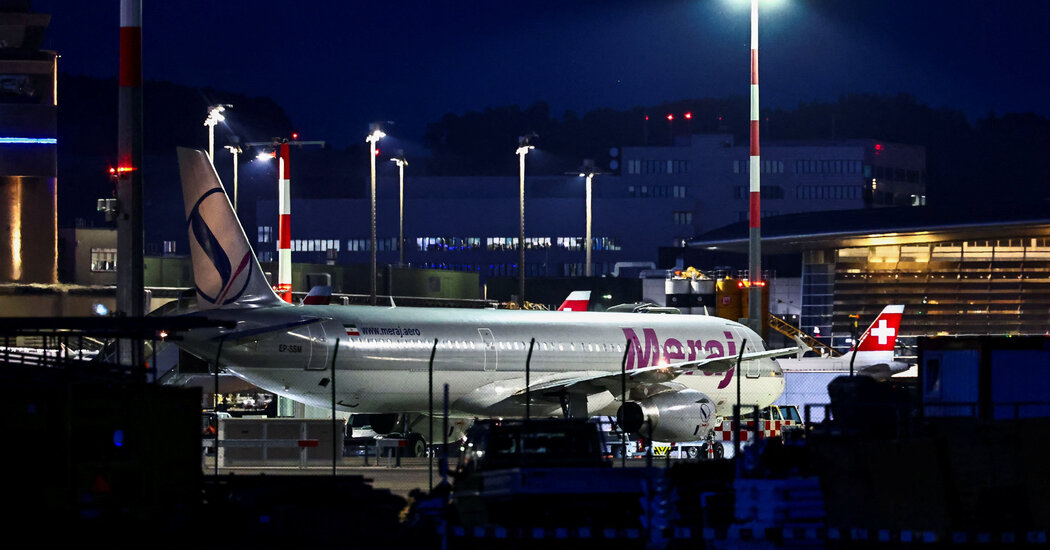
Under the crisp, silent sweep of the Swiss winter sky, Air Force Two touched down early Sunday morning, carrying Vice President JD Vance into a geopolitical crucible that could reshape the future of the Middle East. Only hours earlier, a highly anticipated Iranian delegation had slipped into the country, bringing with it some of Tehran’s most formidable political operators: General Mohammad Bagher Ghalibaf, the veteran parliament speaker and seasoned lead negotiator, alongside Foreign Minister Abbas Araghchi. These men did not arrive as partners in dialogue, but as representatives of two nations exhausted by decades of surrogate warfare, economic strangulation, and ideological drift. The quiet European backdrop, famed for its historical neutrality, stood in stark, almost surreal contrast to the explosive violence and smoldering ruins of the regions they left behind. For the diplomats on both sides, the sudden transition from the visceral panic of air raid sirens to the hushed, mahogany-lined conference rooms of Switzerland was a jarring reminder of how far removed the architects of peace can be from the bloody realities on the ground, yet the immense pressure to convert a fragile, preliminary agreement into a lasting truce hung heavily in the freezing Alpine air.
Vance made it clear before departing American soil that his patience for diplomatic theater was limited, telling reporters he intended to walk these Swiss halls “for a day or two” at most—a calculated posture of strength designed to signal that the United States would not be dragged into endless, fruitless deliberations. Yet behind this brisk public demeanor lay a highly coordinated, multi-layered diplomatic apparatus engineered by some of President Trump’s most trusted inner circle, including special envoys Steve Witkoff and Jared Kushner, both of whom had already quieted into Swiss sanctuary to lay the preparatory groundwork. This high-stakes endeavor, however, is not merely a bilateral dance between Washington and Tehran; it is a complex, multinational jigsaw puzzle kept alive by the quiet, tireless mediation of regional power players. Pakistan, acting as the indispensable diplomatic intermediary alongside Qatari facilitators, confirmed that technical talks were set to commence immediately, drawing heavily on the political and physical gravitas of Pakistani Prime Minister Shehbaz Sharif and Army Chief Field Marshal Syed Asim Munir. This heavy-duty presence of Pakistani military and civilian leadership underscores the sheer desperation of neighboring states to prevent a localized wildfire from engulfing the broader Asian continent, transforming these Swiss chalets into a pressure cooker where the immediate survival of millions of civilians hinges on the signatures of a few exhausted men.
The timing of these talks could not be more fragile, nor could the stakes be more agonizingly high, as the tragic, ongoing conflict in Lebanon between Israeli forces and the Iran-backed militant group Hezbollah threatens to shatter the fragile diplomatic scaffolding before the first official sessions even begin. Originally scheduled to commence on Friday, the Swiss summit had to be abruptly postponed as the skies over Beirut and northern Israel lit up with retaliatory strikes and rocket fire, illustrating how easily the raw violence of the battlefield can derail the sterile timelines of international diplomacy. For the average family sheltering in southern Lebanon or running to bomb shelters in Haifa, the postponement of these talks was not a mere scheduling conflict but a devastating delay in their hope for survival. The mutual distress of these cross-border hostilities casts a dark shadow over the negotiating table, revealing a profound disconnect between the high-flying rhetoric of a universal cease-fire and the grueling reality of a war that refuses to be governed by external decrees. Though the U.S.-Iranian agreement theoretically calls for an immediate end to hostilities on all fronts, neither Israel nor Hezbollah have officially put pen to paper, leaving the negotiators in Switzerland to broker a peace that their own closest allies are actively undermining in real-time.
Adding fuel to this geopolitical firestorm is the escalating crisis over the Strait of Hormuz—the vital, narrow choke point of global energy transport that winds past the southern coastline of Iran. In the wake of intense Israeli airstrikes, which Tehran fiercely condemned as a direct violation of their mutual understandings, the Iranian military took the drastic step of claiming they had closed the waterway to international shipping, a provocative maneuver that sent shockwaves through global energy markets. Although the United States military quickly sought to soothe global anxieties by asserting that marine traffic continues to flow smoothly and that Iran “does not control” the strait, the mere threat of a blockade evokes the terrifying prospect of economic collapse for nations thousands of miles away. Inside the quiet Swiss meeting rooms, this dispute ceases to be an abstract debate over maritime law and instead becomes a visceral struggle over leverage; for Iran, the strait is a vital shield and a sword to brandish against crushing Western sanctions, while for America and its global allies, it represents a non-negotiable artery of global commerce that must remain open at all costs, lest the everyday citizens of the world bear the brunt of skyrocketing fuel prices and disrupted supply chains.
The road to a final accord is littered with these unresolved, deeply entrenched grievances, largely because President Trump’s interim agreement deliberately punted the most difficult questions down the road to prevent negotiations from stalling prematurely. By ignoring the volatile future of Iran’s nuclear program, bypassing its ballistic missile development, and failing to secure a definitive, long-term guarantee for the free passage of ships through the Strait of Hormuz, the preliminary deal left behind a minefield of diplomatic vulnerabilities. Iranian foreign ministry spokesman Esmail Baghaei encapsulated Tehran’s deep-seated skepticism on Saturday, declaring to state media that their delegation’s primary objective in Switzerland was simply to verify if the American side would “follow up on the implementation of its commitments” before any talks of a permanent peace could even be entertained. This sharp rhetoric exposes the profound chasm of distrust that separates the two delegations: while the American people look to their leaders to dismantle a hostile regime’s nuclear aspirations, the Iranian public and their leaders view Washington through a lens of historical betrayal, convinced that the United States will once again renege on its promises the moment the cameras stop flashing and the winter snows melt from the Swiss mountains.
Despite the daunting mountain of obstacles standing in their way, Vice President Vance sought to maintain a sober yet optimistic tone as he departed for the summit, telling reporters that his ultimate hope was to forge concrete progress on both the nuclear standoff and the devastating Lebanon cease-fire, while genuinely acknowledging that the Iranians would have their own pressing list of grievances to air. This rare, candid acknowledgment of the adversary’s perspective is a vital first step in humanizing a conflict that is so often reduced to sterile headlines and partisan mudslinging. The coming days in Switzerland will test not only the diplomatic acumen of Vance, Witkoff, Kushner, and their foreign counterparts, but also the very limits of human empathy and compromise in the face of deep-seated historical trauma. For the millions of families living in fear across the Middle East, the success or failure of these talks is not a matter of political legacy or strategic posturing; it is a literal matter of life and death, a fleeting chance to replace the constant, terrifying thunder of artillery with the quiet, restorative peace of a normal life. Whether these leaders can rise above their mutual animosities to draft a future built on shared security remains to be seen, but as the doors close on the Swiss negotiating rooms, the entire world holds its breath, hoping that the quiet warmth of diplomacy can finally extinguish the flames of active warfare.