



Dual Massive Earthquakes Strike Venezuela: Tectonic Tremors and Tsunami Warnings Trigger Panic Across the Caribbean
The Double Temblor: Thirty-Nine Seconds That Shook a Nation
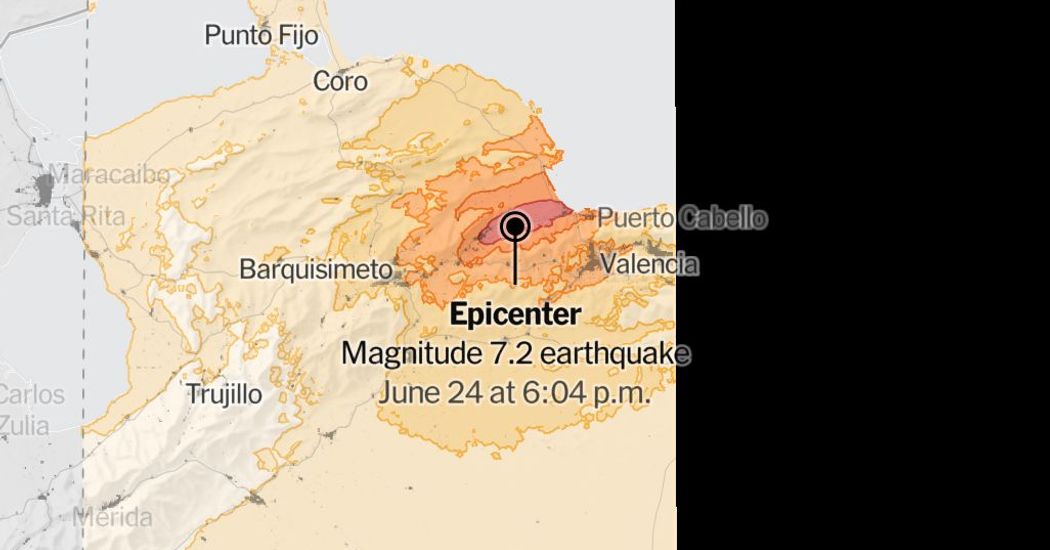
On an otherwise quiet Wednesday evening, the earth beneath northern Venezuela fractured with violent, consecutive ruptures, plunging the region into immediate chaos and triggering widespread panic across the Caribbean basin. At precisely 6:04 p.m. local time on June 24, a powerful magnitude 7.2 earthquake tore through the subterranean fault lines approximately 15 miles northeast of San Felipe, the capital of Yaracuy state. Before residents could comprehend the initial violent shaking or safely evacuate vibrating concrete structures, an even more terrifying catastrophe struck: just 39 seconds later, a second, more catastrophic magnitude 7.5 earthquake convulsed the exact same corridor. This rapid-fire succession of seismic energy—originally registered by some preliminary sensors as a single magnitude 7.1 event before being rapidly upgraded by global monitoring stations—sent shockwaves traveling hundreds of miles across South America and up through the Antilles. The sheer velocity of the double-event meant that the secondary, larger rupture arrived while the ground was still reeling from the first wave of energy, compounding the structural strain on local infrastructure and leaving civil protection agencies scrambling to assess the scale of the damage. Sirens wailed throughout Caracas and neighboring urban centers as millions of citizens rushed into the streets, fleeing high-rise buildings that swayed precariously against the dusk sky, while emergency dispatch lines were instantly overwhelmed by reports of fractured masonry, collapsed facades, and localized power outages along the seismically volatile northern coast.
Venezuela Double Earthquake Timeline (June 24)
6:04:00 PM VET —> [Foreshock] Magnitude 7.2
Epicenter: 15 miles NE of San Felipe
|
(39 Seconds Later)
|
6:04:39 PM VET —> [Mainshock] Magnitude 7.5
Compounded seismic energy & structural collapse
Tectonic Volatility: Why Yaracuy Was the Epicenter of the Crisis
The epicenter of this seismic crisis, situated just northeast of San Felipe, lies within an incredibly complex tectonic zone where the southern boundary of the Caribbean plate actively grinds against the massive South American plate. This boundary is characterized by a series of highly active, strike-slip fault systems, including the notorious Boconó and San Sebastián faults, which have historically been the source of Venezuela’s most destructive geological events. According to seismic experts and USGS earthquake data, the sudden release of built-up lithospheric stress along this fault zone created an unusually shallow rupture, which drastically amplified the intensity of the surface shaking. The United States Geological Survey immediately issued a stark warning regarding the potential for catastrophic human and economic damage, noting that the structural integrity of many buildings in Yaracuy and surrounding states is highly vulnerable to intense ground acceleration. In this part of Venezuela, older colonial earthern buildings, unreinforced masonry homes, and hastily constructed concrete dwellings dominate the residential footprint, sparking grave concerns among international humanitarian organizations about potential casualties trapped beneath structural debris. The Modified Mercalli Intensity scale categorized the shaking in the immediate vicinity as severe to violent, a classification that historically correlates with widespread building failures, significant land subsidence, and the instantaneous disruption of vital municipal lifelines such as clean water, natural gas conduits, and electrical grids.
The Maritime threat: Tsunami Advisories Sent Out Across the Caribbean Basin
As the profound energy of the double-rupture rippled outward from the Venezuelan coastline, the threat shifted rapidly from collapsing inland infrastructure to the volatile waters of the Caribbean Sea. Seizing on the sheer magnitude of the 7.5 mainshock, the U.S. Pacific Tsunami Warning Center acted swiftly to issue a series of urgent tsunami advisories and alerts that cast a pall of anxiety over numerous island nations. Coastal residents of Puerto Rico, the U.S. Virgin Islands, and the British Virgin Islands were urged to maintain a state of high vigilance as maritime authorities analyzed wave propagation models, while warning sirens echoed across the low-lying shorelines of Bonaire, Curaçao, and Aruba. The prospect of ocean displacement triggered immediate evacuation protocols in vulnerable port towns and tourist corridors along Venezuela’s expansive northern shore, where local authorities worked frantically to move citizens to higher ground amidst a lack of functional public address systems. Though these regional tsunami warnings were thankfully downgraded and deactivated a short time later as deep-water sensor buoys confirmed that no major, ocean-wide destructive wave had been generated, the frantic mobilization served as a sobering reminder of the interconnected vulnerabilities that define the Caribbean ecosystem during a major geohazard event.
Tsunami Risk Profile & Impact Zoning
Zone A: Critical Hazard Status (Immediate Coastline)
- Northern Venezuelan Shoreline
- ABC Islands (Aruba, Bonaire, Curaçao)
- Status: Temporary evacuation protocols / shoreline clearing
Zone B: Advisory Status (Northern Caribbean Arc)
- Puerto Rico
- United States Virgin Islands (USVI)
- British Virgin Islands (BVI)
-
Status: Actively monitored; high marine current warnings
Seismological Mechanics: The Science of the Foreshock-Mainshock Phenomenon
To the average citizen caught in the terrifying grip of the double shake, the event felt like an endless, escalating nightmare; to seismologists, however, the disaster represented a classic and highly dangerous “foreshock-mainshock” sequence. The initial magnitude 7.2 earthquake, though powerful enough to stand as a historic disaster on its own, functioned technically as a foreshock that primed the geological faults for the much larger magnitude 7.5 mainshock that followed a mere 39 seconds later. This phenomenon occurs when a highly stressed section of a fault slips slightly, releasing an initial burst of energy, only to instantly transfer that overwhelming stress to an adjacent, highly unstable locked section of the fault, triggering a far grander rupture almost immediately. The rapid update of USGS shake-severity maps highlights the immense difficulty of collecting, processing, and publicizing accurate seismic data in real-time while a fault system is actively failing in multiple stages. Experts caution that as satellite radar, GPS ground-displacement sensors, and regional seismograph arrays continue to feed raw data into global databases, the reported depths and exact epicentral locations of these twin trembling events may be refined further, helping scientists map the precise geometry of the rupture plane and better understand how these dual shocks interacted to destabilize the surrounding lithosphere.
The Looming Shadow: Navigating the Onset of Dangerous Aftershocks
In the wake of such monumental releases of geological tension, the immediate danger to the affected population does not subside when the initial shaking stops; instead, it transitions into the unpredictable and protracted threat of aftershocks. Seismologists have issued urgent notices warning that the fractured ground northeast of San Felipe will continue to experience minor and moderate adjustments for days, weeks, or even years as the regional crust slowly settles into a new equilibrium. These aftershocks, which can easily reach magnitudes of 5.0 or 6.0 themselves, pose an existential threat to search-and-rescue teams, civilian volunteers, and already compromised structures. A building that managed to survive the initial magnitude 7.5 mainshock with cracked load-bearing walls or compromised foundations can easily collapse under the stress of a much smaller subsequent tremor, complicating rescue efforts and instilling a persistent, exhausting psychological terror in the local population. Because these secondary events occur unpredictably and often strike closer to the surface, maintaining strict structural exclusion zones and establishing safe, outdoor temporary shelters have become parament priorities for the humanitarian personnel currently arriving in the disaster zone.
Expected Aftershock Decay Curve over Time
Days 1–3 : [CRITICAL] Multiple high-energy events (M5.0 – M6.5 possible)
Weeks 1-2 : [HIGH] Frequent perceptible shakes; high risk to compromised concrete
Months 1-6 : [MODERATE] Occasional deep rumbles; structural inspections required
Years 1+ : [LOW] Background adjustment; gradual return to baseline activity
Response and Resilience: The Humanitarian Challenge in North-Central Venezuela
As night fell over Yaracuy and the surrounding provinces, the true human scale of the disaster began to materialize against a backdrop of severed communication lines, dark streets, and localized fires. Utilizing sophisticated population density datasets, such as the LandScan models developed by the Oak Ridge National Laboratory, disaster response coordinators quickly realized that hundreds of thousands of people live within the highly destructive “Modified Mercalli Grade 7+” shake zone, making a coordinated, well-funded rescue operation absolutely critical. The political and economic landscapes of Venezuela add a layer of agonizing complexity to the emergency response, with local hospitals already facing chronic shortages of medical supplies, clean water, and stable electricity prior to the earthquakes. Despite these immense structural hurdles, grassroots community networks, church groups, and local civil protection units rallied instantly, using flashlights and improvised tools to clear blockage from key roadways and search collapsed homes for survivors. As international aid organizations mobilize resources to assist the Venezuelan people, the dual tremors of June 24 stand as a stark, powerful testament to both the unpredictable fury of the Earth’s tectonic plates and the urgent need for robust, resilient infrastructure development across the highly vulnerable Caribbean basin.