





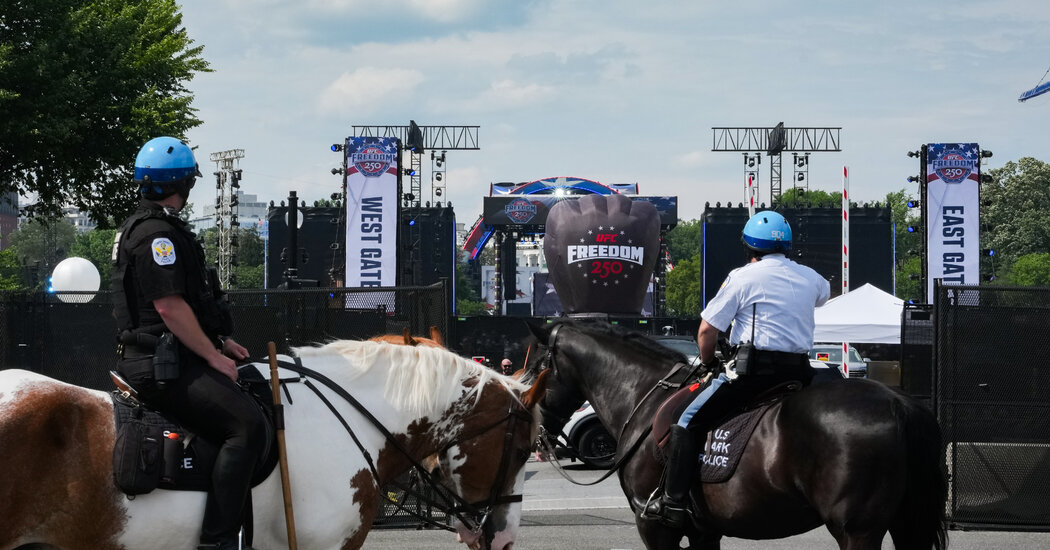
The decision by President Donald J. Trump to transform the pristine, manicured lawns of the White House into a high-octane battleground for Ultimate Fighting Championship bouts on Sunday Marks one of the most unconventional spectacles in modern political history. Named “UFC Freedom 250,” the event places the president squarely at the epicenter of a raw, fast-paced sport that has captured the loyalty of millions of young men—a crucial demographic that heavily powered his 2024 electoral victory but has recently shown signs of drifting away. With the critical midterm elections looming less than five months away, the Republican Party is searching for creative ways to navigate severe political headwinds, stemming from an unpopular military standoff with Iran, persistently high gas prices, and slipping approval ratings for the administration. For GOP strategist Brad Todd and other conservative organizers, the cage-fighting weekend is not merely a sensational distraction but a highly calculated maneuver to reconnect with a disaffected, hard-to-reach class of low-propensity voters who typically tune out policy debates but show immense passion for mixed martial arts. On the other side of the aisle, Democrats have fiercely condemned the event, labeling it a vulgar, tone-deaf display that trivializes the everyday financial hardships of working families who are struggling to keep up with inflation under the shadow of economic anxiety.
To appreciate the political calculatedness of UFC Freedom 250, one must first look at the psychological landscape of the contemporary young American male. Between the 2020 and 2024 presidential campaigns, Donald Trump made historic demographic gains with young men by bypassing traditional mainstream media in favor of a highly coordinated journey through the digital “manosphere.” This alternative cultural universe, dominated by prominent internet personalities, podcasters, and streamers, has built massive, remarkably loyal audiences around topics that are not overtly political but are steeped in themes of self-improvement, physical resilience, and cultural skepticism. Trump’s high-profile appearances on massive platforms like “The Joe Rogan Experience” and Logan Paul’s popular YouTube channel bypasses traditional rhetorical filters, allowing him to speak directly to young men as a relatable authority figure. Coupled with high-profile endorsements from pop-culture icons like legendary pro wrestler Hulk Hogan and UFC president Dana White—both of whom famously energized the crowds at the 2024 Republican National Convention—Trump has successfully fused his political movement with the cultural identity of contemporary masculinity. However, recent polling from the New York Times and Siena College reveals that this fragile coalition is fraying, with Trump’s approval rating among young men suffering a double-digit decline over the last few months, prompting a desperate scramble to use the visceral appeal of the octagon to arrest this downward slide.
This blending of executive office dignity with cage fighting has triggered intense condemnation from Democratic leaders, who view the event as an insulting abdication of presidential responsibility. Prominent critics, led by California Senator Adam Schiff, have leveraged the spectacle to argue that the administration is entirely disconnected from the reality of American household economics. In a widely read post on X, Schiff sharply criticized the president for orchestrating a premium athletic spectacle on the taxpayer-funded grounds of the executive mansion while millions of citizens are desperately fighting to pay their monthly rent, utilities, and grocery bills. This sentiment of disapproval is not confined solely to opposition lawmakers; a recent Reuters/Ipsos poll revealed a deep national skepticism toward the event, with only sixteen percent of all Americans—and a modest one-third of registered Republicans—deeming it “appropriate” for a sitting president to hold professional cage fights on the historic South Lawn. This stark divide highlights a fundamental clash of philosophies on modern leadership: one that values traditional institutional decorum and policy-first governance, and another that believes populist political survival relies on high-energy, made-for-TV spectacles that break through the noise of a saturated, deeply polarized media environment.
Despite the severe partisan backlash, the undeniable reality is that the Ultimate Fighting Championship enjoys a massive, deeply loyal, and surprisingly diverse following across the United States. According to comprehensive data gathered by the research firm Echelon Insights, two out of every five American men actively follow or watch mixed martial arts, illustrating its status as a premier pillar of modern American sports culture. Far from being a monolithic collection of hard-right, MAGA-supporting partisans, the fan base actually cuts directly across party lines, with seventeen percent of Republicans and an incredibly close fifteen percent of Democrats identifying themselves as passionate followers of the sport. Progressive strategists like Billy Begala, the executive director of the Speaking with American Men Project, warn that while it is incredibly easy for liberals to dismiss Trump’s White House fight as cheap and inappropriate, the Democratic Party cannot afford to cede the massive cultural arena of American sports fandom to the conservative movement. These millions of working-class men are not ideological zealots; they are regular, everyday citizens looking for localized community, physical triumph, and an exciting escape from the grueling monotony of daily life, and any political faction that approaches their favorite pastime with open condescension risks permanently alienating them at the ballot box.
Beyond the temporary electoral calculations, the staging of a UFC event at the historic White House represents the culmination of a deeply personal, decades-long friendship between Donald Trump and Dana White, the CEO of the promotion. Long before mixed martial arts achieved its current status as a multibillion-dollar global sport, it was widely banned, heavily stigmatized, and locked out of major athletic venues across the country. In the early 2000s, when almost no major arena would host the controversial organization, Trump stepped forward, hosting key UFC cards at his Taj Mahal casino in Atlantic City, a critical act of validation that helped save the struggling company from financial ruin. This early gesture forged a fierce, unbreakable bond of personal loyalty between White and Trump that has endured through business bankruptcies and presidential campaigns alike, leading to Trump’s personal investment in the UFC’s parent company. When asked directly by a Time magazine reporter why he decided to bring a cage-fighting event to the White House as part of the country’s 250th anniversary celebrations, Trump bypassed standard political talking points, simply saying, “Well, number one, I like it.” This raw, unfiltered explanation captures the core of Trump’s populist appeal; it projects a sense of uncalculating, self-directed authenticity that stands in sharp, refreshing contrast to the highly coached, focus-grouped nature of modern political behavior.
As the nation watches the historic South Lawn undergo this dramatic transformation, political strategists on both sides of the aisle are closely studying the event as a blueprint for the future of voter engagement. Democratic public relations consultant Michael Ceraso, who has worked closely with professional sports and entertainment figures, argues that instead of continuing to overthink and over-analyze their messaging, progressives should learn from Trump’s unapologetic cultural authenticity. Ceraso suggests that candidates on the left need to stop trying to force-feed voters polished policy sheets and instead embrace the popular cultures, sports, and hobbies that they are genuinely passionate about, finding a organic way to build human connection through shared entertainment. Politics in the digital age has evolved far beyond dry legislative debates and traditional television ads; it is now a battle fought in the arenas of cultural relevance, shared identity, and emotional resonance. Whether one views UFC Freedom 250 as a brilliant act of populist outreach or a deeply inappropriate distraction from serious national issues, the event symbolizes the arrival of a new, highly competitive era where the path to raw political power runs directly through the noisy, passionate world of popular entertainment.