





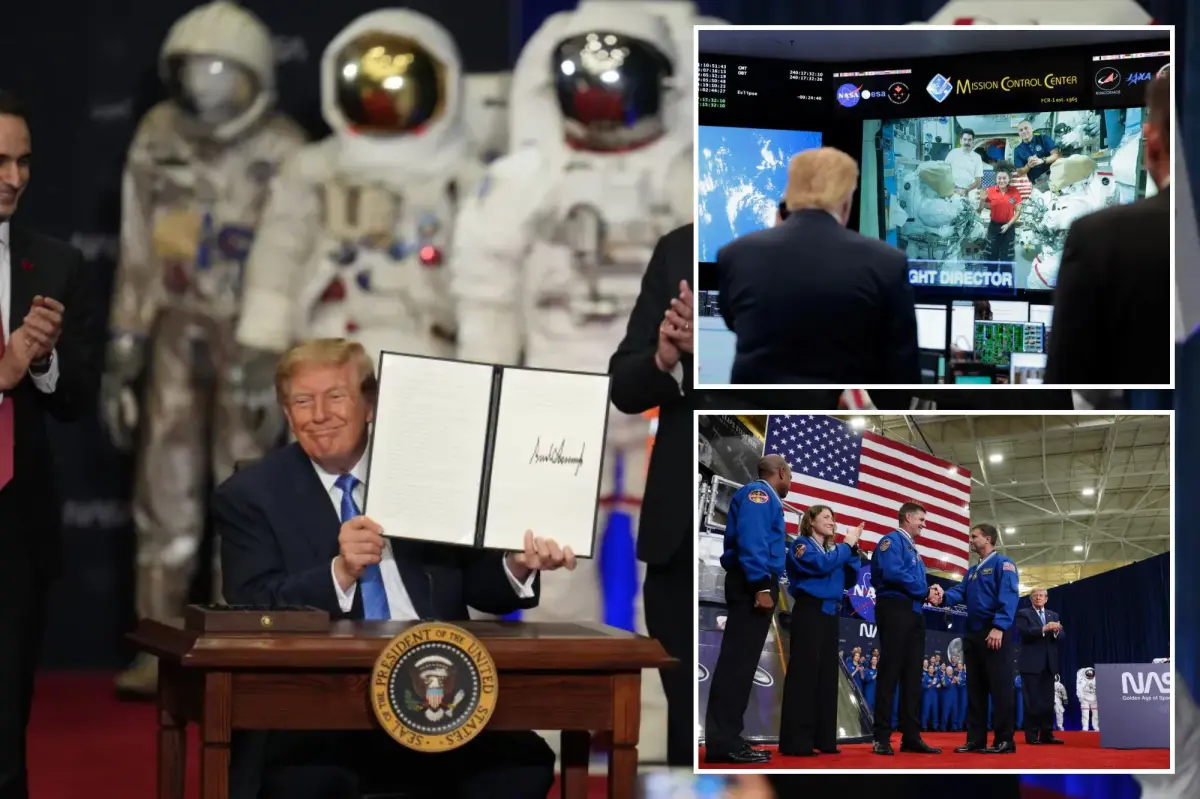
WASHINGTON — There was a rare and unguarded atmosphere at NASA’s Johnson Space Center on Friday, the kind of morning when astronauts, engineers, and policy staffers all seemed to be holding their breath as the future of American spaceflight came into sharper focus. President Trump arrived in Houston with a dual purpose: to offer the nation’s highest form of gratitude to the astronauts who had just circled the Moon and to lay claim to a new frontier in education by announcing the formation of a military Space Academy. In a bright room filled with flight jackets, models of rockets, and the quiet pride of people who make the impossible look routine, Trump described the academy as a “top line” institution. He promised a “beautiful” campus, standards that would make even the most selective universities seem easy by comparison, and a clearly defined role: train the next generation of leaders for the United States Space Force, NASA, and the commercial space industry that has transformed the old dream of orbits and landings into a busy marketplace of launches and payloads. “We’re going to have an academy for what the people in this room love the most,” he told the audience. “That’s exciting. That’s really exciting, and I’m going to be choosing a location very shortly.” The words felt less like a formal plan and more like a promise to the dreamers in the room—an acknowledgment that the next great leap should begin in a classroom. When Trump mentioned that the academy would serve both civilians and the military, he was drawing a straight line from the nation’s first test pilots to the engineers who will one day build habitats on lunar soil and, eventually, press human footprints into Martian dust. For the men and women who spend their lives working in spacecraft simulators and clean rooms, the announcement was a welcome sign that Washington understood something essential: the future belongs to those who educate, inspire, and prepare.
Trump’s comparison of the new academy to West Point, Annapolis, the Air Force Academy, and the Coast Guard Academy was deliberate and revealing. He clearly wanted the Space Academy to belong to that exclusive family of institutions where excellence is not a hope but a baseline. “You think of West Point, and you think of Annapolis, and you think of the Air Force Academy and you think of the Coast Guard Academy. It’s great. They’re all great, but we’re going to have now a Space Force academy,” he said. He went further, arguing that the service academies are harder to get into than Ivy League universities. That is a debatable claim, but it was not hard to understand what he meant: the new academy had to be selective, demanding, and prestigious enough to sit beside the schools that have produced generals, admirals, and astronauts for generations. The president did not say where the campus would be located, but the guessing game has already begun. Lawmakers from Texas, Florida, Alabama, Colorado, and California will almost certainly compete for the honor, and the eventual choice will shape local economies and political reputations for decades. More important, the mission itself is unusual. The academy is meant to train not only Guardians of the Space Force but also NASA scientists and flight controllers, as well as the engineers and private sector pilots who will power the commercial space boom. Trump tied all of this to his broader ambitions for cosmic exploration: a permanent base on the Moon, and then a journey to Mars. The academy, in his telling, would be the doorway to those destinations. “I said, ‘I’ll do it, but it’s got to be top line,’” he recalled, suggesting that he had personally insisted on nothing less than a world-class institution. “It’s got to be the equivalent of the others, which are great. You know, they’re among the hardest schools to get into. You know, you talk about the Ivy League schools. It’s tougher to get into West Point, Annapolis, the Air Force Academy—Coast Guard too.” Whether or not the academy becomes a reality exactly as described, the idea gives formal shape to a new era in which space is no longer a destination for a single agency but a domain that requires its own culture, its own training, and its own version of honor.
Before the president could spend too much time on abstract visions, the room was pulled back to a human moment: the presentation of the Congressional Space Medal of Honor to the four-member crew of Artemis II. This was the crew that, according to the account at the event, traveled around the Moon in April and set a new record for the farthest distance any crewed spaceflight has ever traveled from Earth. The astronauts stood with the squared shoulders of people who have seen the planet from a quarter-million miles away. Trump presented the medals one by one, and the applause was long and loud. For an institution like NASA, these ceremonies are both celebrations and reminders of the risk that has defined the agency’s history. The Artemis II mission was not merely a loop around the Moon; it was a proving ground for the capsules, life-support systems, and human endurance that will be needed for longer voyages. The crew’s safe return had already electrified the country, and their presence at the Johnson Space Center allowed the audience to feel, if only for a moment, the strange humility that comes from meeting people who have looked back at Earth and seen no borders, no conflicts, only a fragile blue sphere suspended in blackness. Trump soaked in the applause and then told an unexpected story. He said that a political summit he had hosted at his Charlottesville, Virginia, winery had been “a disaster” only because the Artemis crew’s return had hijacked everyone’s attention. A television set was wheeled into the room, and the guests became so fixated on the astronauts’ recovery that no one wanted to talk to him. “Nobody did anything, so it was a total waste of time,” he joked, with a grin. The self-deprecating dig was a reminder that, in a world full of debate and division, the image of humans returning from the Moon can still stop a room cold.
The Charlottesville aside was classic Trump: a digression that was part joke, part bravado, and part real observation about the power of spaceflight to interrupt even the most carefully planned political gathering. It also humanized the moment in a way that a formal speech never could. Here was a president, standing in front of some of the most accomplished people in the world, admitting that a group of guests had ignored him to watch a capsule splashing down in the ocean. He did not seem bothered by it. If anything, he seemed pleased, as if the astronauts’ success was a reflection of something larger than any one administration or policy agenda. The audience laughed, and the laughter created a bridge between the gravity of the occasion and the lightness of everyday human behavior. The story also contained a deeper truth. Despite all the debates over budgets, rockets, and bureaucratic priorities, the sight of human beings returning safely from the Moon remains one of the few experiences that can genuinely unite people. It is not a partisan fact. It is simply a human one. The winery story, with its image of guests gathered around a television in Virginia, mirrored what millions of people around the world were doing that day: stopping their routines to watch four travelers emerge from the sea and rejoin the human family. In that sense, the president’s joke was not really a joke at all. It was a recognition that the space program exists not just in mission control boxes and legislative hearings, but in the shared excitement of people who look up at the night sky and wonder what it would be like to go there. And by making himself the butt of the story, Trump reminded everyone in the room that even presidents can be starstruck, even the most powerful person in the country can be rendered irrelevant by the sight of a capsule falling through Earth’s atmosphere.
Then came the call that may have been the most memorable segment of the whole visit. Trump, seated on a stage, placed a call to the International Space Station and spoke with the American astronauts aboard the orbital laboratory. The current station crew included three Americans, three Russians, and one Japanese astronaut—a living symbol of the international cooperation that has kept a continuous human presence in orbit for more than two decades. The connection was crisp, and the conversation had an unmistakably warm, playful undercurrent. Trump told an astronaut named Jack Hathaway that he wanted a mustache like the one Hathaway was wearing. “I want to get a mustache like that,” the president said. Hathaway, a Naval Academy graduate, did not miss a beat. “Absolutely, sir. I appreciate it. Yeah, the mustache is a lot of fun. You definitely have to have one in space. It’s, it’s great in microgravity,” Hathaway replied. The image of a mustache floating in zero gravity became an instant piece of space-age whimsy, a tiny reminder that even in the most serious endeavor humanity pursues, there is room for personality and laughter. Hathaway then praised Trump’s proposal for the Space Academy, saying that America’s leadership in the space program is incredible. The call also had a more solemn layer. Jessica Meir, the commander of the station, described how the team in orbit had spoken “crew to crew” with the Artemis II astronauts during their lunar mission. “It made us all incredibly connected and incredibly proud for what we have accomplished as a country and as an international program,” she said. Her words carried the authority of someone who has lived in space and understands that no single nationality owns the night sky. For a few minutes, the conversation embodied the best version of public life: a commander in chief wanting a ridiculous mustache, an astronaut laughing in microgravity, and a commander expressing pride in shared accomplishment. It is often said that space makes politics look small, and here, in a single call, that truth was on full display.
Taken together, the visit was a portrait of American space exploration at a crossroads. On one hand, there are grand proposals: an academy to develop talent, a permanent Moon base, and the still-distant goal of Mars. On the other hand, there are the intimate, unscripted moments—a joke about a mustache, a story about guests ignoring a president to watch a splashdown, and the quiet pride in a commander’s voice as she talked about the connection between orbiting crews. These are the human threads that make space policy feel urgent, not just as a matter of technology but as a matter of identity. The Space Academy may take years to plan, fund, and open. The location may be debated. The curriculum may be designed and redesigned. But the promise made in Houston was rooted in something older than any school: the belief that people need a place to learn the skills that will carry them beyond the surface of their own world. It is easy to become lost in acronyms and budget cycles, but moments like the ones on Friday bring the enterprise back to scale. A young engineer watching the ceremony might have thought about applying to the academy. A child seeing Hathaway’s mustache float might have imagined herself floating beside him. The astronauts of Artemis II returned with medals, but their bigger gift was the reminder that the future is not inevitable—it is built by people who are educated, encouraged, and allowed to dream. If the Space Academy becomes only a fraction of what Trump described, it will still stand as a symbol of a nation that decided to prepare its children for a frontier instead of merely admiring it from a distance. And if it succeeds, the first classes may well produce the men and women who build the lunar base, fly to Mars, and, perhaps, share a joke with a president from a quarter-million miles away. That is the human story beneath the headlines, and on Friday in Houston, it was impossible to ignore.