



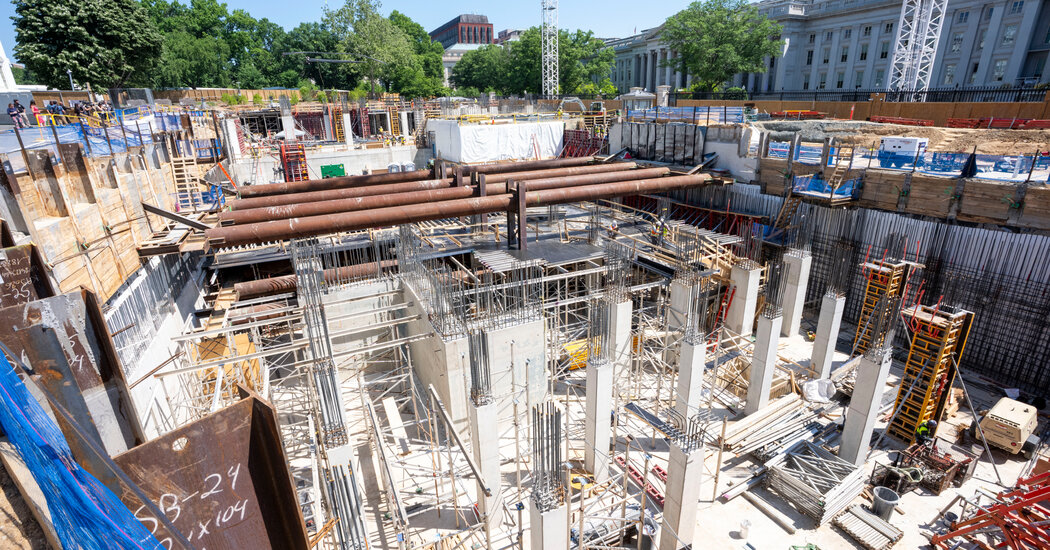
The physical landscape of the American presidency is undergoing a dramatic, high-stakes transformation, marked by a quiet yet monumental shifting of hundreds of millions of dollars away from traditional law enforcement operations and directly into the fortified dirt of the White House grounds. Recently, the Trump administration engineered a massive logistical and financial maneuver, transferring approximately $350 million from the Secret Service’s operational reserves directly into a sweeping series of security and architectural upgrades at the executive mansion. According to official records from the Office of Management and Budget, this substantial sum was divided into two distinct, highly strategic transfers: a massive injection of $340.8 million alongside a secondary allocation of $10.75 million. This quiet reallocation of public resources, which first came to light through investigative reporting by The Washington Post, highlights a profound shift in how the nation’s most famous home is being reimagined. At the heart of this physical overhaul is an ambitious, dual-purpose construction project that seeks to merge the soaring extravagance of high-society entertainment with the cold, steel-reinforced realities of modern military survival. President Trump has set his sights on constructing a sprawling, luxury ballroom designed to host foreign dignitaries and glittering state dinners, but the building’s dazzling facade is only half the story. Beneath the polished floors of this new pavilion lies a highly classified, state-of-the-art military command bunker, designed to keep the commander-in-chief safe from the most catastrophic threats of a volatile world. By dismantling the historic East Wing to pave the way for this massive architectural undertaking, the administration has permanently altered the landscape of the White House, generating an intense national debate over where the boundaries of presidential luxury end and the absolute necessities of national survival begin.
This construction has ignited a fierce political storm surrounding the ethical and financial responsibilities of the modern presidency, exposing a complex web of funding that blurs the lines between private philanthropy and public obligation. From the project’s inception, President Trump sought to disarm critics and appease weary taxpayers by repeatedly insisting that this grand ballroom would not cost the American public a single dime, promising instead that the entire structure would be financed exclusively through private donations. On its surface, the official White House narrative maintains this separation; Rachel Cauley, the communications director for the White House Office of Management and Budget, steadfastly asserted that approximately $400 million in private donations would cover the direct construction expenses of the ballroom itself. Yet, as the massive Secret Service fund transfers reveal, the reality of building in the shadow of the presidency is infinitely more intertwined and costly than a simple donation drive. The Secret Service has openly acknowledged that taxpayer money is being heavily utilized to finance what they categorize as “security enhancements” for both the ballroom and the subterranean bunker. This bureaucratic distinction means that while private funds might assemble the walls and lay the carpets of the luxury hall, the public treasury is bearing the immense burden of transforming that space into a bomb-proof, secure bubble. This complex financial arrangement highlights the difficult, often uncomfortable compromise of modern governance, where the desire for classical, light-filled spaces designed for diplomacy must be retrofitted at astronomical public expense to withstand the dark, violent capabilities of modern warfare.
To truly understand the psychological and historical weight of this massive undertaking, one must look below the surface, down into the subterranean dark where the new military bunker is being fused with American history. The original shelter buried beneath the East Wing was forged during the terrifying, uncertain days of World War II, built as a desperate sanctuary to shield President Franklin D. Roosevelt and his inner circle from the threat of enemy airstrikes. Over the decades, this underground redoubt has stood as a quiet, somber testament to the sudden crises that can instantly paralyze a superpower; it was here that a visually shaken Vice President Dick Cheney and high-ranking national security staff were frantically rushed during the terrifying chaos of the September 11 terrorist attacks. History repeated itself in a more modern, domestic key in the summer of 2020, when Secret Service agents abruptly hurried President Trump deep into the same underground complex as fiery, tense protests over the tragic death of George Floyd erupted just outside the heavy iron gates of Lafayette Square. Now, the old and the new are being welded together under a single, highly deliberate bureaucratic title: the “East Wing Modernization Project.” By grouping the luxury social hall and the emergency military shelter under this collective banner, the administration is making a powerful statement about the nature of modern leadership. As White House spokesman Davis Ingle explained, this massive, multi-million-dollar endeavor is not a luxury vanity project, but rather an effort that is inextricably tied to the fundamental safety of the president, the preservation of the White House grounds, and the long-term integrity of the nation’s most vital security infrastructure assets.
The urgency and high-stakes nature of this modernization project are not merely theoretical concepts debated in secure briefing rooms; they are driven by real, terrifying security crises that have played out in real-time. According to administration officials and federal court documents, the need for a highly fortified, large-scale gathering space was recently driven home by a chilling, narrowly avoided disaster right on the mansion’s doorstep. Federal law enforcement agencies recently thwarted a highly coordinated, direct threat against the historic “U.F.C. Freedom 250” event, which was scheduled to be hosted on the White House grounds. Spokesman Davis Ingle pointed directly to the charges brought against a group of conspirators accused of plotting a violent disruption of this high-profile Ultimate Fighting Championship event as absolute, undeniable proof of why this massive security overhaul is desperately required. In the tense legal battles surrounding the construction, the Secret Service has repeatedly taken the extraordinary step of filing court documents warning that any temporary halt or delay in the collective project could actively put human lives in imminent danger. These grim warnings reveal the heavy, often unseen burden carried by the men and women tasked with shielding the presidency. For the security teams watching the perimeter, an unfortified construction site is not just an aesthetic eyesore or a political talking point, but a gaping vulnerability in an increasingly hostile security landscape where public celebrations can instantly transform into high-risk optical targets for domestic and international adversaries alike.
The sheer scale of the engineering required to safeguard this new space is reflected in the eye-watering financial figures and cutting-edge military technology poured into the project. Initially, the Trump administration had approached Congress with a staggering request for $1 billion in taxpayer funds to cover the vast array of planned White House security enhancements, a sweeping request that was ultimately dropped from a final federal funding bill amid intense partisan scrutiny. Undeterred, the administration turned to internal agency transfers to quietly realize their vision of a hardened, impenetrable executive compound. The Secret Service has detailed plans to direct $220 million of taxpayer money specifically toward “hardening” the partially constructed luxury ballroom against a devastating spectrum of modern attacks. This astronomical sum will be used to install heavy sheets of state-of-the-art bulletproof glass, advanced drone detection and mitigation technologies, and highly sophisticated air filtration systems capable of detecting and neutralizing chemical, biological, and radiological threats. Additionally, an entirely separate $180 million of public funds will be spent to construct a massive, highly secure visitor screening facility designed to process the steady stream of guests arriving at the complex. This transformation represents a fascinating, paradoxical effort by master architects and military engineers to take a space meant for human warmth, artistic expression, and diplomatic celebration, and quietly convert it into a hermetically sealed, blast-protected fortress capable of surviving a sustained military assault.
As the physical structure begins to rise from the dust of the dismantled East Wing, President Trump has taken to his social media platforms to enthusiastically champion the project, framing it as a supreme triumph of American execution and strategic foresight. In a characteristically bold, early-morning dispatch, the president declared that the grand ballroom was coming along “fantastically well,” proudly boasting to his followers that the entire massive complex was progressing both “on time and under budget.” Rather than downplaying the heavily militarized nature of the construction, Trump leaned directly into it, revealing that the finished project would feature a specialized port designed for military drones, alongside an array of other highly sophisticated military elements that he insisted are absolutely vital to the long-term national security of the United States. Ultimately, this sprawling project leaves behind a complex, highly provocative legacy that will be debated for decades to come. To his supporters, the modernized East Wing represents a visionary, pragmatic, and highly necessary fortification of the presidency, ensuring that the commander-in-chief can host the world’s most powerful leaders in breathtaking style while remaining fully protected by the absolute pinnacle of defensive military technology. To his critics, however, the image of a luxury ballroom sitting directly atop a reinforced military bunker, funded through a complex mixture of private donations and diverted Secret Service cash, serves as a striking, deeply symbolic monument to executive power in the twenty-first century—a place where the sparkling theater of global diplomacy is permanently, physically welded to the dark, survivalist anxieties of a deeply divided nation.