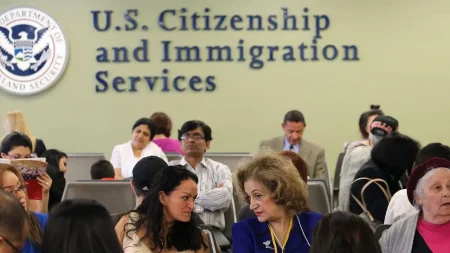



In an announcement that reverberated through the quiet security corridors of Washington, the President formally nominated Lance Schroyer to take the helm of one of the nation’s most visible and scrutinized federal agencies. For years, Schroyer has operated largely behind the scenes, a quiet force within the sprawling apparatus of national security, most recently serving as a trusted senior adviser to the Department of Homeland Security Secretary, Markwayne Mullin. The transition from the shadow of advisory work to the blinding spotlight of a presidential nomination is a profound shift for any public servant, carrying with it a sudden and intense level of scrutiny. In making the announcement, the President emphasized not just Schroyer’s deeply analytical mind and extensive operational resume, but his rare ability to humanize the cold, bureaucratic machinery of federal governance. Those who have worked alongside Schroyer describe him as a leader who regularly walks the halls to speak with staff of all ranks, recognizing that the grandest national security policies are only as effective as the men and women tasked with executing them on the ground. By putting Schroyer’s name forward, the administration is signaling a desire for a leadership style that favors steady, pragmatic problem-solving over ideological grandstanding, setting the stage for a new chapter at an agency that directly impacts the daily lives, safety, and civil liberties of millions of Americans.
To understand the trajectory of Lance Schroyer is to look beyond the dry lines of a standard curriculum vitae and examine a lifetime spent translating complex geopolitical threats into actionable, humane policies. Throughout his career, which spans decades of quiet service in both the domestic and international security arena, Schroyer has consistently resisted the temptation of political partisanship, choosing instead to focus on the intricate, often tedious logistics of keeping a nation safe. Colleagues paint a portrait of a man who is often the first to arrive at the office and the last to leave, a leader who fuels himself on lukewarm coffee and an unwavering belief in the integrity of public service. Unlike many in the upper echelons of federal power who seek out the cameras, Schroyer has historically thrived in the background, drafting critical policy frameworks, resolving communication bottlenecks between agencies, and ensuring that the human element of security is never lost in translation. He is known for asking his teams a fundamental question whenever a new regulation is proposed: “How will this affect a family trying to get home, an officer on a cold border, or a small business owner trying to survive?” It is this persistent empathy, paired with an uncompromising standard of operational excellence, that has earned him the respect of career civil servants and political appointees alike across the political spectrum.
This nominated leap into agency leadership is deeply informed by Schroyer’s close collaborative relationship with DHS Secretary Markwayne Mullin, a partnership that has redefined how the department approaches contemporary security challenges. Secretary Mullin, known for his direct, no-nonsense approach to governance and his deep roots in working-class advocacy, found a perfect intellectual and operational foil in Schroyer’s methodical, detail-oriented strategic planning. Together, they have navigated a series of complex modern crises, from cyber threats targeting critical infrastructure to the delicate logistical balances required at the nation’s borders and transit hubs. Working as Mullin’s close adviser, Schroyer was not merely a passive observer of high-stakes decision-making; he was the architect of policies that required balancing robust defense mechanisms with the preservation of citizen dignity and constitutional rights. This partnership taught Schroyer how to survive and thrive in the highly politicized atmosphere of cabinet-level politics without losing his core principles, providing him with a masterclass in how to lead an agency where every single decision is analyzed under a microscope by the public, the media, and Congress.
The high-profile agency that Schroyer has been tapped to lead stands as one of the most critical, yet frequently criticized, pillars of the American security state, charged with guarding the nation’s gates while maintaining the flow of commerce and daily life. It is an institution where the margin for error is non-existent, and where success is invisible while failure is instantly catastrophic and broadcast worldwide. The men and women who make up this agency operate on the frontlines of airports, ports of entry, and digital networks, often working under high stress, low public appreciation, and constant institutional pressure. Schroyer’s immediate challenge, should he be confirmed, will be to revitalize morale within a workforce that has felt the strain of years of political polarization and shifting policy mandates. Beyond the internal cultural challenges, he will face the monumental task of modernizing physical and digital infrastructure to combat sophisticated global threats, all while ensuring the agency remains transparent, accountable, and deeply respectful of the communities it is sworn to protect and serve.
As the nomination moves toward the United States Senate, Schroyer is preparing to step into the political gauntlet of the confirmation process, a rite of passage that tests the mettle, patience, and resolve of any public nominee. In an era defined by deep partisan divisions, the hearings will undoubtedly feature sharp questioning from lawmakers eager to use the platform to highlight broader ideological battles over national security, immigration, and civil liberties. Yet, those close to Schroyer believe his reputation for unimpeachable integrity, transparent communication, and deep institutional knowledge will serve as a shield against purely partisan attacks. He intends to approach the confirmation not as a political contest to be won, but as an opportunity to build a constructive, bipartisan dialogue about the future of national security. By engaging senators with honesty about the agency’s shortcomings and a clear, pragmatic vision for its improvement, Schroyer hopes to demonstrate that safeguarding the country is a shared human endeavor that transcends political parties.
Ultimately, the story of Lance Schroyer’s nomination is a reminder that behind the massive, faceless institutions of government are real people striving to make a meaningful difference in the lives of their fellow citizens. If confirmed, Schroyer will inherit an immense burden of responsibility, but he will also carry the hopes of thousands of agency employees looking for stable, empathetic leadership and a public yearning for competence and clarity in government. His leadership will be measured not by the complexity of the bureaucratic directives he signs, but by the safety, dignity, and confidence felt by the millions of ordinary people who interact with his agency every day. As he steps forward to accept this challenge, transitioning from the quiet advisory corridors of DHS to the helm of a vital national institution, Schroyer represents a hopeful return to a form of public service that is deeply rooted in humility, operational excellence, and an enduring respect for the human spirit at the heart of the American democracy.