



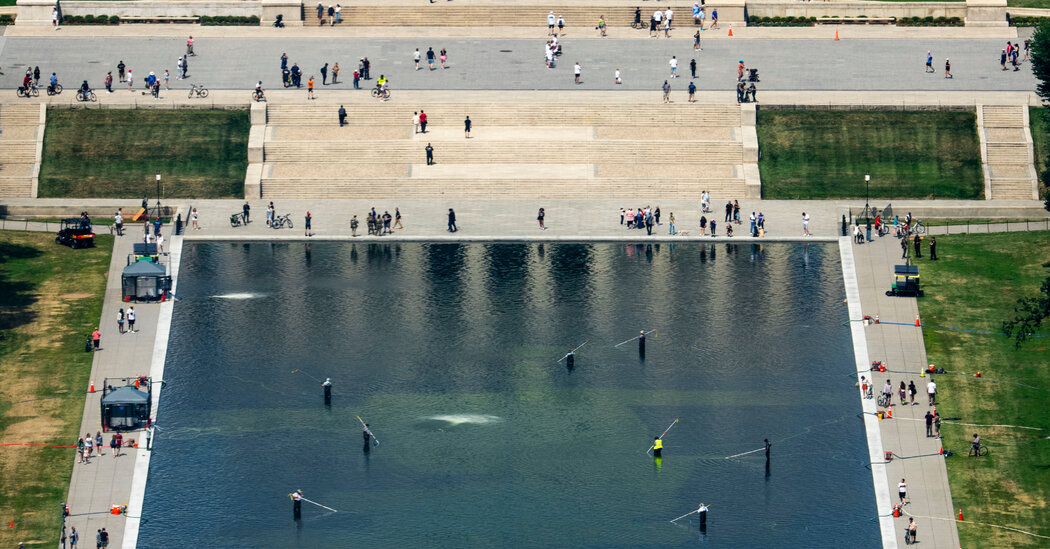
The National Mall in Washington, D.C., is a place designed for quiet reflection, where the imposing marble gaze of Abraham Lincoln looks out over a mirror-like expanse of water toward the sky-scraping monument to George Washington. But on a sweltering Monday, that iconic mirror of American democracy looked less like a national treasure and more like an abandoned, overgrown suburban swimming pool, choking under a thick, emerald-green blanket of algae and littered with floating, ghostly shreds of peeling blue polyurethane. For President Donald J. Trump, the physical decay of this landmark was not just an aesthetic headache; it was a political battlefield that demanded an immediate, preemptive offensive. Speaking to a scrum of reporters with his signature defiance, Trump made one thing abundantly clear: the sorry state of the $16.4 million restoration project was absolutely, unequivocally not his fault. He flatly rejected any suggestion that his administration’s rushed timeline—driven by a desire to showcase a sparkling pool for the upcoming Fourth of July celebrations—had compromised the integrity of the work. Instead, with a vivid dramatic flair, the President painted a picture of a sinister, coordinated effort to sabotage his administration’s achievements, transforming a routine infrastructure failure into a thrilling tale of late-night vandalism and political intrigue.
According to Trump’s narrative, the ambitious renovation had been proceeding flawlessly, a testament to American craftsmanship and administrative efficiency, until a shadowy band of criminals targeted the century-old, seven-acre pool. In his remarks, the President detailed a bizarre plot involving saboteurs armed with agricultural chemicals and sharp weapons, determined to ruin the festive summer landscape of the nation’s capital. “They put, somebody said, fertilizer in the water,” Trump asserted to the gathered press, explaining the sudden, aggressive bloom of green scum with the simplified science of a backyard gardener. He went on to address the unsightly, massive strips of polyurethane sealant that had detached from the concrete floor and were bobbing on the surface of the green water like discarded snake skins, attributing them not to poor adhesion or rushed curing times, but to physical assault. With visceral hand gestures, he claimed that someone had deliberately sliced the pool’s protective coating using “probably a box cutter or a knife of some kind,” expressing a sense of exasperated helplessness by declaring, “I can’t help it if somebody goes in with a knife and starts hacking it up.”
While the President sketched a highly dramatized picture of coordinated sabotage, the human reality on the ground was far more ordinary and, for at least one citizen, deeply distressing. Amidst tight-lipped reports from the Interior Department that five people had been arrested and five others cited for vandalism, the actual events resembled a comedy of errors rather than a national security breach. Enter David Carter Hearn, a 67-year-old cyclist and three-time Olympic canoeist, whose quiet afternoon ride ended in a shocking encounter with law enforcement. Spotting the strange, weeping state of the Reflecting Pool, Hearn had stopped out of pure civic curiosity to inspect the peeling blue paint and the thick algae that sat clumped along the edge of the water. When he reached down to touch the lifting sealant—an act of simple, human inquisitiveness—he was suddenly apprehended by officers, arrested, and charged with the destruction of government property. Insisting on his innocence, Hearn later described himself as a mere “curious, concerned citizen” who simply found himself “at the wrong place, wrong time,” highlighting the vast, absurd gulf between the administration’s narrative of malicious saboteurs and the reality of confused locals caught in a dragnet of defensive political optics.
To fully understand the defensiveness surrounding the Reflecting Pool, one must look back at its historically tempestuous relationship with the federal government and the deep-seated political rivalries that define modern Washington. The pool has been plagued by chronic leaks, stagnant water, and aggressive algae blooms for decades, representing a persistent, muddy thorn in the side of multiple administrations. For Trump, the messy situation provided a perfect opportunity to reignite his long-standing feud with his predecessor, former President Barack Obama. Trump lashed out at Obama for failing to permanently resolve the pool’s structural issues despite spending more than $35 million on a massive, two-year renovation project between 2010 and 2012. “Barack Hussein Obama, have you ever heard of him?” Trump snapped at reporters, emphasizing his predecessor’s full name to evoke partisan division. He pointed out that within a mere month of reopening under the Obama administration, the pool was once again matted with ugly green algae and continued to leak a staggering 16 million gallons of water annually—water that the debt-ridden National Park Service had to continuously pay to replace, revealing how the monument had become a money pit long before the current administration took office.
Driven by a desire to succeed where his predecessor had failed, and to do so in record time, President Trump had bypassed the traditional, legally mandated competitive bidding process to award two hasty, no-bid contracts totaling $16.4 million. The administration justified this circumvention of federal procurement rules by citing an “urgent need” to have the Reflecting Pool pristine and glowing in “American flag blue” by the July 4th holiday. A Virginia-based firm, Atlantic Industrial Coatings, was handed a $14.7 million contract to apply the special waterproofing polyurethane sealant, while an Ohio-based company, Greenwater Services, received $1.7 million to install a new, state-of-the-art water-treatment system. However, as independent engineering experts had quietly warned, rushing such a massive chemical application on a crumbling concrete structure without allowing proper time for the sealant to cure and bond was a recipe for disaster. Faced with public mockery as the blue coating began to peel away in sheets, Atlantic Industrial Coatings defended its reputation online, insisting that the damaged sections represented only “a very small part” of the massive, seven-acre project, while quietly preparing for the humiliating task of draining the pool once again to perform extensive, emergency repairs.
Ultimately, the saga of the Lincoln Memorial Reflecting Pool serves as a vivid, almost classical metaphor for the collision between political ambition and the stubborn, unyielding laws of nature. No amount of presidential bluster, finger-pointing, or accusations of knife-wielding vandals could alter the reality that water, chemicals, and concrete require time, precision, and care to successfully integrate. As the National Park Service prepared to drain the pool yet again, leaving a stark, dusty crater in the heart of the nation’s capital, the grand monuments surrounding it stood silent, as they have for generations. They seemed to remind the passing tourists and weary citizens that while political administrations come and go, bringing with them their urgent deadlines, hasty contracts, and fierce blame games, the physical world cannot be bypassed by decree. The peeling blue sealant and the persistent green algae remain as humble, humanizing reminders that even the most powerful leaders on earth must eventually bow to the slow, patient processes of time, science, and the elements.