






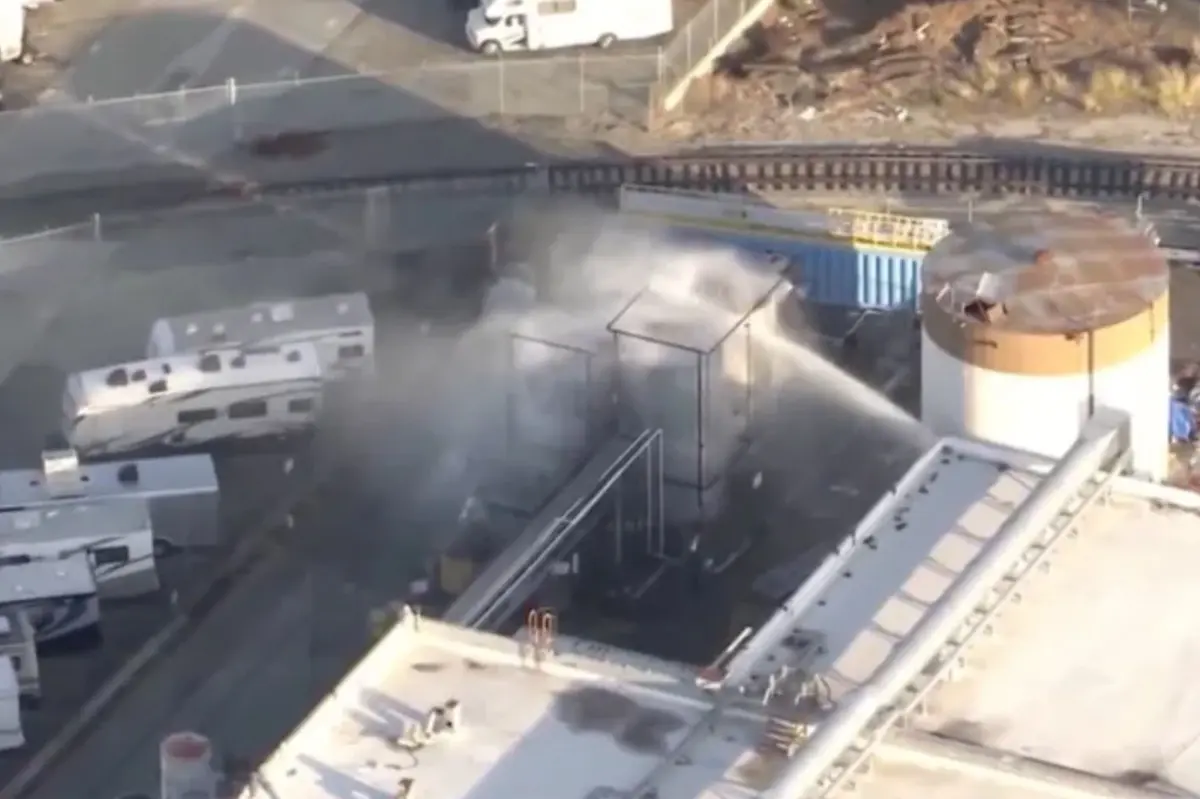
The sun-soaked suburban landscape of Garden Grove, California, usually hums with the familiar, comforting rhythms of quiet daily life—children playing in manicured yards, neighbors exchanging pleasantries over residential fences, and commuters navigating the bustling streets of Orange County. However, this peaceful afternoon routine was shattered on a warm Thursday when an invisible and dangerous threat began to seep into the local atmosphere from an aerospace facility located on the 12100 block of Western Avenue. What initially began as a faint, unusual odor rapidly escalated into a full-scale environmental and public safety crisis when emergency officials identified a major vapor leak originating from a massive, 34,000-gallon chemical storage tank. The Orange County Fire Authority was quickly dispatched to the scene as the sheer scale of the potential disaster became clear, transforming a quiet weekday afternoon into a high-stakes emergency zone. Residents, suddenly finding their neighborhood swarmed by emergency vehicles with flashing red and blue lights, were ordered to immediately evacuate their homes as a toxic cloud of chemical vapor threatened to drift over their properties. The suddenness of the evacuation order left many in a state of sheer disbelief and panic, forced to hastily grab beloved pets, essential medications, and irreplaceable family mementos before fleeing into the unknown. The community was left to watch from behind police blockades, staring anxiously at the imposing industrial complex that had, in an instant, transformed from a quiet neighbor into an active chemical hazard. The terrifying realization that a massive quantity of dangerous chemicals was stored just a stone’s throw from their dining room tables cast a long, dark shadow over the neighborhood, instantly turning what should have been a relaxing evening at home into a stressful, disorienting trial of displacement and fear.
At the heart of this frightening incident was methyl methacrylate, a volatile and highly reactive industrial chemical that serves as a cornerstone in the manufacturing of plastics, acrylic resins, and advanced aerospace components. While this compound is invaluable to modern engineering and the production of durable materials that support the aerospace industry, its raw form is incredibly dangerous, particularly when allowed to escape into the open air as a concentrated, traveling vapor cloud. When inhaled, methyl methacrylate can cause immediate, painful physical reactions, ranging from severe irritation of the eyes, nose, and throat to dizziness, headaches, and acute respiratory distress. For the families living downwind of the facility on Western Avenue, the realization that a 34,000-gallon tank—a volume comparable to a large backyard swimming pool—was actively releasing this toxic vapor into the sky was a source of profound physical and emotional terror. The human body is ill-equipped to handle such chemical onslaughts, and the mental anguish of wondering whether a simple breath of fresh air could cause long-term pulmonary damage is a unique form of torment. To make matters worse, the chemical possesses a sharp, sweetish, but deeply unpleasant odor that serves as a constant, sensory reminder of the invisible hazard permeating the air. This chemical reality humanizes the sterile statistics of industrial mishaps, reminding us that behind every hazardous material placard is a community of flesh-and-blood human beings whose health, safety, and peace of mind are suddenly placed at the mercy of mechanical failures and chemical volatility. As the vapor cloud expanded, the invisible threat forced a confrontation between the clinical utility of modern manufacturing chemicals and the fragile, biological vulnerability of the suburban community residing right outside the factory gates, highlighting the constant, quiet risks inherent in our high-tech industrial economy.
Faced with this potentially catastrophic chemical release, the brave men and women of the Orange County Fire Authority and specialized hazardous materials (Hazmat) teams rushed directly into the danger zone, serving as a human shield between the community and the toxic vapor. Clad in heavy, fully encapsulated, brightly colored chemical protective suits that resembled astronaut gear, these first responders had to systematically assess the integrity of the monstrous 34,000-gallon tank under incredibly tense and physically demanding conditions. Operating in the stifling heat of their protective gear, technicians utilized advanced monitoring equipment to measure the toxicity of the air, mapping out the microscopic boundaries of the hazard to guide evacuation perimeters. The tactical chess match of neutralizing a methyl methacrylate leak is fraught with peril; responders must carefully manage temperature, pressure, and containment protocols to prevent the chemical from reacting violently or igniting, all while the wind threatens to shift and carry the toxic plume deeper into nearby neighborhoods. Throughout Thursday afternoon and into the long, anxious hours of the night, emergency crews worked tirelessly to control the vapor release, their efforts punctuated by the hum of heavy equipment and the constant crackle of radio dispatchers. This exhausting vigil stretched into Friday when, despite the best efforts of the hazardous materials teams, changing atmospheric conditions and persistent pressure anomalies within the massive storage container forced a disappointing reassessment of the situation, showing that the battle to fully secure the site was far from over. Their mission was not merely a mechanical exercise in sealing a leak, but a vital humanitarian effort to preserve the safety of thousands of anxious citizens waiting for news, recalling the immense personal sacrifices made by local emergency personnel who step into toxic plumes so that families can return to clean, secure homes.
The physical toll on the emergency responders was mirrored by the deep psychological and emotional exhaustion experienced by the evacuated residents, whose lives were thrown into a state of tumultuous limbo. After the initial panic of Thursday’s sudden evacuation, many families spent a sleepless night in temporary local shelters, cramped motel rooms, or parked cars, anxiously awaiting the reassuring word that the air was clear and it was safe to return. Instead of relief, Friday morning delivered a gut-wrenching setback when authorities, citing lingering dangers and a resurgence of toxic vapor emissions, reissued the evacuation orders, forcing residents out of the area for a second consecutive day. This double blow of displacement shattered any fragile sense of security the community had managed to rebuild overnight, replacing it with a mixture of frustration, fatigue, and profound vulnerability. Mothers and fathers had to comfort frightened children who did not understand why they could not go home to retrieve their favorite toys, while elderly residents struggled with the disruption of their medical routines and daily comforts in unfamiliar environments. Pet owners faced the heart-wrenching challenge of keeping anxious animals calm in tightly packed vehicles, while local business owners on Western Avenue watched their livelihoods grind to a halt under police tape. Throughout the ordeal, neighbors who had previously only exchanged polite nods became lifeline support systems for one another, sharing phone chargers, bottled water, and comforting words in parking lots as they watched the news updates on their screens. This sudden communal reliance was a beautiful testament to human resilience, yet it was painted against a backdrop of deep exhaustion and frustration as the community held its breath, praying that the toxic cloud would finally dissipate and allow them to reclaim their lives.
This environmental crisis on Western Avenue brings to light a much larger, systemic issue that shapes many suburban communities across Southern California: the close, often precarious proximity between heavy industrial facilities and residential neighborhoods. During the post-World War II economic boom, Orange County evolved into a premier global hub for the aerospace, defense, and high-tech manufacturing industries, bringing economic prosperity and thousands of stable jobs to the region. However, as suburban developments expanded outward to accommodate a growing population, the lines between heavy industrial zoning and peaceful residential neighborhoods began to blur, creating a patchwork geography where houses and schools stand side-by-side with factories storing highly toxic compounds. For decades, residents of Garden Grove have lived alongside these nondescript, high-walled concrete facilities, driving past them daily without ever realizing that millions of gallons of hazardous substances are housed just yards away from their properties. The sudden leak of methyl methacrylate serves as a dramatic wake-up call, stripping away the illusion of detachment and forcing local communities to confront the hidden dangers inherent in this urban-industrial coexistence. It raises urgent, necessary questions about environmental justice, land-use planning, and municipal zoning laws that allow such massive chemical storage facilities to operate within spitting distance of family homes. Furthermore, it highlights the desperate need for greater transparency from chemical-handling corporations, who must actively engage with their host communities rather than retreating behind corporate security gates. Residents have a fundamental right to know exactly what chemicals are being processed near their backyards and what emergency plans are in place should disaster strike, transforming the relationship between industry and community from one of blind tolerance to active, informed accountability.
Ultimately, the most profound relief amidst the chaos on Western Avenue was that no immediate injuries or casualties were reported, a miraculous outcome that speaks volumes to the swift efficiency of the Orange County Fire Authority and the cooperation of the local community. However, the absence of physical injuries does not mean that the neighborhood of Garden Grove has escaped this ordeal unscathed, as the psychological wounds and eroded trust will take far longer to heal than the physical containment of the chemical tank. In the coming weeks and months, a thorough and transparent investigation must be conducted to determine exactly how a 34,000-gallon containment system failed so spectacularly, and appropriate measures must be taken to hold the responsible aerospace facility accountable for the disruption and danger they brought to so many lives. The lingering scent of methyl methacrylate may eventually fade from the air, but the memory of those tense, evacuative days will remain etched into the collective consciousness of the residents, who will never look at the local industrial landscape the same way again. They will look out their windows with a new, watchful perspective, knowing that true neighborhood safety is not merely the absence of a visible fire, but the active, daily commitment to rigorous environmental stewardship and corporate responsibility. The recovery process will require continuous air monitoring, open community forums, and a joint effort from city officials, corporate leaders, and local residents to restore the sacred sense of security that was lost. Through this trial, the people of Garden Grove have demonstrated incredible strength and communal bond, proving that while chemicals can leak and structures can fail, the resilient spirit of a united community remains completely unbreakable as they rebuild their lives.