




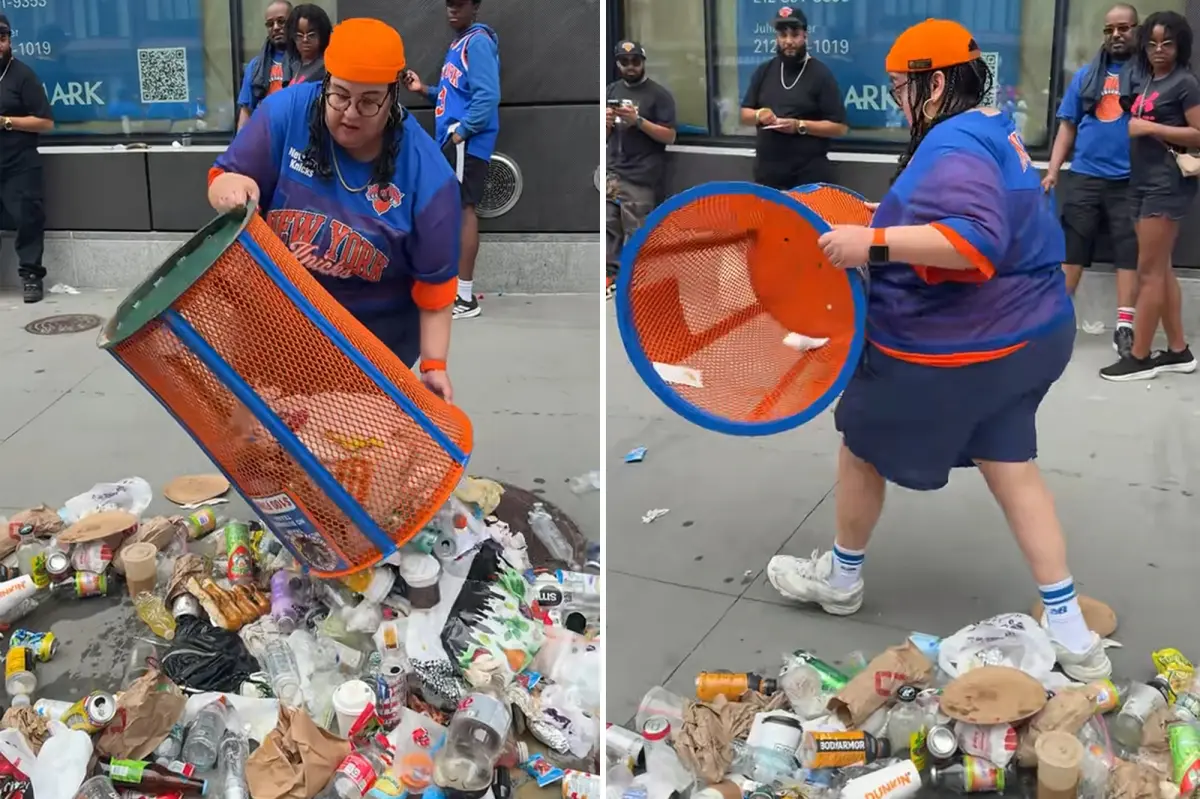
In a city that has seen just about everything, New York recently played host to a viral spectacle that perfectly balances comedic absolute absurdity with shocking civic audacity. The center of this social media storm was a woman captured on video committing what onlookers could only describe as an “incredibly stupid” act of public theft in broad daylight. Dressed head-to-toe in a vibrant blue New York Knicks t-shirt, an eye-catching orange cap, and casual denim shorts, she approached one of the city’s newly minted, custom-painted trash receptacles. Without a shred of hesitation or concern for the crowd gathering around her, she tipped the heavy wire-mesh can over, dumping a mountain of discarded cups, wrappers, and half-eaten food directly onto the concrete sidewalk. After shaking out the final remnants of garbage, she casually hoisted the massive, dirty bin under her arm and marched away like a victorious warrior carrying prized plunder. A few paces later, she joined another individual sporting matching Knicks gear, leaving behind a bewildered, horrified street of spectators who could do nothing but film the shameless heist. The footage immediately exploded across the internet, serving as a bizarre testament to how easily collective sports euphoria can descend into absolute lawlessness on the historic streets of Manhattan.
The stolen item in question was not just any ordinary piece of municipal utility; it was a carefully crafted commemorative relic born from a unique intersection of street fashion and civic pride. To celebrate the New York Knicks’ monumental, long-awaited NBA championship, the New York City Department of Sanitation (DSNY) had teamed up with local clothing brand Only NY. Together, they designed and distributed a limited run of hand-painted, mesh-wire trash cans featuring the team’s classic royal blue and orange color scheme, strategically placed along key urban pathways ahead of the highly anticipated ticker-tape parade. The initiative was meant to beautify the city, turning mundane public waste bins into symbols of communal celebration and artistic triumph. However, anyone familiar with the raw, opportunistic underbelly of New York’s collector culture could have foreseen the immediate fallout. Almost as soon as the partnership was announced, local online forums and social media channels were flooded with warnings that these attractive pieces of street art would not last a day. One user on X, formerly known as Twitter, made a strikingly prophetic post just twenty-four hours prior, warning that the entire city would soon be drowning in its own refuse because fans would undeniably steal every single one of the painted bins as trophies.
The public reaction to the viral video of the theft was a wild mix of hilarious cynicism and outright condemnation, capturing the distinct dual nature of New York’s cultural voice. Online commentators quickly jumped on the practical absurdity of the heist, with one social media user joking that the trash can would undoubtedly find its way onto Facebook Marketplace by nightfall, branded as “Rare Vintage Knicks Memorabilia” with a hefty $450 price tag. Others pointed out the sheer logistical nightmare of the crime, marveling at the sheer, unyielding dedication it would take for someone to try dragging a massive, smelly public sanitation bin onto a crowded MTA subway train during the peak of rush hour. However, the humor was not shared by city administrators who have to deal with the messy aftermath of such antics. The Department of Sanitation released a hard-hitting statement expressing disgust over the incident, flatly stating that dumping trash onto public streets and stealing municipal property for private gain are illegal, antisocial behaviors that run entirely contrary to true New Yorker values. To make matters worse, the department pointed out the sheer foolishness of committing such a blatant double crime directly in front of active smartphone cameras. Meanwhile, the New York Police Department quietly noted that they had not yet received formal complaints, keeping the incident in a bizarre, temporary digital limbo of viral infamy.
To truly understand what drove a fan to dump a pile of garbage on a sidewalk just to possess a dirty metal cylinder, one has to examine the heavy emotional weight of the sports victory itself. Before this historic run, the New York Knicks had spent fifty-three long, agonizing years wandering through a desert of mediocrity, disappointing seasons, and broken dreams. Generation after generation of long-suffering fans had inherited a legacy of heartbreak, making this particular championship win an almost religious experience for the entire metropolis. When the final buzzer sounded, it triggered a psychological release of pressure so intense that it seemed to temporarily rewrite the social contract governing the city. For many, ordinary laws of preservation and respect for public spaces were momentarily replaced by a desperate, feverish desire to grab onto any tangible piece of history they could find. In this heightened emotional landscape, a custom-designed trash can transitioned from a municipal waste container into a holy relic of the grandest sports victory the city had seen in over half a century. This boundary-crossing behavior proved once again that sports fanaticism, when pushed to its absolute limits, can completely strip away normal human inhibitions, transforming average citizens into shameless agents of chaos.
This trash-can heist, however, was far from the only chaotic display of unhinged fan behavior during the celebratory aftermath of the Knicks’ parade. At the historic Canyon of Heroes, amidst a blizzard of falling ticker-tape, a surreal, R-rated physical conflict erupted that quickly became another viral sensation. High above the packed, roaring crowd, a young woman scaled a streetlight pole to secure a bird’s-eye view, only to be violently pulled down and supplanted by another aggressive fan looking to claim the high ground. The intense scramble quickly devolved into an undignified street brawl, during which the displaced woman retaliated by grabbing her opponent’s trousers and pulling them down to her knees. To the shock and roaring amusement of onlookers, this move exposed the woman’s bright orange Knicks-themed underwear, prompting the exposed fan to begin twerking directly on the pole while her adversary repeatedly punched her exposed backside. It was a scene so bizarre and hyper-specific to the wild spirit of the day that it defied belief, embodying a carnivalesque atmosphere where the lines between celebratory joy, physical violence, and public theater became completely blurred in the heat of victory.
While these viral moments provided a strange sort of amusement of urban absurdity, they also reflected a much darker, more destructive undercurrent that cast a shadow over the historic championship night. The raw intensity that fueled trash-can thefts and high-altitude street fights quickly crossed the line into outright violence and dangerous civil unrest across several major hubs of the city. By the time the dust finally settled on the night of the big win, local authorities reported sixty-three arrests, four stabbings, one shooting, and at least ten injured police officers who were caught in the crossfire of the untamed celebrations. In Times Square, an angry, adrenaline-fueled mob targeted parked yellow school buses that had been brought in to transport soccer fans to an upcoming tournament event. Rioting fans climbed onto the roofs of the vehicles, smashed windows, and ultimately set one of the buses ablaze, sending plumes of thick, black smoke billowing into the iconic New York skyline. It serves as a sobering reminder of the incredibly thin line that separates collective civic joy from dangerous, destructive anarchy in a city of over eight million people. The stolen blue-and-orange trash cans, the undignified streetlight fights, and the burning buses in Times Square all tell a singular, complex story of New York: a city capable of expressing unmatched love and pride, but one whose volcanic passions can just as easily burn down the very streets they are celebrating.