





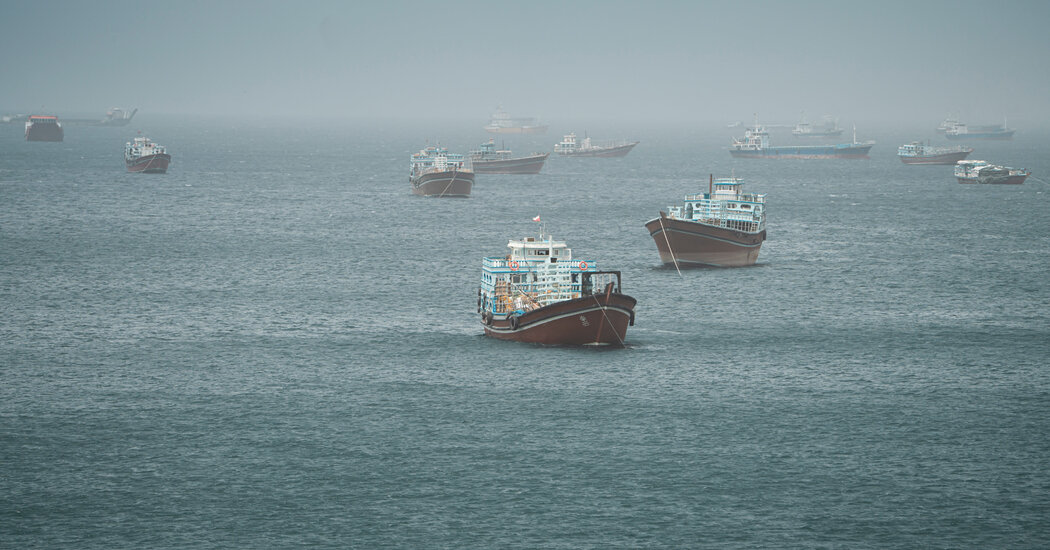
The world was holding its collective breath, staring down the barrel of a devastating military conflict in the Middle East that threatened to spiral completely out of human control. For months, the specter of a devastating war had loomed large, casting a dark shadow over global energy markets, international diplomacy, and the everyday lives of ordinary citizens who watched nervously as gasoline prices crept toward historic highs. When the Trump administration suddenly announced a temporary agreement with the Iranian regime this past weekend, it wasn’t the grand, sweeping peace treaty that many had dreamed of, nor was it a comprehensive nuclear disarmament or missile reduction deal. Instead, what emerged from the high-stakes, at-the-brink negotiations—quietly and meticulously brokered behind closed doors by an unexpected intermediary, a hard-line Pakistani general—was a fragile, temporary arrangement designed primarily to stop the bleeding and de-escalate a rapidly deteriorating situation. It represents a vital, albeit temporary, pause in hostilities that promises to reopen the vital Strait of Hormuz, a crucial oceanic artery through which nearly a quarter of all the world’s petroleum transit passes daily. By averting what was rapidly becoming the most severe global energy disruption of the modern era, the agreement offers a momentary sigh of relief to a global economy that felt poised on the edge of a precipice. The sheer human relief of this moment cannot be overstated; instead of a catastrophic exchange of missile strikes and naval blockades that could have dragged multiple nations into an endless quagmire, there is now a tentative, uneasy quiet. However, this is not a permanent resolution, but rather a strategic timeout, subject to the final, highly volatile approval of both President Donald Trump and Iran’s supreme leader, who has spent weeks in deep hiding to escape targeted assassination attempts. If both leaders ultimately sign off on the exact wording of this delicate understanding, the immediate threat of a catastrophic military escalation will recede, giving diplomats a rare, narrow window to talk rather than shoot, and saving countless lives that would have otherwise been caught in the crossfire of a modern industrial war.
For President Donald Trump, this sudden shift in trajectory represents a striking rhetorical and strategic about-face that reflects the brutal pressures of domestic politics and the cold realities of global governance. Only eleven short weeks prior to this announcement, the President had taken to social media to issue a fierce, unyielding ultimatum, declaring in all-capital letters that there would be absolutely no diplomatic deal with Iran except for their “UNCONDITIONAL SURRENDER.” Yet, the realities of an impending November midterm election, combined with a weary American electorate that overwhelmingly expressed opposition to another costly foreign war in opinion polls, forced a dramatic recalibration of the White House’s approach. With gasoline prices stubbornly hovering around the politically disastrous threshold of $4.50 a gallon, threatening to devastate Republican electoral prospects nationwide, the administration was forced to recognize that a protracted naval blockade and military campaign was a political liability they could ill afford. Consequently, the bellicose threats of total destruction have been replaced by a markedly different, almost businesslike tone on social media, with the President calmly assuring his followers that negotiations are proceeding in an orderly and constructive fashion and that there is no need to rush because time is firmly on the American side. He has maintained a tough public posture by emphasizing that the economic blockade against Iran will remain in full force and effect until the Iranian supreme leader and his top officials officially certify the agreement, yet his sudden assertion that the bilateral relationship with Tehran is becoming much more professional and productive reveals a profound shift in mindset. By choosing to kick the most complex and contentious issues down the road in exchange for an immediate end to Iran’s economic stranglehold on the world’s most vital waterway, Trump has opted for a pragmatic compromise over his previously demanded total victory, proving once again that in the high-stakes theater of international relations, survival and economic stability often triumph over ideological purity.
On the other side of this high-stakes geopolitical poker game, the Iranian regime was facing its own existential crisis, driven to the negotiating table by a battered economy that was rapidly approaching a total and catastrophic collapse. Under the crushing weight of relentless international sanctions and the loss of nearly all its vital oil revenue due to the American-led maritime blockade, the Islamic Republic found itself on the absolute brink of financial ruin, facing widespread public desperation and severe economic paralysis. This economic devastation occurred against the backdrop of a fierce, month-long military campaign known as “Operation Epic Fury,” launched on February 28 by President Trump and Israeli Prime Minister Benjamin Netanyahu with the explicit goal of permanently dismantling Iran’s nuclear and missile programs once and for all. However, as the smoke begins to clear, it has become increasingly obvious that this joint military operation failed to achieve its primary, ambitious objectives; despite immense pressure, the Iranian regime remains in physical possession of over eleven tons of enriched nuclear fuel, including nearly a thousand pounds of highly enriched uranium that sits dangerously close to weapons-grade quality, buried deep underground beneath the rubble of bombed facilities. Furthermore, a highly ambitious, covert plan designed to spark domestic regime change, overthrow the current government, and install Mahmoud Ahmadinejad—the former hard-line president—back into power as a puppet leader never materialized, leaving the entrenched clerical leadership still in control. With their leaders in deep hiding to avoid foreign drone strikes and their populace facing severe inflation and shortages, the Iranian government chose the least-bad option available to them, trading a temporary pause in their escalatory actions for a vital economic lifeline that might allow their domestic economy to recover before it completely shattered. The intense psychological pressure of this military campaign, which forced top political figures into isolation to avoid assassination, highlights the immense personal stakes involved for those in power, who were suddenly forced to choose between ideological defiance and physical survival as their country burned around them.
While the immediate prospect of a reopened Strait of Hormuz brings enormous relief to the global energy sector, the actual mechanics of the temporary agreement are alarmingly vague and fraught with unresolved technical complexities that could easily cause the entire deal to collapse at any moment. American administration officials have quietly expressed optimism, briefing journalists on a planned second phase of intense negotiations aimed at addressing the core nuclear issues that triggered the initial conflict, claiming that Tehran has already agreed in principle to surrender its highly enriched uranium stockpile—a critical mass that could theoretically be converted into a dozen nuclear weapons in a very short amount of time. However, the Iranian government itself has remained conspicuously silent on this crucial point, fully aware that its highly enriched fuel, along with its capability to disrupt transit through the Strait, represents its absolute best geopolitical leverage against Western pressure. Crucially, the exact mechanism by which Iran would safely dispose of this highly enriched material remains entirely unresolved, as does the critical question of whether they will eventually agree to ship all their additional uranium out of the country under the supervision of the International Atomic Energy Agency. Compounding these nuclear anxieties is Iran’s steadfast refusal to even discuss limits on the range and payload of its ballistic missile arsenal, a non-negotiable issue for Israel, whose major metropolitan areas remain well within range of Iranian missile batteries and who view any deal that ignores this threat as an existential betrayal. Furthermore, the agreement fails to address Iran’s recent, legally aggressive claim of sovereignty over the Strait of Hormuz—which has traditionally been treated as an international waterway open to all—leaving a dangerous legal and military gray area that could easily spark another maritime confrontation if the current diplomatic efforts falter. This omission is particularly concerning to international maritime insurers and global shipping conglomerates, who remain hesitant to send multi-billion-dollar cargo vessels through these tense waters without explicit, binding guarantees of safety and freedom of navigation, raising doubts about how quickly trade can truly recover.
This sudden diplomatic pivot has triggered a ferocious domestic backlash within the United States, exposing deep, bitter fault lines within President Trump’s own political party and drawing sharp condemnation from prominent foreign policy hawks who accuse the administration of a cowardly surrender. Republican critics, who had enthusiastically championed the aggressive military posture of Operation Epic Fury, wasted no time in publicly venting their anger, arguing that the President had prematurely folded under intense economic pressure and failed to finish the job of permanently neutralizing the threat. Senator Roger Wicker, the influential chair of the Senate Armed Services Committee, led the charge with a blistering public warning that this premature concession would render all the sacrifices and strategic gains of the military campaign completely worthless, essentially returning the region to a highly volatile status quo. This sentiment was echoed by Mike Pompeo, Trump’s former CIA Director and Secretary of State, whose highly critical public assessment of the deal prompted a shockingly hostile response from the current White House communications director, Steven Cheung, who publicly told Pompeo to shut his mouth and leave the real work to the professionals. Meanwhile, seasoned, non-partisan Middle East negotiators who had spent decades working in the region expressed deep skepticism from an entirely different perspective, characterizing the sudden agreement as a highly flawed, desperate peace of necessity born out of a poorly conceived war of choice. These veteran diplomats note with concern that by abandoning its original, highly ambitious war aims in exchange for a temporary economic reprieve, the administration has squandered its most valuable strategic leverage, leaving itself with very few direct mechanisms to secure the long-term, verifiable restraints on Iran’s nuclear capacities that are absolutely essential for permanent peace. This internal political warfare highlights a deeper, systemic crisis in American foreign policy, where the pursuit of long-term strategic victories is increasingly sacrificed on the altar of short-term electoral survival and highly personalized, public relations battles played out on social media.
As the world watches to see if this fragile, Pakistani-brokered truce will hold, the ultimate success of future negotiations hangs on two massive, unresolved financial mysteries: how the United States will handle Iran’s demands to unfreeze billions of dollars of assets and when, if ever, it will lift the crushing economic sanctions that have paralyzed the Iranian economy. A senior American official hinted that these incredibly contentious financial issues have not yet been formally negotiated, though they could eventually form the basis of a grand geopolitical trade, using the vivid phrase “no dust, no dollars” to signal that any financial relief for Tehran is strictly contingent on the physical removal of Iran’s highly enriched uranium dust from its bombed facilities. This transactional approach highlights the profound irony of President Trump’s current diplomatic predicament; having spent years relentlessly attacking his predecessor, Barack Obama, for negotiating a flawed nuclear deal that returned billions in frozen Iranian funds, Trump now finds himself desperately attempting to negotiate a highly similar, albeit vastly less comprehensive, transaction under intense domestic electoral pressure. Even as the President uses his public platforms to loudly insist that his potential deal is the exact opposite of the 2015 nuclear accord, he has been forced to acknowledge that nothing has been fully finalized, leaving the international community to navigate a highly volatile, deeply uncertain landscape. Ultimately, this temporary agreement is not a triumph of grand strategy or a permanent resolution to a decades-long rivalry, but rather a raw, human compromise born of mutual exhaustion and political survival—a fragile, necessary bridge built over an active volcano, designed to buy just enough time for both sides to avoid a catastrophic war that neither could truly afford to win. Behind the dry diplomatic jargon of blockades and enrichment levels lie the very real human lives of average citizens in both nations—American drivers struggling to budget for basic fuel, and Iranian families suffering under the weight of crushing inflation—who must now wait in anxious anticipation to see whether their leaders will choose the path of enduring peace or return to the brink of mutual destruction.