


Salisbury, Connecticut, is a quintessential New England town nestled quietly in the state’s scenic northwestern corner, a place widely celebrated for its rolling Litchfield Hills, historic architecture, and the tranquil waters of Twin Lakes. Early on a crisp Tuesday morning, around five o’clock, the air was cool and a peaceful autumn mist hung low over the asphalt of Route 44. This winding, historic two-lane highway serves as a vital corridor for both local residents and regional commercial transport, requiring vigilant focus from overnight long-haul drivers navigating its gentle bends in the dark. On this particular morning, a massive commercial tractor-trailer was making its way through the pre-dawn stillness, hauling a heavy, tightly packed load of domestic beer intended for local distributors and retail store shelves. At approximately 5:39 a.m., as the truck approached Twin Lakes Road, the quiet rhythm of the rural morning was violently shattered. In a terrifying fraction of a second, the heavy semi-truck veered off the paved roadway, its massive tires slipping onto the soft, damp grass shoulder. The driver, suddenly wrestling with the tremendous, shifting momentum of a forty-ton loaded trailer, was unable to steer the vehicle back onto the asphalt. With a deafening, metallic roar that echoed through the sleeping woodland, the tractor-trailer tipped, crashing heavily onto its side and sliding across the road, instantly transforming a peaceful scenic highway into a chaotic scene of industrial wreckage.
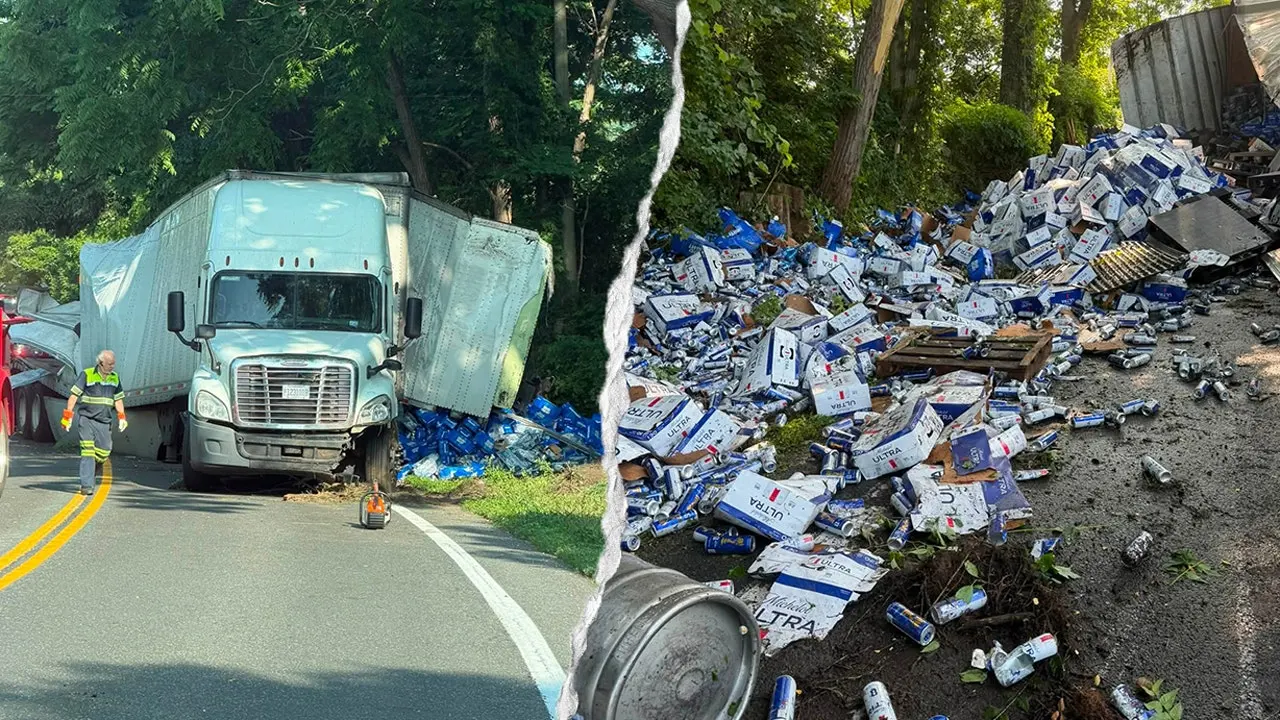
When the dust and mechanical screams finally settled into an eerie silence, the breathtaking physical scale of the wreckage became apparent. The tractor-trailer lay sprawled awkwardly across the entirety of Route 44 like a fallen steel giant, blockading travel in both directions with its undercarriage exposed and the structural integrity of its cargo bay completely compromised. The violent impact had torn open the metal walls of the trailer, releasing a massive, cascading tidal wave of aluminum across the gray asphalt. Thousands of silver and blue cans of Michelob Ultra and Bud Light burst from their cardboard cases, littering the highway as far as the eye could see. Millions of ounces of carbonated lager sprayed into the clean morning air, turning the dry road surface into a slick, frothy, and deeply fragrant river of wasted beverage. Photographs subsequently released by the Connecticut State Police depicted a surreal, visually arresting scene that looked more like an abstract art installation than a traffic accident, with the crushed metal semi-truck sitting in the middle of a massive, shimmering mosaic of aluminum and sodden cardboard. It was immediately clear to the state troopers arriving on the scene that this was no ordinary fender-bender; it was a logistics disaster of epic proportions that would require hours of backbreaking physical labor to clear.
Within minutes of the crash, the quiet of the Salisbury morning was broken once again, this time by the rising wail of emergency sirens as local volunteer fire departments, paramedics, and state police troopers rushed toward Twin Lakes Road. The immediate priority for the first responders was the health and safety of the driver, who had miraculously survived the violent rollover and was quickly treated at the scene by emergency medical service crews. Once the human element was secured, the massive challenge of managing the scene began. State troopers immediately shut down a large stretch of Route 44, setting up detours to reroute the flow of early morning commuters who were just beginning their daily drives to work. As word of the “beer spill” spread through Salisbury, a wave of lighthearted bemusement swept through the community, offering a moments of humor to offset the frustration of morning traffic delays. Commuters found themselves navigating narrow, winding country backroads, while local emergency crews worked diligently on the front lines of the mess. The Connecticut State Police public communications team kept the public updated, expressing deep gratitude to the locals for their patience as they handled the unprecedented, sticky obstacle course blockading their town.
Clearing a ruined, forty-ton commercial vehicle from a major roadway is a highly complex engineering feat under the best circumstances, but doing so while wading through a swamp of slippery, ruptured beer cans elevated the cleanup to a grueling task. To meet this challenge, a diverse coalition of state and local agencies descended upon the scene, including the Connecticut Department of Transportation, heavy-duty towing recovery teams, and representatives from the state’s Department of Consumer Protection. The involvement of consumer protection officials was necessary due to the heavily regulated nature of alcoholic beverages, requiring strict oversight to ensure that none of the damaged, untaxed cargo was publically scavenged or improperly returned to the marketplace. Massive towing rotators were brought in, their diesel engines roaring as operators carefully rigged heavy steel cables to the frame of the overturned semi-truck to hoist it upright. Meanwhile, highway crews armed with shovels, push brooms, and front-end loaders began the arduous, sticky process of scooping up the mountain of crushed aluminum and waterlogged cardboard, loading the sticky debris into commercial dumpsters so the highway could be thoroughly washed down and made safe for rubber tires once again.
As the physical cleanup stretched long into the afternoon, several environmental and regulatory questions began to surface regarding the aftermath of the massive liquid spill. Intriguingly, local media reports revealed that the Connecticut Department of Energy and Environmental Protection (DEEP) had not been officially notified of the crash during the initial cleanup phase. Given Salisbury’s proximity to delicate watersheds and the nearby Twin Lakes ecosystem, a large-scale release of organic material like beer—which can deplete oxygen levels in water as it ferments—theoretically poses localized ecological risks. However, quick action by onsite emergency crews successfully contained any hazardous vehicle fluids, such as diesel fuel or motor oil, preventing toxic runoff from entering the surrounding soil. Simultaneously, state police accident reconstructionists began their detailed investigation into the root cause of the crash, analyzing tire tracks, weather conditions, and vehicle telemetry data to determine whether steering failure, driver fatigue, or a sudden wildlife encounter caused the truck to leave the road. This thorough inquiry highlights the demanding, high-stakes reality of the long-haul trucking industry, where a single second of driving distraction or physical exhaustion can lead to massive commercial disasters on public roads.
By late afternoon, the final pieces of aluminum wreckage had been cleared away, the road had been washed clean of all sticky residue, and Route 44 was formally reopened to the public, allowing the quiet rhythm of Salisbury to return to normal. Though the physical debris is gone, the memory of the great Tuesday morning beer spill will undoubtedly linger in the folklore of the Litchfield Hills for generations, transformed from a messy traffic inconvenience into a legendary local tale. This bizarre incident highlighted the impressive coordination and dedication of Salisbury’s public safety network, demonstrating how local volunteers and state workers can seamlessly collaborate to resolve a massive, highly unusual highway crisis. For the truck driver, the day ended with profound relief at surviving a traumatic rollover, while for the community, it served as a vivid reminder of how quickly the predictable patterns of daily life can be interrupted by the unexpected. As the sun set over the calm waters of Twin Lakes, the sweet, yeasty aroma of hops finally faded from the damp autumn air, leaving behind only clean asphalt and a wildly memorable story to be shared over cold drinks in the town’s local taverns for years to come.