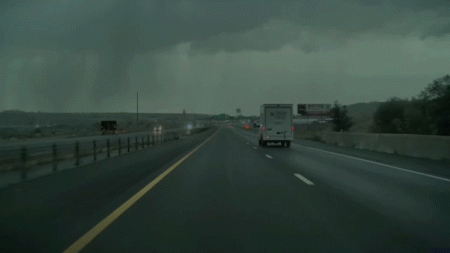



In the unforgiving heat of the Arizona desert, water is not just a resource; it is the very currency of survival, the invisible thread that stitches together sprawling cities, verdant fields, and the quiet dignity of rural communities. Almost sixty years ago, in the waning days of the 1960s, the state made a monumental and deeply human gamble to secure its future prosperity. Eager to fund the Central Arizona Project—a colossal system of canals and pumps that would carry Colorado River water across hundreds of miles of rugged terrain to the booming metropolises of Phoenix and Tucson—Arizona struck a deal with the devil, or perhaps more accurately, with the bureaucracy of the federal government and the vested interests of its neighboring states. The bargain was simple, stark, and laden with future consequence: Arizona could have its lifeline, but only if it legally agreed to be the absolute first in line when the inevitable day of reckoning arrived. In the arcane language of Western water law, this meant accepting a “junior” priority status, a legal surrender that promised painful sacrifice during times of shortage. For the policymakers and farmers of that era, it was a calculated act of hope, rooted in the 20th-century belief that the Colorado River was a bountiful, unstoppable force that would never truly fail them. They looked at the river’s robust flows and saw a permanent solution to their arid predicament, effectively betting the future stability of their children and grandchildren on the assumption that the wet years would always outweigh the dry. That promise, written into law and etched into the governance of the American Southwest, hung over the state for decades like a dormant thunderstorm—present, ominous, but mercifully unrealized. Now, however, under the watchful eye of the Trump administration, the clouds have finally broken, and the dormant thunderstorm has unleashed its pent-up fury. The historical promise has been called due, and Arizona, the state that once gambled everything on the river’s generosity, is being forced to pay the ultimate price for its foundational ambition. It is a price that many never anticipated paying, even as they signed their names to the future.
The Central Arizona Project itself was a testament to human audacity, an engineering marvel carved into a landscape that seemed to reject the very idea of permanence. To understand the weight of the recent cuts, one must first understand the visceral reality of the canals themselves—concrete arteries stretching over three hundred miles, carrying roughly 1.5 million acre-feet of water annually to a population that would otherwise be unsustainable. The construction, which spanned decades and cost billions, was a source of immense civic pride and boisterous celebration. When the first water finally cascaded into the Phoenix metro area in the late 1980s, it felt like the conquest of nature itself, a triumphant narrative of man over the elements. This extraordinary achievement was secured through the intricate and ruthless mechanics of the Law of the River, a tangled web of compacts, treaties, and Supreme Court decrees dating back to 1922. In this legal framework, the Lower Basin states—Arizona, California, and Nevada—were allocated a fixed amount of water, but crucially, the priority of those rights varied. California, with its immense political power and earlier claims, held the senior rights, meaning it could force Arizona to bear the brunt of any shortage. Arizona’s sacrifice of its own priority was not merely a bargaining chip; it was the lynchpin that held the entire political deal together. California’s congressional delegation refused to approve federal funding for the CAP unless they were legally guaranteed that their own supplies would remain untouched while Arizona’s flowed. The human dimension of this negotiation was fraught with tension, distrust, and backroom maneuvering. Arizona’s leaders, men like Carl Hayden and Mo Udall, argued passionately that the state deserved its share, while California’s water lords, such as the powerful Metropolitan Water District, lobbied relentlessly to protect their own turf. In the end, the compromise was forged upon the backs of future generations: Arizona would prosper now, and when the river ran short, the water managers of the future would have to eat a humble pie of drought. The farmers who pushed for the CAP believed they were securing a permanent legacy of abundance, not signing a promissory note that would one day come due in the form of fallowed fields and economic despair.
For the better part of two decades following the CAP’s completion, the gamble seemed to have paid off handsomely, and the bitter reality of that legal surrender was forgotten amid the intoxicating boom of the modern American Southwest. The population of Arizona exploded, rising from a couple of million in 1970 to over seven million today. Subdivisions sprouted across the Sonoran Desert like desert wildflowers after a rare rain, each one featuring emerald lawns and shimmering swimming pools that defied the arid landscape. Agriculture thrived in Pinal County and the Yuma Valley, producing cotton, alfalfa, and winter vegetables that fed the nation. The river, meanwhile, behaved itself, flowing at near-average levels and storing massive reserves in Lake Mead and Lake Powell. The promise of seniority cuts was relegated to the dusty footnotes of water law textbooks, a theoretical contingency that seemed increasingly irrelevant. But nature, indifferent to human legalities, was slowly rewriting the script. Beginning in the year 2000, a “megadrought”—the worst in over a millennium—began to grip the region, squeezing the moisture from the Rocky Mountain snowpack that feeds the river. The reservoirs started to fall at an alarming rate, revealing the chalky white bathtub ring high on the canyon walls of Lake Mead, a stark and horrifying visual testament to the river’s decline. The complacency of the boom years shattered as water managers watched the levels plummet. What was once a legal abstraction became a statistical certainty. Climate scientists warned that the flow of the Colorado River had already shrunk by nearly 20% compared to the 20th-century average, and with rising temperatures, the future promised only more evaporation and less snowmelt. The human anxiety began to spread—from the boardrooms of municipal utilities to the kitchens of farm families. Homeowners casually washing their driveways suddenly looked at the shrinking reservoirs on the news and felt a knot of unease. The generation that had so blithely accepted the state’s junior status was now staring into the face of that enormous, unforgiving legal bill. The “time that has come” was not merely an administrative trigger; it was the emotional awakening of an entire state to the fragility of its existence, brought about by a river that had finally started to speak the long-dreaded words of scarcity.
It was under the Trump administration that the political and legal machinery finally ground forward to force that reckoning. In 2019, after years of intense negotiations among the seven basin states, the federal government brokered the Drought Contingency Plan (DCP), a landmark agreement designed to keep Lake Mead from collapsing to critically low levels. The DCP was a monumental exercise in crisis management, and at its very heart lay Arizona’s long-standing promise. For the Trump administration, pressured by a looming crisis and the need for a political win on a complex environmental issue, the DCP represented a pragmatic, if painful, solution: the states would voluntarily take cuts now to avoid a catastrophic forced shortage later. Arizona, legally bound by its junior priority, was compelled to shoulder the largest share of the burden. Under the plan, Arizona agreed to leave a significant portion of its CAP allocation in Lake Mead, with the first, deepest cuts falling directly on the agricultural heartland of Pinal County—the very fields that had been the most vocal champions of the original project. The negotiating room was thick with the weight of history and the sting of sacrifice. Farmers and agricultural lobbyists argued desperately that they were being made the scapegoats for a problem they didn’t create, pointing to urban conservation failures and the effects of climate change beyond their control. Yet, the logic of the legal structure was inescapable. The state’s state-sponsored water utilities, tasked with supplying Phoenix and Tucson, knew they had to protect their urban customers at all costs, which meant their agricultural counterparts had to bear the brunt. The signing of the DCP was not a moment of triumph but a grim, sober acknowledgment. As water officials put pen to paper, there was a palpable sense of a century-long party finally coming to an end. The Trump administration framed the deal as a success of voluntary cooperation, a testament to the power of collaborative governance, but on the ground, the human cost was already being calculated. The promise made in 1968 was no longer a footnoted legal curiosity; it had become the defining reality of an entire state, transforming the abstract concept of “being first in line” into a concrete, looming chain of consequences about to be unleashed on the land and its people.
The human impact of that long-dormant promise being activated has been swift, deep, and heartbreakingly tangible. In central Arizona’s Pinal County, the idyllic pastoral scenes of cotton and alfalfa fields swaying in the breeze are giving way to vast expanses of cracked, dusty earth. Farmers who for generations have worked the same soil are being forced to leave their fields fallow, watching as their multigenerational livelihoods evaporate along with the water. The economic ripples extend far beyond the farm gates, crashing into the small towns that depend on agriculture—implement dealers, seed suppliers, local diners, and school districts all feel the chill of reduced business and reduced property tax revenue. For individuals like the fourth-generation farmers, the cut is not just a bureaucratic adjustment in a water budget; it is the end of a family story, the dissolution of a heritage tied intrinsically to the sacred act of coaxing life from the desert. Meanwhile, in the gleaming urban centers, the impact is initially more subtle but no less psychologically profound. Phoenix residents, protected by the priority system, still turn on their taps with reliable ease, but they are increasingly confronted with a new cultural ethos of conservation—an aggressive push toward xeriscaping, rebates for turf removal, and strict watering schedules. The contrast is jarring: the lawns of Scottsdale remain green while the fields of Casa Grande turn to tinder. Yet within this landscape of deprivation, there have been startling acts of human ingenuity and solidarity. Native American tribes, such as the Gila River Indian Community and the Colorado River Indian Tribes, have stepped forward as unexpected partners, offering to lease some of their own valued water rights back to the state in exchange for federal funding and vital infrastructure improvements. This collaboration represents a profound shift in the political landscape, as tribes, historically marginalized and often the most underserved, are now key players in the region’s survival. Their cooperation speaks to a deeper, more resilient thread of community that persists even when the foundation of the old promise crumbles. The harvest may be drying up, but the human spirit, forced to adapt, is finding new ways to cooperate, conserve, and creatively reimagine the future of this arid frontier.
As we stand on the precipice of this new era, the question that looms over Arizona is not simply whether the state can survive the cuts, but whether the original promise—that generational gamble—was ultimately a curse or a catalyst for necessary evolution. The Trump administration’s declaration that the time has come has stripped away the comforting illusions of endless growth and forced the state to confront the hard arithmetic of a shrinking river. It is a reckoning that no amount of legal maneuvering can delay. For the farmers who lose their water, it is a personal tragedy of immense scale, a testament to the fact that nature ultimately trumps human ambition. Yet, for a state built on a foundation of audacity, this moment of crisis is also an opportunity to forge a new, more sustainable relationship with its environment. The desert has always demanded resilience, and the current generation of Arizonans is being tested not just by the loss of water, but by the necessity of redefining success in a land of scarcity. The battered farmers may pack up their irrigation pumps, but the urban planners are investing in cutting-edge desalination research, advanced water recycling, and gray-water systems that are becoming models for the arid world. The children growing up in this new Arizona are learning a different lesson than their grandparents—one that emphasizes ecological stewardship over the conquering of nature. The legacy of the 1968 promise is not a simple victory or defeat; it is a complex moral tale about the delicate balance between progress and limits, between the dreams of one generation and the burdens they pass to the next. As the sun sets over the falling reservoirs, casting long shadows across the empty canals, there is a quiet dignity in the way the state accepts its fate. The water that once flowed so freely to build a civilization is now a precious, contested commodity, husbanded with care. The promise has been fulfilled, but its fulfillment has brought a new, wiser humility. The time has come, and with it, perhaps, the beginning of a great and humble adaptation—the true legacy of a desolate, beautiful, and ever-enduring land.