






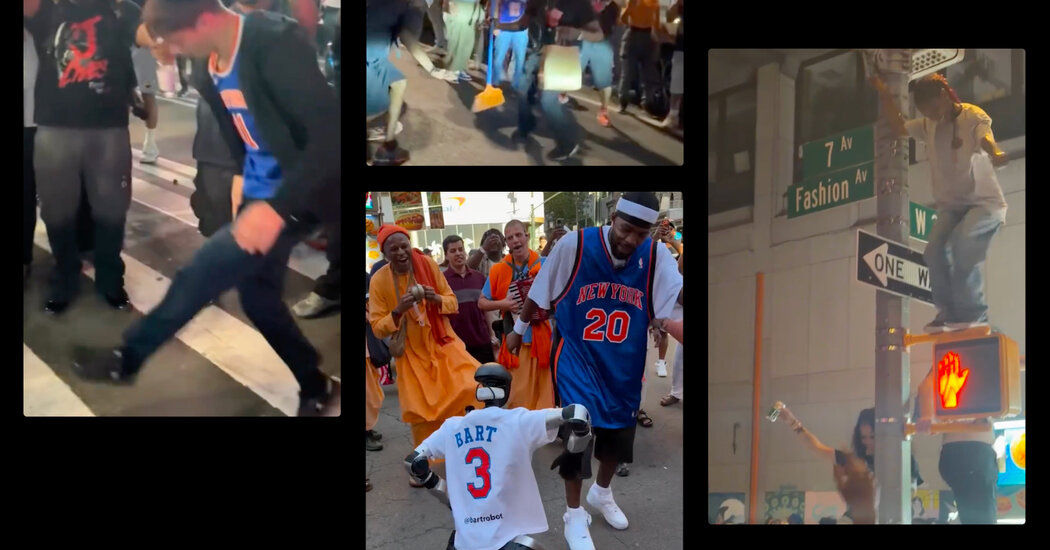
The true magic of a sports championship run is rarely confined to the glossy hardwood of an arena or the sterile boundaries of a television screen; instead, it spills outward like water from a burst fire hydrant, saturating the concrete veins of the city with a kinetic vitality that demands immediate physical expression. During the New York Knicks’ historic charge, this collective electricity manifested as a glorious, city-wide dance epidemic, an unchoreographed celebration that vibrated through every borough and united millions of diverse souls in a shared physical language of pure, unadulterated joy. From the neon-drenched canyons of Times Square to the crowded, humid platforms of the subway system, fans surrendered to a joyful gravity, transforming everyday public environments into spontaneous stages of absolute bliss. The rhythm of victory was entirely infectious, prompting absolute strangers to link arms in dizzying spins, execute playful, shuffling street-style kicks in the middle of halted traffic, and even engage in precarious, hilarious feats of balance—such as one daring fan who was captured on video grooving while expertly balancing a large television screen flat on his head. There was a beautiful, chaotic democracy to these movements; they required no formal choreographic training, no shared cultural history, and absolutely no words to communicate. When the Knicks sealed a heart-stopping, single-point comeback victory over the San Antonio Spurs, a wave of disbelief turned into immediate, ecstatic movement as the entire metropolis seemed to leap in unison, a synchronized bounce that dissolved the rigid boundaries between the elite and the everyday. In the heart of these celebratory mosh pits, glamorous Hollywood stars like Timothée Chalamet could be seen jumping shoulder-to-shoulder with blue-collar transit workers and lifelong outer-borough diehards, embodying the beautiful truth that beneath the varying layers of systemic status, the spirit of the game reduces everyone to the same essential state: a fan, an artist, and a dancer. This was the legendary summer where the skies over the five boroughs seemed to glow permanently in shades of blue and orange, and the simple act of traversing a New York sidewalk meant stepping onto an inclusive stage of communal theater where anyone could lead and everyone was invited to join the dance.
To observe this spontaneous eruption of physical movement across the city is to understand that the connection between basketball and dance runs far deeper than mere post-game celebration; in fact, the New York Knicks have long functioned as the professional sports equivalent of a gritty, avant-garde modern dance company. If teams like the Showtime Lakers of the eighties represented the poised, seemingly effortless elegance of classical ballet, the Knicks have always embodied the raw, earthbound, and highly strenuous aesthetic of modern dance pioneers. Beyond the astronomical salaries, corporate branding, and media circus lies a baseline human reality: this is a team defined by struggle, hustle, and an unyielding commitment to intense physical labor. Modern dance, at its core, does not shy away from the gravity, the sweat, or the visible effort of movement; rather, it celebrates the friction of the body interacting with physical space, and this is precisely how the Knicks play the game. They are scrappy, fiercely raw, and profoundly unpolished in the most beautiful way imaginable, fighting tooth and nail for every single possession as if their very lives depended on the outcome. While they are certainly capable of executing jaw-dropping, aesthetically perfect plays, the true soul of their game lies in the chaotic, winding journeys in between—the relentless diving for loose balls, the exhausting defensive rotations, the screens set with bone-rattling force, and the sheer willpower required to transition from defense to offense. Just as Martha Graham pioneered a style built on contraction and release, the Knicks play with a physical intensity that relies on sudden bursts of muscular force and dramatic recovery. Their artistry is not found in effortless flight, but in the heavy, grounded reality of the struggle, making their performance deeply relatable to a working-class city that understands the necessity of daily labor. There is a deep, resonant human artistry in watching athletes struggle openly, exposing their exhaustion and vulnerability on the court, yet refusing to yield to the physical limitations of their own bodies, mirroring the way dancers push through injury and fatigue to articulate an emotional truth that words fail to capture.
This direct alignment with the principles of modern dance becomes even more profound when we consider how both the players and their long-suffering fanbase handle the inevitable moments of failure, injury, and heartbreak that define any grueling season. In the words of the legendary modern dance master Merce Cunningham, a dancer’s life is defined by the constant, daily mandate to “begin again”—a philosophy that views every mistake, every physical shortcoming, and every new sunrise as a fresh opportunity to rebuild oneself from scratch. The Knicks have embodied this existential resilience for decades, and so too have their loyal supporters, who have endured years of empty promises, management crises, and heartbreaking losses without ever completely abandoning their devotion. To be a Knicks fan through the dark years—when the action on the Madison Square Garden court felt less like a beautifully choreographed athletic display and more like a series of reckless, uncoordinated brawls—was to participate in a shared, long-term labor of love. For years, we watched the games on flickering screens in corner delis, neighborhood laundromats, and quiet living rooms, collectively groaning at missed free throws and turnovers, yet always returning the next night with renewed hope. This shared history of patience transformed our fandom into a form of active physical participation, so that when the team finally triumphed, our bodies felt the release as deeply as if we ourselves had run miles across the court, culminating in an outpouring of joy that washed away years of athletic despair. When the team finally found its rhythm and began its triumphant ascent, that historical pain was instantly transmuted into a powerful collective flow state, as if the players and the fans were working together within the very same body, breathing in perfect synchronization. This mutual resilience created an unbreakable bond, a shared “Empire State of Mind” where the physical exhaustion of the athletes on the court was directly mirrored by the emotional investments of the millions watching from domestic living rooms, crowded sports bars, and nosebleed stadium seats, creating a unified community that refused to let temporary setbacks interrupt their march toward glory.
At the peak of this athletic and artistic symbiosis exists a state of consciousness that both elite dancers and professional athletes spend their entire lifetimes trying to access: the elusive, transcendent “flow state,” where conscious thought dissolves and pure intuition takes control of the physical body. We witnessed this phenomenon manifest in its most breathtaking form during the pivotal Fourth Game of the playoff series, when forward OG Anunoby executed a seemingly impossible play, dashing from an improbable distance to seamlessly tip a loose ball back into the basket. To watch him move in that split second was like watching a phantom slip effortlessly through a crowded room—his physical form became blurry yet extraordinarily clear, executing a complex series of micro-adjustments with a grace that defied the laws of physics. This was not merely a display of supreme hand-eye coordination; it was a moment of pure, transcendent inspiration where the spirit moved through him, translating years of grueling practice into one spontaneous stroke of genius. This kinetic empathy is what bridges the gap between spectator and participant; we do not merely watch Anunoby jump, our own muscles twitch in sympathetic harmony. This subconscious physical alignment is what makes sports so uniquely powerful, transforming a game of basket-and-ball into an interactive performance art piece where the energy generated on the hardwood reverberates through the nervous systems of millions of watching citizens, compelling them to rise from their seats and move. When fans witness an athlete tap into this high-frequency state of existence, a psychological mirror neuron effect occurs within the audience, triggering a visceral, physical desire to mimic that state of elevated freedom in their own lives. Watching the game ceases to be a passive, intellectual exercise and instead becomes a deeply kinetic, participatory experience that bypasses the rational mind entirely, leaving the observer with no choice but to release their own bottled-up energy through the expressive, liberating medium of dance, projecting the triumphs of the court onto the canvas of their own physical reality.
This urge to translate athletic drama into street-level performative art explains why the city’s public squares quickly transformed into theatrical arenas where the boundary between spectator and performer was completely erased. Basketball is, at its heart, a highly dramatic narrative structure complete with heroes, villains, sudden reversals of fortune, and epic climaxes, making it a natural catalyst for street-level theatrical expression among a population known for its outgoing personality. Following key victories, young street performers and classically trained artists alike took to the streets to offer physical interpretations of the game’s highest emotional peaks, such as a young breakdancer who confidently commanded a massive crowd after Game Four, parting the sea of onlookers to execute a flawless, gravity-defying backflip before immediately launching back into a series of complex power moves. In these crowded spaces, the atmosphere was charged with a rare, untainted optimism that seemed almost theatrical, characterized by fans waving brooms high in the air to symbolize a series sweep, and holding up improvised signs declaring “Good Vibes Only.” The street became a democratic canvas where the classical training of a dancer met the raw, uninhibited joy of a sports fan, creating a unique hybrid culture where teamwork on the court directly inspired a sense of kinship and mutual support among strangers on the sidewalk. This individual brilliance was offset by moments of profound collaborative harmony, mirroring the way the Knicks themselves had evolved from a collection of individual talents into a highly coordinated, cohesive unit that operated with the singular mind of a world-class dance company. This collaborative spirit was nurtured through endless hours of repetitious warm-up drills and defensive exercises where the players cultivated an almost telepathic kinesthetic awareness of one another’s positions on the floor, allowing them to breathe, move, and react as a singular, multi-limbed organism during the high-stakes pressure of a championship game, demonstrating that true greatness is never achieved in isolation but through the seamless integration of individual expression into a collective masterpiece.
Ultimately, the lasting legacy of this historic championship run is the rare, untainted atmosphere of pure happiness it injected into the cultural fabric of New York, serving as a powerful reminder of sports’ unique ability to heal, unite, and inspire. Amidst the skeptical glances of critics and the cynical realities of modern life, the Knicks served as the ultimate Frederick Astaire to the city’s Ginger Rogers, perfectly matching our collective steps, elevating our spirits, and helping an entire population rediscover its inherent rhythm. Even when the whimsical, overly optimistic brooms used to symbolize a series sweep were put away, and even when the initial frenzy of the street parties began to quiet down, the deep-seated joy of this shared experience remained permanently etched into the hearts of the fans. It proved that the coveted “flow state” of effortless happiness and communal connection is not a luxury reserved solely for elite point guards or professional ballerinas performing under the bright lights of prestigious theaters. Rather, it is a universally accessible state of being that is there for the taking for absolutely anyone, whether you are celebrating a historic victory in a crowded, booming bar in the middle of Manhattan, or simply dancing in a quiet, secret celebration all alone in the sanctuary of your own bedroom, forever connected to the beating heart of a city that learned how to move as one. This enduring connection reinforces the idea that we are all part of a larger, living organism, constantly moving, failing, and beginning again in a continuous cycle of hope and effort. The Knicks’ journey became our journey, their movement became our dance, and in their final triumph, we found a mirror for our own capacity to persist through adversity. Long after the stadium lights have faded and the championship banners have been hung, the memory of this collective groove will continue to resonate through the city streets, reminding us that whenever life demands that we begin again, we can always find our footing and dance our way back to the light.