





The Pitch and the Proxy: How Geopolitics and Internal Strife Have Divided Iranian Football
1. The Shadow of Diplomacy and the Weight of the Pitch
=== GEOPOLITICAL FLASHPOINTS ===[ Strait of Hormuz Negotiations ] <—> [ Israel-Hezbollah Escalation ]
| |
v v
[ Fragile U.S.-Iran Diplomacy ] <—> [ Mid-East Security Crisis ]
|
+———> { IRANIAN WORLD CUP DEBUT } <———+
|
v
[ Intense National Pressure ]
As diplomats in Geneva and Washington work behind closed doors to hammer out a fragile agreement to reopen the economically vital Strait of Hormuz, the geopolitical chessboard of the Middle East continues to cast a long, suffocating shadow over the sporting world. This delicate diplomatic dance is unfolding against a backdrop of intensifying regional conflict, illustrated by recent Israeli airstrikes targeting the Dahiya neighborhood of Beirut—a stronghold of the Iranian-backed militant group Hezbollah—which have drawn warnings from international leaders, including President Trump, who urged all participating factions to stand down to preserve the prospects of a broader U.S.-Iran peace initiative. Yet, the high-stakes world of international relations does not stop at embassy doors; it bleeds directly onto the grass of the football pitch, where Iran’s national team is preparing for its highly anticipated opening match of the World Cup against New Zealand. For the players donning the team’s colors, the ninety minutes on the field represent far more than a simple athletic competition; they are stepping into an arena where their every movement, gesture, and silence will be scrutinized as a political statement, capturing the immense psychological pressure of representing a nation currently caught in the crosshairs of global warfare, domestic upheaval, and unresolved diplomatic tension.
2. Historical Echoes of Sport as a Surrogate Battlefield
=== WORLD CUP HISTORICAL FLASHPOINTS ===[ 1974: East vs. West Germany ] —> Subversive Jersey Swapping
[ 1986: Argentina vs. England ] —> Post-Falklands “War on the Pitch”
[ 1998: Iran vs. United States] —> The Peak of National Unification
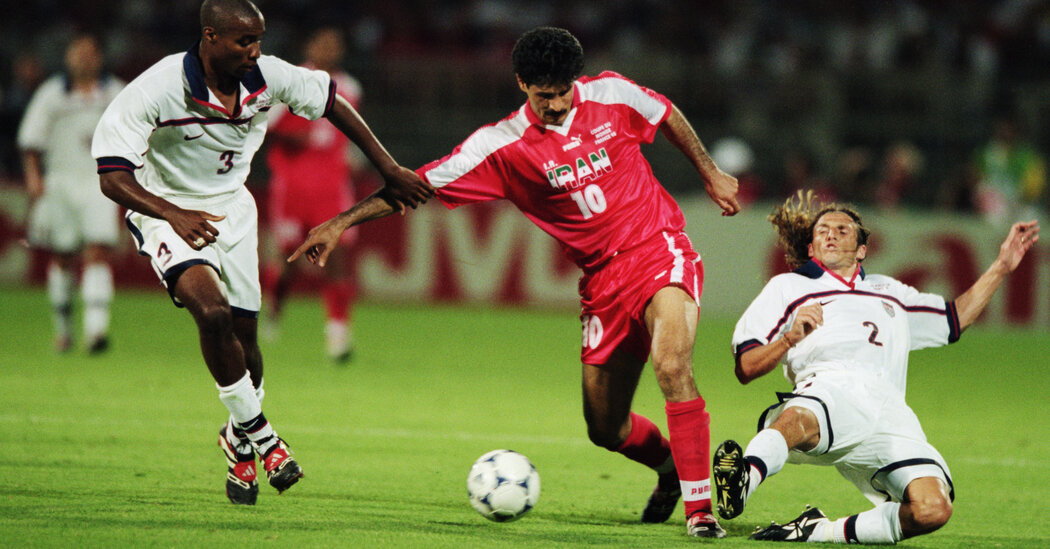
The convergence of global football and intense national rivalry is a phenomenon as old as the World Cup itself, acting as a historical theater where unresolved historical grievances and ideological battles are fought with a ball rather than bullets. One need only look back to the Cold War matches of 1974, when East Germany’s unexpected victory over West Germany prompted players to secretly swap jerseys in the tunnel, defying the explicit prohibitions of the East German communist regime, or to the highly charged 1986 quarterfinal between Argentina and England, played just four years after the bloody Falklands War, where players from both squads later admitted the match felt less like a game of sport and more like an active border conflict. Perhaps no match in modern history embodied this socio-political convergence more than the legendary 1998 World Cup encounter in Lyon, France, where Iran faced off against the United States in what commentators universally labeled the most politically explosive game in tournament history. For a generation of Iranians who had lived through the devastation of the 1979 Islamic Revolution and the grueling decade-long war with Iraq that followed, that team—anchored by legendary figures like a youthful Ali Daei, whose international goal-scoring record would stand unrivaled for decades until the rise of Cristiano Ronaldo—became a powerful symbol of resilient national rebirth. The subsequent historic upset, which saw Iran eliminate the United States, triggered an unprecedented outpouring of pure joy on the streets of Tehran, where millions of citizens, including young children held aloft by celebrating parents, danced alongside traffic police in an open, defying display of shared cultural identity that temporarily dissolved the political barriers of the state.
3. The Fractured Republic: How Modern Crackdowns Severed Soccer’s Unifying Power
=== THE COLLAPSE OF UNITY ===[ 1998: National Unity ] [ 2026: Existential Fracture ]
- Unified Street Celebrations – Deep Civil Discard & Trauma
- Shared Cultural Resilience – Memory of Brutal Crackdowns
- Pride in the Post-War Era – Slogans of “Woman, Life, Freedom”
Almost three decades after that warm night in Lyon, the fragile illusion of football as a unifying national force in Iran has completely shattered under the weight of systemic domestic trauma and state-sponsored violence. The current World Cup tournament does not merely take place against the backdrop of an impending regional war; it unfolds in the immediate wake of one of the deadliest and most systematic domestic crackdowns in Iran since the establishment of the Islamic Republic, sparked by the “Woman, Life, Freedom” protests that saw thousands of citizens killed, tens of thousands imprisoned, and a subsequent surge in state-sanctioned executions designed to silence remaining dissent. Recognizing the immense influence of the beautiful game, the Iranian government has aggressively sought to co-opt the national team as a soft power validation tool, utilizing state-controlled media to paint the squad as loyal guardians of the revolutionary establishment. This aggressive politicization of the sport has thrust Iranian fans into a state of profound existential grief, forcing them to grapple with the painful reality that cheering for their beloved team in 2026 is no longer a simple act of civic pride, but a performance that will be heavily weaponized by the state apparatus to project a false narrative of domestic peace and national alignment to the rest of the watching world.
4. Defiance, Coercion, and the Evolution of the “Government Team”
                     === THE DISSYMETRY OF PROTEST ===
[ Defiance ] [ Co-optation ]- 2009: Green Wristbands in Seoul – 2026: Pre-Match State Rallies
- 2022: Anthem Silence in Qatar – 2026: “Minab 168” State Brand
- Historic Silent Resistance – 2026: AI-Generated State Prop
The history of the national team is marked by a quiet, agonizing battle between the players’ desire for self-expression and the state’s demand for absolute ideological conformity. This struggle burst into the open during a 2009 World Cup qualifier in Seoul, when several team members took the field wearing green wristbands in a subtle nod to the Green Movement protests at home, only for the accessories to vanish at halftime following aggressive, back-channel threats of forced retirement and state-imposed professional exile. That same tension reemerged during the opening matches of the 2022 World Cup in Qatar, where players initially refused to sing the national anthem as a silent tribute to the protesters fighting in the streets of Tehran, only to awkwardly capitulate in later matches under intense pressure directed at their families back home. In the years since, the space for such quiet defiance has shrunk dramatically, replaced by a sophisticated regime campaign that has seen players staged at pro-government rallies, branded with state-approved slogans like the “Minab 168” moniker—a term chosen by the government to commemorate Iranian children killed in historical conflicts with Western powers—and featured in sophisticated, AI-generated promotional videos produced by state-run news agencies that wrap the team in religious and revolutionary iconography. By forcing the athletes to become active participants in this state theater, the regime has successfully alienated a massive segment of the domestic population, leading many political dissidents and everyday citizens to reject the squad entirely, branding them as nothing more than “the government’s team.”
5. Divided Loyalties and the Battle for a Nation’s Soul
                     === THE CITIZEN'S PARADOX ===
         [ Mohammad (Tehran) ]             [ Shawheen Keyani (L.A.) ]
                 |                                     |
                 v                                     v
     "The Team is Compromised."           "They Represent the People."
     - Disenchantment with Players        - Platform to Transcend Media
     - Viewing Success as State Prop      - Separation of State & Culture
This polarization has created a deep chasm between those who view the team as an extension of an oppressive regime and those who still cling to the sport as a sanctuary of cultural identity, revealing the immense emotional toll of being a sports fan in a deeply divided society. In the teahouses and living rooms of Tehran, lifelong enthusiasts like Mohammad, a thirty-year-old resident speaking under a pseudonym for fear of violent state retaliation, describe a profound sense of disenchantment, explaining that many of his peers now actively root against their own national squad out of a belief that any success on the pitch will only be used to legitimise the regime’s domestic atrocities. Yet, across the diaspora, this view is countered by creative voices like Shawheen Keyani, a Los Angeles-based filmmaker who grew up in Iran, who argues that the national team remains one of the few avenues left to present a humanized, multifaceted portrait of the Iranian people that transcends the bleak, fear-driven caricatures of western media. This fundamental disagreement highlights the tragic burden placed on modern Iranian fans, who are forced to ask themselves who they are truly cheering for when they root for Iran, knowing that the sport they love has been systematically transformed into a battleground for a regime that values their passion only as a tool for political survival.
6. Parallel Traces of Preservation and Power on the Global Stage
=== PARALLEL PATHS OF HISTORICAL MEMORY ===[ IRAN SOCCER CRISIS ] —> State co-optation vs. true cultural expression.
[ DAVID HOCKNEY (88) ] —> Defiance of censorship through queer visual art.
[ JAPANESE MONARCHY ] —> Preservation of patriarchy vs. modernization.
[ MARGARITA MORA (91) ] —> Keeping indigenous Andean weaving methods alive.
This collision of culture, political power, and personal identity is by no means unique to the pitches of the World Cup; it echoes across a globe wrestling with the transition of legacy and the preservation of authentic cultural expression against institutional control. We see this struggle reflected in the life of the legendary British-American painter David Hockney, who recently passed away at the age of 88, leaving behind a body of sun-drenched artwork that not only captured the spirit of mid-century Los Angeles but served as a defiant, public defense of gay imagery against state censorship during a much more conservative era. It is mirrored in Tokyo, where Japan’s imperial family is currently navigating a looming succession crisis, choosing to explore archaic laws that allow the adoption of distant male relatives rather than reform their traditional patriarchal rules to allow women to inherit the Chrysanthemum Throne. Even in the remote, quiet peaks of the Venezuelan Andes, where 91-year-old master weaver Margarita Mora spends months manually dyeing wool with wild avocado pits to preserve ancient, pre-Hispanic textile motifs, the struggle to keep genuine human artistry alive against the march of mechanized globalization is constant. Whether expressed through the stroke of a painter’s brush, the calculated preservation of imperial dynasties, the slow rhythm of an Andean loom, or the frantic energy of a citrus-infused Xec salsa prepared in the kitchens of the Yucatán, humanity’s deepest instinct is to reclaim its stories from those who wish to suppress, commercialize, or weaponize them—proving that on the pitch of global politics, the fight for who gets to define a nation’s soul is far from over.