


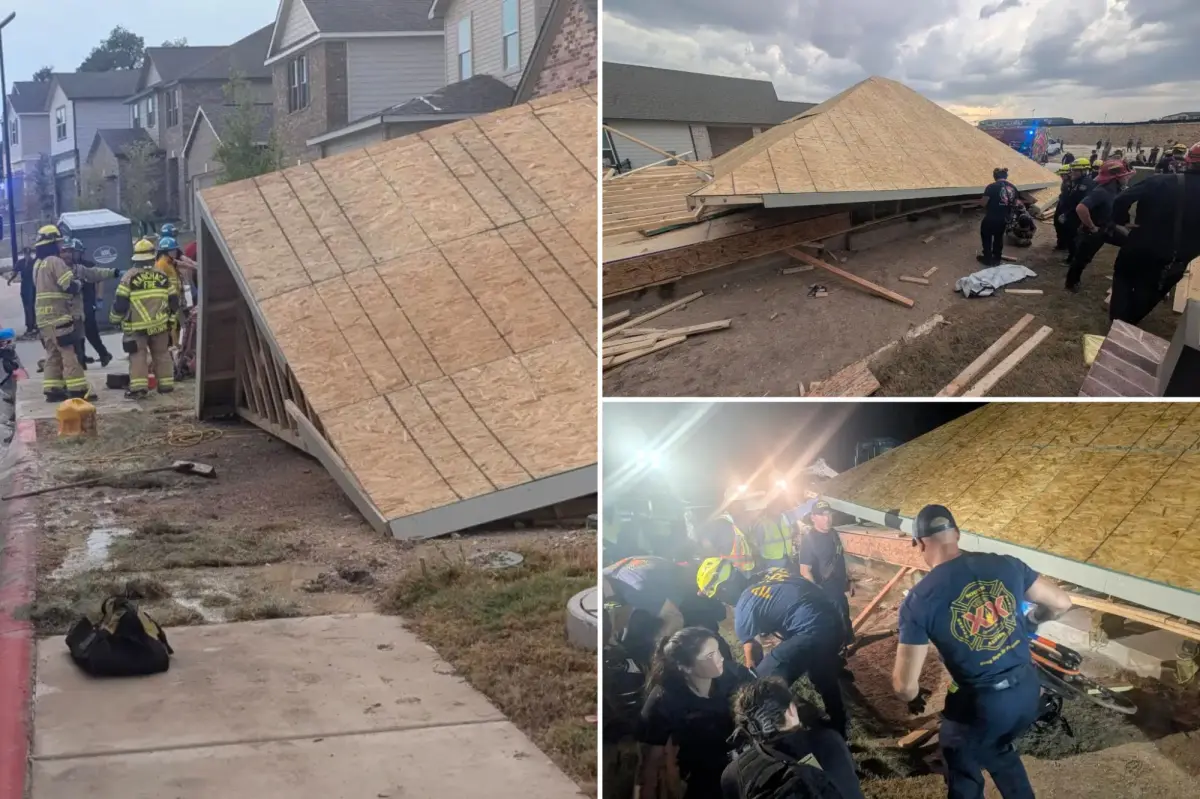
On a windswept Thursday in Central Texas, what began as an ordinary workday for a crew of construction workers turned into a heartbreaking tragedy in a matter of seconds. Severe storms swept through the region, bringing with them ferocious winds that measured between fifty and seventy miles per hour. In Travis County, these winds proved to be more than just a weather warning; they were a force powerful enough to bring an entire two-story home crashing down, with four workers still inside. What followed was a frantic escape, a desperate rescue, and ultimately the confirmation of a death that left an entire community in mourning. Travis County Emergency Services confirmed the fatality on Friday morning, but the emotional weight of the event will linger far longer than any official statement. The home, still under construction, was supposed to become someone’s future, a place of beginnings and memories. Instead, it became the site of a disaster, and a stark reminder that the very structures we rely on for safety can, in an instant, become instruments of harm. For the workers, for the survivors, for the family of the man who did not make it out, this was not just a weather-related incident; it was a life-altering loss that will be felt for years to come.
The details of the collapse, as shared by Travis County Emergency Services, paint a harrowing picture. Four workers were at the home when the winds intensified and the structure began to give way. There was no dramatic warning, no time to prepare; the house simply surrendered to the storm. Two of the workers managed to escape as the building was collapsing around them, their quick reactions and sheer luck saving their lives. But the other two were not so fortunate. The entire two-story home came down, trapping both men beneath the wreckage. When first responders arrived, they found one of the trapped workers awake and breathing, pinned underneath the framework of the house. The man was alive, conscious, and likely terrified, his survival hanging by a thread as rescue teams worked to free him. The other worker, however, had sustained severe injuries and did not survive. The contrast between those two outcomes—one man fighting for his life, the other already gone—captures the cruel randomness of such disasters. In the chaos of collapsing wood, drywall, and steel, there is no order, no fairness, and no time to make sense of what is happening. The men who escaped likely carry the trauma of those moments, haunted by the sounds of breaking beams and the screams of their colleagues. And the two workers trapped beneath the debris experienced a terror that most of us cannot begin to imagine.
The rescue operation that followed was nothing short of extraordinary, involving some of the most skilled first responders in the region. Travis County Emergency Services District 5, working alongside the Austin Fire Department’s Special Operations team, faced a daunting and dangerous task. The house had collapsed entirely, creating a maze of unstable rubble that could shift at any moment. To free the one worker who was still alive, the teams had to stabilize the wreckage and then carefully lift portions of the home off of him. It was a delicate, high-stakes operation in which any mistake could mean the difference between life and death. The rescuers worked with precision and urgency, knowing that time was precious and that the pinned worker’s condition could deteriorate at any moment. They talked to him, reassured him, and did everything in their power to keep him calm while they worked. Meanwhile, they were faced with the grim reality that another worker was beyond saving. For the rescue teams, this was not just a job; it was a matter of human dignity, of bringing a measure of care to a scene of chaos. The image of first responders lifting a house off a living person, while another person lies nearby, is one that will stay with them for the rest of their careers. Their efforts were heroic, and their dedication to preserving life, even in the face of overwhelming odds, deserves the deepest gratitude of the community they serve.
The intensity of the storm was perhaps best captured by a neighbor who watched the events unfold from just a few feet away. She described the winds as so fierce that the trees were blowing sideways, bending under a force that seemed almost supernatural. Then she heard a loud boom—the unmistakable sound of a structure giving way. The house next door had collapsed, and the noise was so powerful that it cut through the roar of the storm. For that neighbor, the ordinary sounds of a windy afternoon were shattered by a deafening crash, and she suddenly found herself at the edge of a tragedy. Wind reports from the region confirmed gusts of up to sixty miles per hour during the storms on Thursday afternoon, but numbers and statistics cannot convey the raw power of those winds. They can only hint at what the workers experienced as the walls began to tremble and the roof started to fall. The storm swept through quickly, leaving behind not only physical destruction but also emotional devastation. In the aftermath, the neighborhood was quiet, the kind of quiet that follows sudden violence, filled with unanswered questions and unspoken grief. For the neighbor, the memory of those sideways trees and that loud boom will forever be tied to the loss of a life.
This tragedy also shines a light on the often overlooked dangers faced by construction workers every single day. They are the people who build our homes, our schools, our places of work, yet they do so under conditions that are frequently unpredictable and hazardous. Severe weather, in particular, creates hidden dangers that cannot always be anticipated. A windstorm can turn a half-finished structure into a death trap in seconds, as this incident tragically demonstrates. Safety protocols and weather warnings are important, but they are not infallible. Workers on the ground have to make split-second decisions, weighing the pressure to complete a job against the need to stay safe. In this case, the winds arrived with such force that there may have been little time to react at all. The two men who escaped may spend the rest of their lives wondering why they made it while their colleagues did not. Survivor’s guilt is a heavy burden, and they will need support, not just in the immediate aftermath but in the months and years to come. The family of the deceased worker now faces the unimaginable task of grieving a loved one who went to work one morning and never came home. Their loss is not just personal; it is a loss that ripples through the entire community, reminding us all of the fragility of life.
In the end, a construction site in Travis County is now a place of remembrance rather than a place of building. The home that collapsed will likely be cleared away, and perhaps another structure will rise in its place. But the life that was lost cannot be replaced. The worker who died was someone’s father, son, brother, partner, or friend. He was a person with dreams, stories, and a future that was stolen by the wind. His death is a stark reminder that behind every statistic is a human being, and behind every accident report is a family left to pick up the pieces. We can honor his memory by acknowledging the sacrifices that construction workers make every day, often without recognition. We can also extend our compassion to the survivors, the rescuers, the neighbor who heard the boom, and everyone else touched by this tragedy. In the face of such loss, there are no easy answers, only the quiet strength of a community coming together. As the winds eventually died down and the debris was sorted through, the focus shifted from rescue to recovery, from hope to grief. But even in that grief, there is a reminder of our shared humanity—the willingness of strangers to risk their lives for others, the empathy of a neighbor who described what she saw, and the collective sorrow we feel when one of us falls. The construction worker who died in Texas did not die alone, and he will not be forgotten. He was one of us, and his story is now part of the larger story of all those who labor to build the world we live in.