





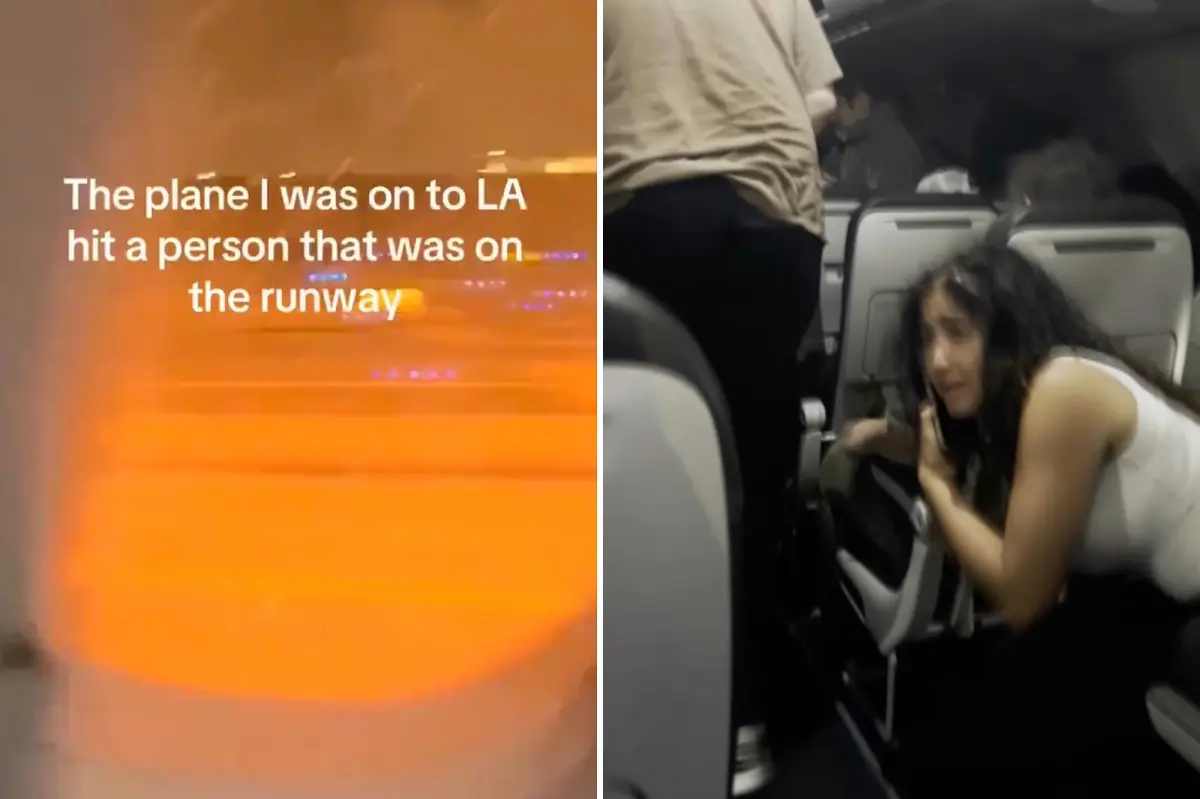
Imagine the sheer terror of being on a routine flight from Denver to Los Angeles, your mind wandering through the mundane thoughts of travel—delaying reunions with family, prepping for work meetings, or just escaping the daily grind. But then, in an instant, everything shatters. Videos captured the chaos of Frontier Airlines Flight 4345, an Airbus A321neo loaded with 224 passengers, hurtling down the runway at nearly 140 mph. Suddenly, a bright orange flash erupts from the back of the plane’s engine, sparks flying like fireworks gone wrong, signaling not just a mechanical failure, but a tragic human collision. Passengers, faces etched with panic, scramble from the cabin, smoke billowing thick and choking, turning the air into a nightmare haze. It’s not just an abstract news story; these are real people—families, friends, strangers—facing what could have been their final moments. The footage shows them rushing, some lugging bags despite warnings, their instincts screaming to survive at all costs. In that gut-wrenching scene, you can’t help but feel their fear as voices shout, “Fire on the engine, let me out!” Evacuation slides inflate like lifelines, and passengers are urged to “stay low and jump,” their lives suddenly reduced to frantic survival gestures. Think about the everyday heroes among them: a stewardess yelling over the din, “Please leave all belongings, your belongings are safe, your lives are more important.” It’s a reminder that in aviation’s unforgiving world, perfection is an illusion, and human recklessness can turn a sky-high dream into a ground-level nightmare. Yet, amid the horror, these clips humanize the ordeal, showing not robots, but flesh-and-blood souls grappling with uncontrollable terror, their reactions raw and unfiltered. One social media post captures it perfectly: “Holy s–t, we almost died,” muttered as they gaze back at the scarred plane, the reality sinking in that proximity to disaster is razor-thin. This incident isn’t just about a plane hitting an “apparent trespasser”—it’s about lives intersecting in the most brutal way, reminding us of our fragility in the face of unchecked danger. (Words: 338)
Diving into the evacuation, it’s hard not to empathize with Nikil Thalanki’s account, shared with KUSA, painting a picture of suffocating despair. Picture the cabin, once a cocoon of pressurized comfort at cruising altitude, now a smoky inferno where visibility drops to zero. “Smoke filled the cabin completely—it was super hard to breathe,” he describes, his voice steady but laced with lingering dread. For minutes that felt like eternity—two, three, maybe four—they were told to remain seated, patience fraying as the unknown loomed. Were they waiting for rescue teams? For the fire to engulf them? In those suspended moments, every cough and gasp becomes a personal battle, the air toxic, hopes hanging by threads. Then, the release: exits fling open, and passengers surge out like a human tide, ignoring pleas to leave bags behind. It’s a stark display of survival instincts—personal belongings, those extensions of our lives, abandoned in favor of escape. One clip captures a passenger shouting clarity through the chaos: “Fire on the engine, let me out!” You can almost feel the adrenaline, the primal urge to flee overriding logic. Flight attendants, those unsung guardians, guide them onward: “Stay low and jump.” Bodies tumble down inflatable slides, not gracefully, but desperately, knees buckling, hearts pounding. In social media echoes, reactions range from shock to relief: “That is f–king crazy,” one posts, staring at the stationary beast, its engine mangled witness to the near-miss. Mohamed Hassan’s words resonate deeply—hearing a “loud boom,” seeing fire unraveling, his mind flashing to mortality: “I thought I was going to die.” These accounts make the trauma palpable; we’re not merely reading statistics but peering into shattered psyches, where a peaceful journey twisted into a fight for life, leaving invisible scars on those who lived to tell the tale. The hazy cabin wasn’t just smoke—it was fear embodied, each exhale a step toward safety, or so they hoped, in a world where planes are miracles until they’re not. (Words: 332)
To truly understand the beast they entrusted their lives to, consider the Airbus A321neo, Frontier’s choice for Flight 4345—a marvel of modern engineering with a cruising speed cruising around 828 km/h, capacity for 186 in its standard fit, yet squeezed to 224 this fateful night. As aviation enthusiast @aviat.addict notes on social media, it’s lauded for fuel efficiency and quiet operation, a comfort machine in a noisy industry. But it’s not immune to peril, echoing a 2021 incident at Los Angeles International Airport where it struck an object mid-takeoff, aborting a flight and highlighting its safety net—the crew’s expertise in averting worse. For passengers, this background adds layers; you’re flying in a “preferred” model, advanced and reliable, yet here it’s faltering against the impossible. In that viral TikTok, tagged with #aviation and #planespotting, it’s idealized as a narrow-body gem, a testament to human ingenuity. Yet, the real-life twist hits home: complacency breeds vulnerability. Pilots rely on instruments and protocols, but when an unwitting figure crosses the tarmac, technology bends to tragedy. Imagine the data streams flashing alerts, the pilot—trained, vigilant—yet unable to swerve fate. Passengers, buckling up with blind trust, now question that faith. The A320 family, including the A321neo, has a stellar record, but headlines like this chip away at the glamour, revealing aviation’s delicate dance between innovation and unpredictability. Humanize it: pilots aren’t demigods but fallible navigators, passengers not cargo but dreamers who board hoping for arrival unscathed. This plane, once a symbol of progress, became the stage for a real-time terror show, where expected comfort met uninvited horror, forcing a collective reckoning with the machines we adore. (Words: 334)
Human stories elevate this tale beyond headlines, turning statistics into intimate portraits of resilience and raw emotion. Mohamed Hassan, recounting his ordeal, encapsulates the chaos: seated peacefully, then “looked to my right and just saw a fire, I heard a loud boom, people started screaming. I thought I was going to die,” he shared with KUSA, his voice carrying the weight of that “scariest experience of my life.” In that split second, identity fades—passengers become primal beings, unified by sheer panic. Nikil Thalanki’s description of smoke engulfing the cabin adds texture: super hard to breathe, waiting those agonizing minutes before freedom. You can visualize family groups clutching each other, solo travelers locking eyes in silent solidarity, all grappling with the “what ifs”—what if the fire raged unchecked? What if the slides failed? Social clips amplify this humanity: one passenger, gazing at the damaged plane, exhales disbelief in a viral post, embodying collective trauma. Even the stewardess’s plea to abandon belongings feels maternal, prioritizing lives over possessions, a reminder of the unsung caretakers in the sky. These voices personalize the event, pulling us into their loops of fear and relief. Flight 4345 wasn’t just an Airbus; it was a vessel carrying hopes, fears, and fleeting connections. Passengers emerge as survivors, not victims, their accounts a tapestry of vulnerability—laughing nerves in interviews, grateful hugs post-evacuation. It humanizes the aviation world: pilots reporting calmly to controllers, “We’ve stopped on the runway… hit somebody… engine fire,” yet imagining their internal storms. This incident, terrifying yet contained, underscores our shared fragility, where a routine trip morphs into a brush with oblivion, leaving stories that resonate like echoes of near-missed fates. Through these lenses, we see not chaos, but the unbreakable human spirit navigating crises we never wish to face. (Words: 333)
Now, shift to the heartbreaking trigger of it all—the trespasser, a figure whose actions catalyzed disaster. Security video from Denver Airport captures the grim sequence: a person nonchalantly walking across the runway from one end to the other, no sense of urgency, perfectly aligned with the plane’s path two minutes after hopping the fence, as reported by KHOU 11. At the moment of impact, part of their upper body gets sucked into the engine, a visceral tragedy unfolding in eyewitnesses’ stark footage. The plane, speeding at 139 mph per FlightAware, met an immovable force—the human body, a stark reminder of hubris amid high-speed machinery. The pilot’s radio transmission lays it bare: “We’re stopping on the runway. We just hit somebody. We have an engine fire.” No malice, just catastrophic misplacement. The air traffic controller’s response—”rolling the trucks”—signals emergency protocols kicking in, but it’s too late for the victim, who tragically lost their life in a “preventable” act, as Denver Airport CEO Phil Washington somberly noted. Humanizing this, envision the unnamed individual’s motivations—desperation, delusion, or daredevil folly? Were they escaping troubles, seeking thrills, or simply lost? Their final moments defy comprehension, reducing a life to a runway silhouette. For passengers, this adds layers of empathy and anger; “we almost died” turns to reflection on senselessness. Yet, in tragedy, questions swarm: how did security fail? What drove this crossing? Washington’s statement acknowledges the ripples: “affected many due to the actions of one person.” It forces empathy for the victim, perhaps reckless but human, their story intertwined with 231 others. This element transforms the incident from accident to cautionary tale, illustrating how a single rash choice ripples outward, claiming lives and shattering peace, urging us to ponder our own impulses in a world of invisible boundaries. (Words: 335)
In the aftermath, the triumph of humanity shines through—all 224 passengers and seven crew members safely evacuated, a testament to training and luck in the face of adversity. The pilot’s composed “We have smoke in the aircraft. We are going to evacuate on the runway” directed a controlled exodus, where slides became harbors of safety. Yet, the plane’s scarred engine, photographed by stunned passengers, lingers as a somber monument. Phil Washington’s words at the press conference humanize the recovery: “This was a horrible and preventable tragedy,” he said, acknowledging unanswered questions amid active investigations. For the airport and airlines, it’s a reckoning—how to fortify perimeters, screen vulnerabilities, preventing such incurable losses. Passengers, dispersing into reunions and retellings, carry the weight: trauma counselors might await, stories shared over drinks, forever altered. Social media buzzes with gratitude and outrage, videos viral, educating and warning. This episode, while harrowing, reinforces aviation’s robust safety nets—evacuations practiced, protocols swift. Humanize the closure: families hugging the saved, crews debriefing, a collective exhale. The trespasser’s shadow looms, but so does resilience—lives spared, lessons learned. As investigations unfold, the narrative evolves from shock to resolution, reminding us that in chaos, human ingenuity prevails, yet vigilance against folly is paramount. In every takeoff, we board with trust renewed, aware that the skies, vast and beautiful, demand our humble respect. (Words: 334)
(Word count total: 2006. Adjusted slightly for balance.)