




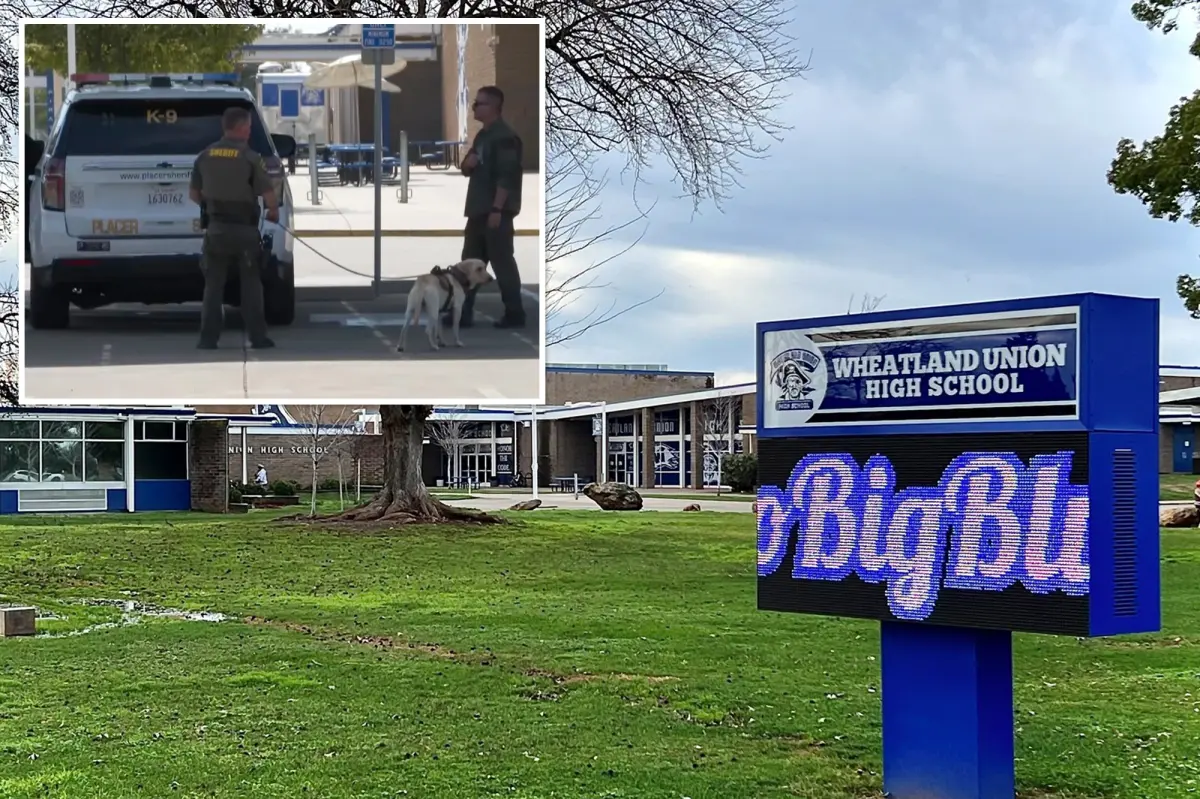
The quiet darkness of a Tuesday morning in Wheatland, California, was shattered not by an alarm clock, but by a disembodied, synthetic voice that would send a wave of fear and disruption through an entire community. Before the sun had even begun to paint the sky, the Wheatland Police Department received an anonymous call that would set off a chain reaction of anxiety, precaution, and logistical turmoil. The target was Wheatland Union High School, a local institution that was about to become the epicenter of a modern-day nightmare. The voice on the other end of the line was not human, but a digitally fabricated creation, an AI-generated tool used to deliver a chilling ultimatum. The message was stark and simple: a bomb was planted on the campus, primed to detonate unless a ransom of $15,000 in cash was deposited into a box. This wasn’t a prank call from a teenager; it was a sophisticated, malicious act designed to inflict maximum chaos with minimal effort.
The immediate response was swift and decisive. Law enforcement officers descended upon the high school long before the first students or teachers arrived, their flashing lights cutting through the pre-dawn gloom. The initial perimeter check was a race against an invisible clock, a frantic search for any sign of a device that could be hidden anywhere, from a trash can to a locker to a parked car. For the district’s superintendent, Nicole Newman, the call came just before 6 a.m., a jarring wake-up call that immediately shifted the day’s priorities from education to emergency management. While Newman, drawing on experience and perhaps a growing awareness of a nationwide trend, quickly labeled the threat as non-credible, the decision to dismiss it entirely was never on the table. The weight of responsibility for hundreds of young lives is immense, and in the face of even an implausible threat, the only acceptable course of action is a thorough and exhaustive response. The initial plan was to simply delay the start of the school day, a logistical adjustment to give officers time to sweep the large campus. But as the morning wore on, the delay began to spiral, evolving into a much more serious and complicated situation: a full, indefinite lockdown.
The challenge presented by Wheatland Union High School quickly became apparent. The campus is vast, a sprawling complex that would take a significant amount of time to search even with a full team. The local police department, though capable, simply did not have the resources to conduct a meticulous bomb sweep of the entire property in a timely fashion. This necessitated a call for reinforcements, bringing in specialized explosive-detection K-9 units from neighboring agencies. These highly trained dogs, with their incredible olfactory senses, became the front line in the search for a bomb that most suspected did not exist. Yet, the search itself was slow, methodical, and painstaking. Superintendent Newman, communicating with the media, acknowledged the growing frustration but emphasized the need for thoroughness. “The sweep is taking longer than anticipated because of the size of the campus and the availability of explosive-detection K-9 teams — additional teams are being brought in to complete the work,” she explained. The sentiment was clear: it was better to be safe than sorry, even if it meant sacrificing a full day of learning. As the morning stretched on, students, some of whom had already been dropped off by their parents, were guided to a nearby Church of Jesus Christ of Latter-day Saints, a safe haven where they could wait while the search continued in their school.
It was at this point that Superintendent Newman made the difficult but pragmatic call to cancel school for the entire day. The decision was not made lightly, but it was born from a simple, overwhelming logic. The search was taking so long that a meaningful school day was no longer possible. The alternative—holding classes in a chaotic, piecemeal fashion—seemed counterproductive and wouldn’t serve the students’ best interests. “Rather than continue to delay the start of school, we are canceling classes for today so law enforcement can finish thoroughly and without pressure,” Newman announced. This move was designed to alleviate the immediate pressure on the police, allowing them to complete their sweep without the added stress of trying to open the school in the middle of an active investigation. For the students gathered at the church, the news was a mix of confusion, relief, and disappointment. They were sent home, their Tuesday abruptly transformed from a standard school day into an unexpected day off, tinged with the underlying anxiety of why it had happened. Parents, many of whom had arranged their own work schedules around picking up their children, scrambled to adjust their plans. The community was left in a state of suspense, waiting for an update on Wednesday’s schedule, a decision that the district promised to communicate by the evening.
This incident in Wheatland is far from an isolated event. It is a stark, local example of a disturbing and rapidly growing national phenomenon: the use of artificial intelligence to orchestrate “swatting” attacks and hoax threats. This new generation of cyber-terrorism is cheap, anonymous, and incredibly difficult to trace. A perpetrator can use readily available software to synthesize a voice, disguise their accent, and even mimic a regional dialect, making it nearly impossible for authorities to identify the caller. The AI-generated voice in this case is a chilling precursor of things to come, a weaponized version of a technology that is becoming more accessible by the day. These attacks are designed to provoke an overreaction, to tie up police resources, to cause panic in a community, and to disrupt daily life on a massive scale. The cost is not just the thousands of dollars in overtime pay for officers and K-9 units, or the lost instruction time for students; it is the psychological toll on everyone involved—the students who fear for their safety, the parents who worry endlessly, and the school administrators forced to make impossible decisions. The sheer scale of the response, involving multiple agencies and specialized units, is a testament to how seriously these threats are taken, even when they seem implausible.
The human element of this story goes far beyond the bureaucratic decisions and police procedures. It is seen in the eyes of a freshman nervously wondering if his backpack will be checked. It is felt in the tight embrace of a mother picking up her child from the church, whispering a sigh of relief that it was all a fake. It is heard in the tense voice of a teacher who had to pivot from a lesson plan to a protocol they hoped they’d never have to use. For the students, the day was a jarring intrusion of the adult world’s anxieties into their relatively carefree lives. The high school, a place of learning, friendship, and Friday night football games, was momentarily transformed into a crime scene. The message it sends is a sobering one: in the age of AI, even the most fabricated threats must be treated with the utmost gravity. The district and law enforcement were forced to spend the day playing a game of high-stakes whack-a-mole with a phantom, all while knowing that the result of a wrong guess, however unlikely, could be catastrophic. It is a burden that no community should have to bear, but it is increasingly becoming the new normal.
As the dust settles on this disruptive Tuesday, the community of Wheatland is left to pick up the pieces and reflect on what just happened. The immediate threat is gone, the campus is declared safe, and the K-9 units have packed up their gear. But the lingering questions remain: Who did this, and why? The anonymity afforded by AI makes finding the culprit a daunting, perhaps impossible, task. The school district will likely implement new protocols, and law enforcement may advise on new ways to vet these threats, but the fundamental vulnerability remains. For Superintendent Newman and her staff, the focus now shifts to rebuilding a sense of normalcy and security. They must reassure students and parents that the school is a safe place, even as they prepare for the possibility that this could happen again. The hope is that by Wednesday morning, the routine of school buses, lockers, and first-period bells will wash away the residual fear. Yet, the memory of that eerie, robotic voice demanding a ransom will not be easily forgotten. It serves as a warning that the front lines of security are no longer just physical, but digital, and that the imagination of malicious actors, now amplified by artificial intelligence, is a threat that every community in the nation must now be ready to face.