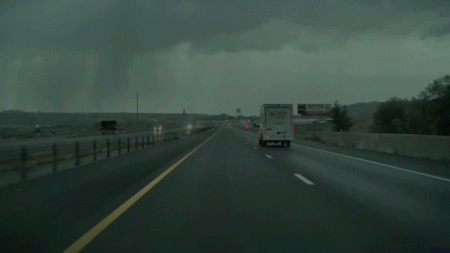




Newly released surveillance footage captures the heart-stopping final moments of a pursuit that would change two lives forever, as federal law enforcement vehicles tore through the streets of Austin, Texas, one recent weekend. The video, grainy and filled with the urgent wail of sirens, shows at least two vehicles rushing to close in on a speeding car driven by 28-year-old Wilber Rafael Garces Perez, a Venezuelan migrant who had come to the United States in search of a better life. The chase culminates in a burst of violence that leaves Garces Perez shot, bleeding, and in the custody of U.S. Immigration and Customs Enforcement (ICE) officers. The Department of Homeland Security has confirmed the footage is authentic, but the story it tells is anything but simple. It is a story of a young man working as a DoorDash driver, a routine delivery turned nightmare, and the armed agents who saw him as a target. It is also a story about how the same events can look radically different depending on the lens through which they are viewed, and how the pursuit of justice can become as murky as the shadows in the surveillance footage.
The man at the center of the incident, Wilber Rafael Garces Perez, had been living a precarious existence common to many undocumented immigrants in America—working gig jobs, staying out of the spotlight, and trying to earn an honest wage. According to his attorney, Katie Lincoln Goldfinch, Garces Perez was in the middle of his shift as a DoorDash courier when officers in an unmarked vehicle tried to run him off the road. The lawyer’s retelling is visceral and disturbing: a sudden, terrifying interception, the screech of tires, the sideswipe of metal against metal, a bumpy chase, and then the searing pain of a bullet entering the back of his neck. Goldfinch insists her client was not a violent criminal, but a frightened young man who must have been utterly confused when armed agents descended upon him in an unmarked car. She described how, after the shooting, officers yanked him from his vehicle, leaving him wounded and helpless. The image she paints is one of an overzealous law enforcement operation gone horribly wrong, a scenario in which an unarmed civilian was treated like a hardened fugitive, shot for reasons that remain unclear, and then denied proper medical and legal treatment while his life hung in the balance.
Yet the official evidence contradicts large parts of the attorney’s account, and the truth seems to be trapped somewhere between the two narratives. The surveillance footage, authenticated by the Department of Homeland Security, shows no obvious damage to Garces Perez’s vehicle, raising questions about the claim that officers sideswiped his car. More tellingly, body-worn camera footage from Austin police officers who responded to the scene shows a very different version of the aftermath. In that video, officers are seen gently assisting Garces Perez out of his vehicle, not roughly pulling him from it, as his lawyer had alleged. These discrepancies do not necessarily invalidate the attorney’s core concern—that a man was shot and may have been treated unfairly—but they demonstrate how chaotic, confusing, and layered the truth can be in the heat of such an encounter. Was there a moment when Garces Perez made a sudden move that spooked an already anxious officer? Did he resist commands, or did he try to flee because he feared being detained and deported? The answers are not yet clear, but the need for a thorough and transparent investigation is undeniable. What remains certain is that a young man now carries a bullet in his body and a trauma that will never fully heal, no matter what the inquiry concludes.
The aftermath of the shooting has been anything but quiet. Garces Perez, despite his wounds, was arrested and placed in ICE detention. Instead of being rushed to a hospital and given round-the-clock care, he was held in an immigration detention facility’s infirmary, isolated and fighting for his life. His attorney, Katie Lincoln Goldfinch, has been vocal in her demands, describing her client as “gravely ill” and in a “dire” condition. In an emotional Facebook statement, she revealed that a bullet remains lodged in his body, and she demanded that ICE restore his communication privileges and return him to the hospital immediately. “He needs access to appropriate medical care,” she wrote, her voice carrying a tone of mounting urgency and desperation. The fact that an injured man, shot by federal agents, is being treated almost as a prisoner rather than a person in need of aid has deeply disturbed advocates and civil rights groups. For many, the case has become a sobering reminder of the harsh and often unforgiving nature of the immigration enforcement system, where a person can be viewed as a threat first and a human being last.
The political fallout has been swift and fierce. Democratic lawmakers have seized on the incident, using it as a rallying cry against what they call a “rogue” agency intent on terrorizing cities and endangering the lives of ordinary residents. For them, the shooting of a DoorDash driver is yet another example of ICE operating with impunity, without respect for the communities they are supposed to protect. One of the most prominent voices in this fight is U.S. Representative Greg Casar, a Texas Democrat who visited the detention facility where Garces Perez is being held. In a video posted to X, Casar looked directly into the camera and accused ICE of blaming the victim while withholding crucial evidence. “ICE has been trying to blame all of this on him without releasing any of the video footage, any of the evidence,” he said, his tone a mix of anger and disbelief. His visit and words have amplified the call for accountability, and across Austin, groups affiliated with socialist and communist movements have organized protests, clamoring for transparency and justice. The streets have become a stage for a familiar battle: federal law enforcement versus immigrant communities, all played out in the glaring light of public scrutiny.
Beyond the political arguments and competing narratives is a profoundly human story. Wilber Rafael Garces Perez came to the United States, likely fleeing the collapsing economic and political conditions in Venezuela. He took on a gig that allowed him to make ends meet, navigating a city that is both welcoming and hostile to immigrants. In one terrible moment, his life was upended. Now, he lies in a detention facility infirmary, a bullet in his neck, isolated from the outside world, uncertain of his future. The surveillance footage and bodycam videos are more than just evidence; they are fragments of a man’s life breaking apart in real time. We see a speeding car, a chase, a gunshot—but we do not see the fear in his eyes or the pain in his voice when he realizes he has been shot by the very people who are supposed to protect and serve. The attorney and the lawmakers speak for him, but we do not know what he would say if given the chance. In the end, this case is not just about whether ICE acted properly or whether the lawyer’s claims are accurate. It is about the fragility of justice, the human cost of border enforcement, and the fragile trust between the government and the millions of immigrants who live in the shadows, hoping to make a life without becoming a headline. Until the full truth is revealed and the evidence is made transparent, the world can only watch and wonder about the fate of a young man whose only crime may have been being in the wrong place, with the wrong kind of document, in a country that is still trying to define what justice truly means.