



The sudden and terrifying outbreak of fast-moving wildfires in the Spokane area of Washington state has once again laid bare the raw, destructive power of nature and the profound vulnerability of human communities in its path. As walls of flames consumed dry brush, leaped across roads, and turned hundreds of family homes into heaps of gray ash, the disaster sparked a nationwide conversation about readiness, survival, and the agonizing psychological toll of losing everything in an instant. This painful reality was illuminated by an unexpected voice: Spencer Pratt, the former reality television personality and Los Angeles mayoral candidate, who survived the devastating 2025 Palisades Fire which completely destroyed his Pacific Palisades residence. Reaching out to the victims in Spokane with deep empathy, Pratt used his social media platform to deliver a sobering warning to Americans who still believe such catastrophes only happen to other people. Expressing his profound sympathies to the thousands of displaced Washington residents, Pratt emphasized that no amount of intellectual awareness can truly prepare a person for the visceral shock of seeing their life’s physical footprint erased in minutes. His message served as a stark reminder that as climate patterns shift and urban areas increasingly encroach upon wild spaces, the threat of catastrophic fire is no longer a distant possibility but an imminent reality for countless communities across the country.
Pratt’s warning went beyond mere expressions of grief, offering instead a highly pragmatic and fiercely urgent checklist for disaster preparedness that challenges the complacency of modern life. He urged families to abandon the dangerous assumption that emergency services or local governments will always be capable of saving their properties when a firestorm strikes, noting that the sheer speed of modern blazes often overwhelms even the most sophisticated firefighting infrastructure. In his raw and direct address, Pratt painted vivid, haunting scenarios designed to pierce through public apathy: he asked people to imagine the terror of a wildfire arriving at two o’clock in the morning while they are fast asleep, or sweeping through their neighborhood while they are stuck at work downtown, or even while they are miles away enjoying a weekend recreational trip, completely unable to rescue beloved pets trapped inside. The heartbreaking reality of lost animals was a point of deep grief for Pratt, who noted that for many families, losing a pet to a fast-moving fire is identical to losing a human family member. Beyond immediate survival, he warned that the emotional aftermath is a long, isolating journey, urging Spokane residents to rely heavily on one another and calling on the broader public not to forget the stricken community once the sensational headlines inevitably fade from the news cycle. Ultimately, Pratt concluded his emotional appeal by advising survivors to lean into their spiritual faith, quoting scripture to remind the brokenhearted that there is comfort to be found even amid the total ruin of their earthly possessions.
In the face of such overwhelming loss, symbols of resilience and community solidarity have emerged to offer solace to those who have lost everything. A powerful photograph shared by former Washington State Representative Matt Shea captured a solitary, undamaged American flag standing proudly on its pole amidst the charred, smoking ruins of a completely leveled neighborhood, a visual testament to survival that Shea described as “an amazing picture of hope among the ashes.” This image of enduring strength resonated deeply with a traumatized public, as did messages of spiritual and emotional support from prominent figures like former Seattle Seahawks quarterback Russell Wilson, who took to social media to rally prayers and support for the people of Spokane. Meanwhile, the immediate, practical burden of human displacement fell upon local charity networks, with the American Red Cross Northwest Region establishing emergency shelters that quickly filled to capacity. Over four hundred displaced residents, clutching whatever belongings they could salvage in the frantic moments before evacuation, spent stressful nights sleeping on cots alongside their frightened pets in a makeshift shelter in Spokane. The Red Cross characterized the three separate fires as a localized weather-driven crisis that has permanently altered the lives of thousands of families, prompting the organization to launch a massive, resource-intensive relief effort while desperately calling for local volunteers and financial donations to sustain their operations.
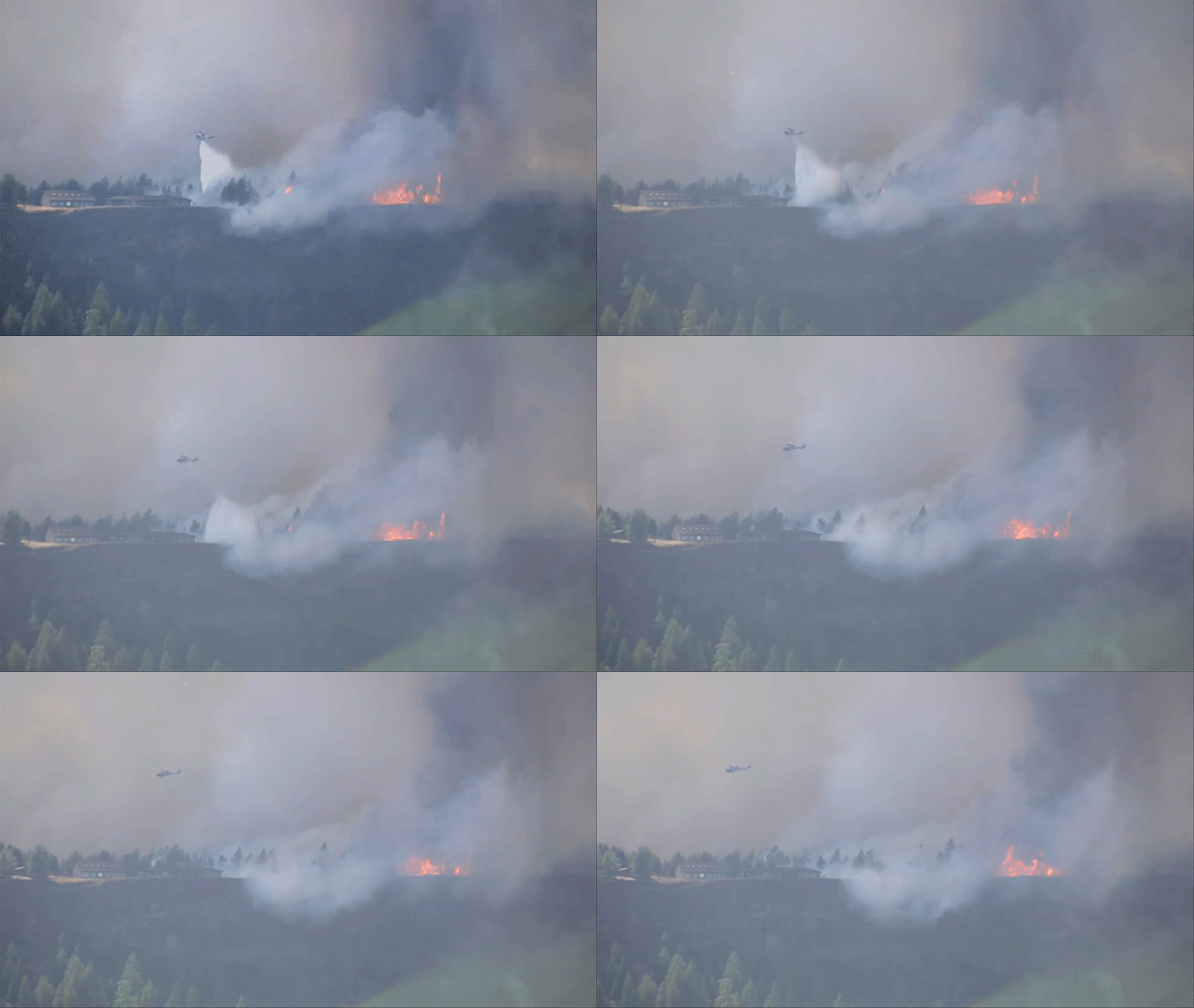
The operational reality on the ground remains an uphill battle of heroic proportions as more than nine hundred firefighters and specialized support personnel struggle to contain three massive, aggressive blazes. According to Incident Commander Benjamin Cossel of the U.S. Department of Agriculture, the wildfire emergency is currently being fought on three distinct fronts: the Autumn Lane Fire, which has consumed 3,333 acres; the Old Trail Fire, which has scorched 3,481 acres; and the Fairview Fire, which has rapidly expanded to 914 acres. Compounding the anxiety of local emergency managers, all three of these major blazes remained at zero percent containment as of the latest operational updates, with the vast majority of firefighting resources concentrated on the volatile Autumn Lane Fire. The physical toll of this disaster is staggering, with authorities confirming that approximately five thousand homes have been placed under mandatory evacuation orders, forcing families onto clogged roads as thick plumes of black smoke choked the horizon. Already, official assessments confirm that more than six hundred structures have been completely destroyed, a number that emergency officials grimly warn is highly likely to rise as search and rescue teams gain access to previously unreachable hot zones where active flames continue to block entry.
This escalating crisis has triggered a swift and coordinated political response spanning local, state, and federal levels of government, highlighting a shared determination to bypass partisan divisions in the service of disaster relief. Representative Michael Baumgartner, a Republican representing Washington, initiated immediate communications with Homeland Security Secretary Markwayne Mullin to advocate for rapid federal intervention and financial assistance. This effort was quickly amplified by Washington Governor Bob Ferguson, a Democrat, who held direct, high-level discussions with both Secretary Mullin and President Donald Trump to convey the sheer scale of the devastation threatening Spokane and other vulnerable regions across the state. Governor Ferguson reported that President Trump expressed genuine concern for the displaced citizens of Washington and promised to work collaboratively with state leadership to fast-track requests for federal aid. Expressing optimism that a federal emergency declaration would be approved with unprecedented speed, Ferguson’s efforts were echoed by Democratic Senator Patty Murray, who confirmed that her office is closely monitoring the situation and that the federal government is fully committed to long-term recovery efforts. Murray publicly lauded the tireless work of local fire crews, the Washington National Guard, and personnel from nearby Fairchild Air Force Base, while emphasizing that the road to recovery for the shattered communities of Spokane will be exceptionally long and demanding.
At the county level, local government officials have taken extraordinary administrative measures to streamline the emergency response, with the Spokane County Board of Commissioners voting unanimously to declare a formal state of emergency. This declaration grants local authorities the sweeping legal and financial power to bypass bureaucratic red tape, allowing them to rapidly purchase critical emergency equipment, secure temporary housing, and deploy vital resources directly to the frontlines without delay. Spokane County Commissioner Mary Brooks spoke for many when she expressed her profound sorrow for the families whose lives have been upended, while offering prayers of protection for the first responders risking their lives through consecutive sleepless nights. As part of this coordinated effort to protect lives, emergency officials issued an urgent, unconventional appeal to the public, begging boaters, kayakers, and paddleboarders to completely stay off local lakes, rivers, and reservoirs. These waterways have become critical staging areas for massive aerial water tankers and helicopters that must execute incredibly low, high-speed passes to scoop up thousands of gallons of water to dump onto the advancing flames. Officials warned that recreational water use during this crisis poses an extreme safety hazard to both the flight crews and the public, emphasizing that giving these aircraft clear, unobstructed access to water sources is a matter of life and death for the threatened communities waiting on the hillsides below.