


Spain’s First Lady to Stand Trial: Inside the Corruption Scandal Rocking Madrid
1. The Judicial Bombshell at the Heart of Moncloa Palace
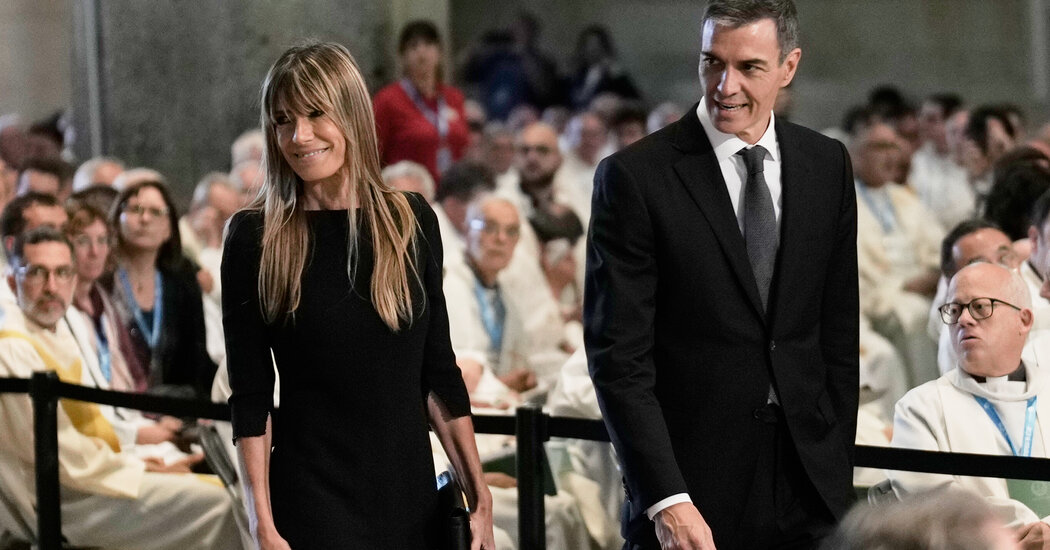
In a decision that has sent shockwaves through the highest echelons of European power, a Madrid judge has ruled that Begoña Gómez, the wife of Spanish Prime Minister Pedro Sánchez, must stand trial on serious charges of corruption and influence peddling. The momentous ruling, handed down by Madrid’s Investigating Judge Juan Carlos Peinado in an uncommonly blunt 84-page document, marks the first time in modern Spanish democratic history that a prime minister’s spouse has faced criminal prosecution while her husband remains in office. Ms. Gómez, who has been under intensive judicial scrutiny since early 2024, stands accused of leveraging her unique position as the nation’s first lady to secure lucrative public contracts and state concessions for private entities with which she maintained close professional and personal relationships. In a move that underscores the perceived severity of the flight risk and the gravity of the accusations, Judge Peinado ordered Ms. Gómez to immediately surrender her passport to authorities and mandated that she report to a designated court every fifteen days until a formal trial date is set. The judge did not mince words in his written decision, observing dryly that “behaviors such as these emanating from presidential palaces seem more characteristic of absolutist regimes, thankfully long forgotten in our country.” This extraordinary judicial reprimand has instantly transformed what was once a simmering political headache for the ruling center-left government into an existential crisis, placing the Spanish premier’s wife at the center of a high-stakes legal drama that threatens to paralyze the nation’s executive branch.
2. Understanding Spain’s Unique Legal System and the Genesis of the Case
To comprehend how a private citizen and academic like Begoña Gómez found herself facing a potential prison sentence, one must navigate the distinct, often highly politicized mechanisms of the Spanish justice system. Unlike Anglo-American legal systems, where public prosecutors hold a near-monopoly on bringing criminal charges, Spain allows for a mechanism known as the acusación popular (popular prosecution), which permits private citizens, advocacy groups, or even political parties to submit a complaint directly to an investigating judge. It was under this framework that a self-described anti-corruption collective known as Hazte Oír (Make Yourself Heard) initiated the initial legal complaint against the first lady, alleging that she had written letters of recommendation that directly aided a group of companies bidding for state contracts. Soon after the investigation commenced, other politically active organizations, including the right-wing populist party Vox, formally joined the accusatorial bench, transforming the courtroom into a battleground over the integrity of Spain’s public institutions. At the heart of the prosecution’s case are the business activities of Juan Carlos Barrabés Cónsul, a prominent entrepreneur who reportedly benefited from Ms. Gómez’s support in securing million-euro government tenders, alongside Cristina Álvarez, a personal assistant to the first lady who is currently being investigated for acting as an intermediary in these transactions. While Ms. Gómez’s legal defense team vehemently denies all allegations of wrongdoing, asserting that her professional activities were entirely legal and transparent, the investigating judge concluded that there is more than sufficient circumstantial and documentary evidence to warrant a full, public trial.
3. Pedro Sánchez’s Defensive Strategy and the “Lawfare” Narrative
For Prime Minister Pedro Sánchez, the impending criminal trial of his wife is not merely a domestic tribulation but an assault on his political legacy and the leftist coalition he has meticulously assembled. Since the investigation first came to light in the spring of 2024, Sánchez has adopted an aggressively defensive strategy, consistently framing the prosecution as a coordinated political hit job designed to achieve through the courts what his opponents could not accomplish at the ballot box. This strategy reached a dramatic crescendo in April 2024, when Sánchez shocked the nation by publishing a four-page letter on social media in which he threatened to resign, withdrawing from public duties for five days of “reflection” to consider whether leading the country was worth the personal toll on his family. Ultimately, the prime minister chose to remain in office, emerging from his self-imposed isolation with a defiant message that cast his survival as a defense of Spanish democracy itself against what he characterized as “lawfare”—the weaponization of the judiciary by conservative and far-right forces. However, as the legal proceedings against Ms. Gómez have advanced from introductory hearings to a formal trial order, this narrative of victimhood has faced growing skepticism from moderate voters and legal purists, who argue that the head of government is attempting to undermine the independence of the judiciary by publicly delegitimizing a sitting judge.
4. An Expanding Web of Scandals Ensnaring the Socialist Administration
The charges against the first lady do not exist in a political vacuum; rather, they represent the most high-profile chapter in a rapidly expanding ledger of legal controversies that have besieged the Spanish Socialist Workers’ Party (PSOE). In a dramatic escalation just last month, specialized police units conducted a high-profile raid on the PSOE’s national headquarters in Madrid, searching for electronic communications and financial documents linked to a broader network of alleged graft and party funding irregularities. This raid followed weeks of intensifying public anger, culminating in massive street demonstrations outside the party’s offices where thousands of ordinary Spaniards, waving national flags, demanded Sánchez’s immediate resignation. The political pressure has been compounded by judicial investigations targeting the prime minister’s immediate family and closest political allies, including his brother, David Sánchez, who is currently facing trial over allegations of tax evasion, influence peddling, and holding a highly paid, non-existent patronage job funded by public money in the region of Extremadura. Adding to this sense of institutional decay, Spain’s former socialist prime minister, José Luis Rodríguez Zapatero, a close confidant and mentor to Sánchez, was recently placed under formal judicial investigation following allegations that he received illegal kickbacks totaling upwards of $2.4 million in exchange for lobbying the government to bail out an ailing, politically connected airline during the pandemic.
5. Political Warfare: A Divided Nation and Calls for New Elections
The news of the impending trial has instantly supercharged the rhetorical warfare between Spain’s deeply polarized political factions, leaving little room for compromise or nuance. Within minutes of the judge’s ruling, senior members of Sánchez’s cabinet rushed to social media and television studios to denounce the decision, with Minister of the Presidency and Justice Félix Bolaños leading the charge by declaring it a “disastrous day for those of us who believe in justice.” Bolaños and other loyalists have argued that the trial is a media circus designed to inflict maximum reputational damage on the premier, asking rhetorically who would repair the irreversible damage done to the first lady’s character if she is ultimately acquitted. On the opposing side of the aisle, the conservative Popular Party (PP) and the right-wing Vox party have seized upon the ruling as irrefutable proof that the current administration is morally and politically bankrupt. Miguel Tellado, the general secretary of the Popular Party, mockingly observed that within the current socialist leadership, “if you don’t have a member of your family indicted, it seems like you’re nobody,” before renewing his party’s urgent demand for Sánchez to dissolve parliament and call a snap general election. Meanwhile, conservative civic activist groups have celebrated the judicial decision on social media, hailing Judge Peinado’s stubborn pursuit of the case as a victory for the rule of law and an inspiring example of a judiciary that refuses to yield to executive intimidation.
6. The Existential Crisis for Spain’s Government and Its Foreign Standing
As Spain prepares for the unprecedented spectacle of its first lady sitting in a criminal dock, the long-term viability of Pedro Sánchez’s minority government hangs in the balance. Sánchez, widely regarded as one of the ultimate survivors of modern European politics due to his uncanny ability to forge improbable legislative alliances, is now facing a mathematical and political reality that may finally escape his control. His coalition relies heavily on the erratic support of Basque and Catalan regional nationalist parties, many of whom are highly sensitive to charges of systemic corruption and may begin to distance themselves from the prime minister to preserve their own local electoral prospects. Beyond the immediate legislative gridlock in Madrid, the scandal threatens to severely diminish Spain’s international standing at a time when Sánchez has attempted to position himself as a leading progressive voice on global issues, from European integration to Middle Eastern diplomacy. If the trial of Begoña Gómez becomes a protracted, daily media circus filled with damaging revelations about the inner workings of Moncloa Palace, the resulting political paralysis could prevent the government from passing key national budgets, implementing economic reforms, and managing the rising social tensions that have come to define contemporary Spanish life.