



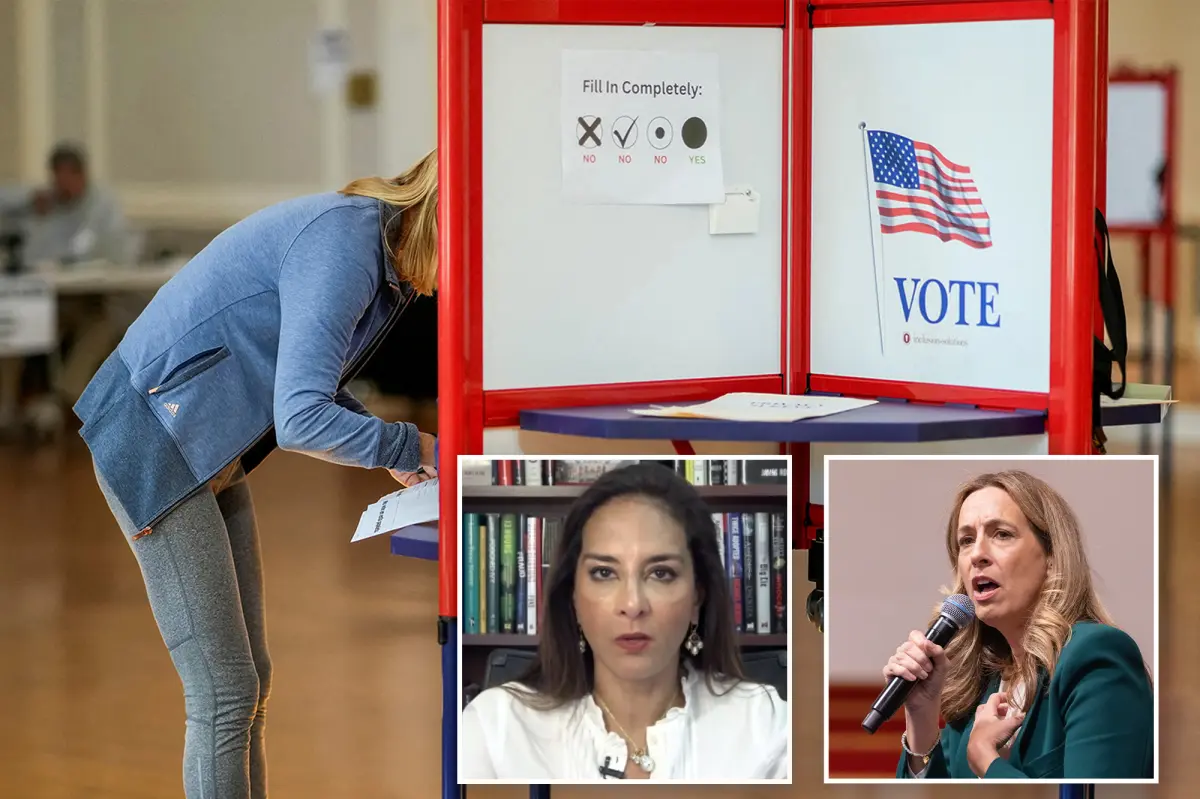
In an era where the sanctity of the ballot box has transitioned from a quiet cornerstone of daily civic duty into a fiercely contested ideological battlefield, the latest confrontation between federal authorities and state leaders highlights the profound anxieties currently shaping American political life. At the heart of this brewing storm is a highly charged clash of narratives between Assistant Attorney General Harmeet Dhillon, representing the Justice Department’s Civil Rights Division, and New Jersey Governor Mikie Sherrill. Dhillon has leveled a severe accusation of political hypocrisy against Sherrill, claiming the governor publicly condemned President Donald Trump’s allegations of voter roll vulnerabilities while privately knowing that her own administration was about to face a massive, embarrassing revelation regarding its voter database. For everyday citizens, who simply want to trust that their votes are counted fairly and secure from outside interference, watching these high-level officials trade hostile barbs feels deeply unsettling. This dispute is not merely a dry, clinical administrative disagreement over filing deadlines or database maintenance; rather, it is a deeply human drama about integrity, accountability, and the eroding trust between the public and the institutions designed to protect them. As political polarization deepens, the core mechanisms of democracy are increasingly treated as ideological ammunition, leaving voters caught in the crossfire of a relentless public relations battle where truth is often obscured by partisan spin and defensive posturing.
The specific timeline of this dispute serves to illustrate how rapidly information is weaponized in modern political warfare, creating an environment where timing is everything and narrative control is paramount. The conflict erupted in earnest following a primetime address by President Trump on July 16, during which he laid out a series of alarming intelligence claims, including allegations that Chinese operatives had successfully acquired sensitive American voter data while federal intelligence agencies actively concealed the breach from the voting public. Alongside these global national security warnings, Trump pointed directly to several states governed by Democrats, specifically singling out New Jersey, and asserted that their voter registration rolls were heavily populated with individuals who are not United States citizens. Proving that this was not merely rhetorical flourish, the Department of Homeland Security simultaneously released data showing that upwards of 35,000 potential noncitizens were indeed registered on the Garden State’s voter rolls. According to Dhillon, the sequencing of these announcements suggests that Governor Sherrill was fully aware of these looming federal statistics before they were made public, yet chose to preemptively go online to dismiss the president’s warnings as exaggerations and falsehoods to protect her administration from immediate political fallout. This sequence of events paints a picture of a calculated, high-stakes game of political chess, where defensive messaging takes precedence over addressing administrative flaws that could compromise the legitimacy of a state’s electoral process.
In the wake of Trump’s address, Governor Sherrill did not back down, choosing instead to align herself with a broader coalition of state executives to push back against what they viewed as an orchestrated attempt to undermine public confidence in democratic institutions. Sherrill signed onto a joint statement with twenty-three other Democratic governors, spearheaded by Kentucky Governor Andy Beshear, which sought to aggressively discredit the president’s sweeping claims and characterize his rhetoric as a collection of dangerous conspiracy theories. The unified statement forcefully asserted that American elections have been repeatedly proven to be safe, reliable, and secure, labeling the federal allegations as a coordinated effort to intimidate voters and suppress turnout. Furthermore, the co-signed document attempted to shift the national conversation back toward traditional kitchen-table issues, claiming that the Democratic governors were the ones consistently working to improve the daily life of families by lowering costs, fostering job growth, and defending fundamental personal freedoms. This strategic counter-offensive highlights a fundamental divide in how both political factions conceptualize election security: one side views any scrutiny of the voter rolls as an attempt to protect the system’s integrity, while the other interprets such actions as an insidious form of voter suppression designed to silence minority communities and dismantle democratic norms.
Beyond the rhetorical skirmishes on cable news and social media, the Justice Department under Dhillon’s direction has introduced concrete legal threats, emphasizing that the failure to cooperate with federal investigations will carry severe legal consequences. Dhillon issued a stern five-day ultimatum to Governor Sherrill, demanding the immediate release of New Jersey’s voter registration data to the federal government so that a thorough audit could be conducted. In making her case, Dhillon sought to ground the abstract legal debate in a basic principle of fairness that resonates with every individual voter: the idea that a single illegally cast ballot effectively cancels out the voice of a law-abiding citizen. By framing the issue around the protection of legitimate voters, Dhillon successfully tapped into a universal desire for fairness, arguing that the governor’s primary oath of office is to protect the constitutional rights of her own citizens rather than engaging in partisan finger-pointing. Although Dhillon insisted that cleaning up the voter rolls is a bipartisan necessity and expressed a willingness to cooperate with any state official open to working together, she made it unequivocally clear that the Justice Department would not hesitate to deploy the full weight of federal litigation to force compliance from hostile state governments. This escalation underscores how easily federalism can fracture when national security and state administrative sovereignty collide in an atmosphere of intense mutual suspicion.
Faced with the expiration of the federal deadline, Governor Sherrill made it clear that she would not easily capitulate to what she views as a politically motivated overreach by the Trump administration. Demonstrating her independence, Sherrill used a public appearance at a grocery store in Essex County—where she was signing unrelated, community-focused legislation—to address the unfolding crisis directly with journalists. While acknowledging the seriousness of the motor-voter registration irregularities and announcing that her administration was launching its own independent state-level investigation, Sherrill vehemently defended her refusal to hand over the data to federal authorities. She argued that the federal government was far more interested in weaponizing the administrative error to stoke division and fuel a narrative of election fraud than in actually working to ensure the smooth, fair execution of the democratic process. This response, echoed by her spokesperson Sean Higgins, portrays a leader who believes she is defending her state from federal overreach and protecting her constituents’ privacy from an administration she believes is acting in bad faith. By framing her resistance as a defense against the political exploitation of state-level administrative errors, Sherrill seeks to reassure New Jerseyans that her administration can correct its own mistakes without allowing external partisan actors to dictate the terms of local governance.
New Jersey’s high-profile stand against the Department of Justice is far from an isolated incident; rather, it reflects a broader, systemic fracture occurring across the United States as several other major states, including Pennsylvania and New York, similarly resist federal efforts to seize voter registration records. These states argue that stringent federal and state-level privacy protections prevent them from sharing sensitive citizen data, setting up a monumental legal showdown over the boundaries of state sovereignty and federal oversight. The Department of Justice has already begun to back up its threats with action, initiating lawsuits against state officials, including New Jersey’s own Lieutenant Governor Dale Caldwell, in an attempt to break the logjam. This escalating cycle of lawsuits, accusations, and public mutual distrust paints a sobering picture of the current state of American governance. When the essential task of maintaining accurate voter rolls becomes so hopelessly politicized that federal and state agencies cannot cooperate without resorting to litigation, the ultimate casualty is the average citizen’s faith in the democratic process. Solving these administrative errors requires transparency, collaborative efforts, and mutual respect between different levels of government, but as long as both sides remain entrenched in their respective political trenches, the human system of democracy will continue to suffer under the weight of perpetual suspicion and partisan warfare.