





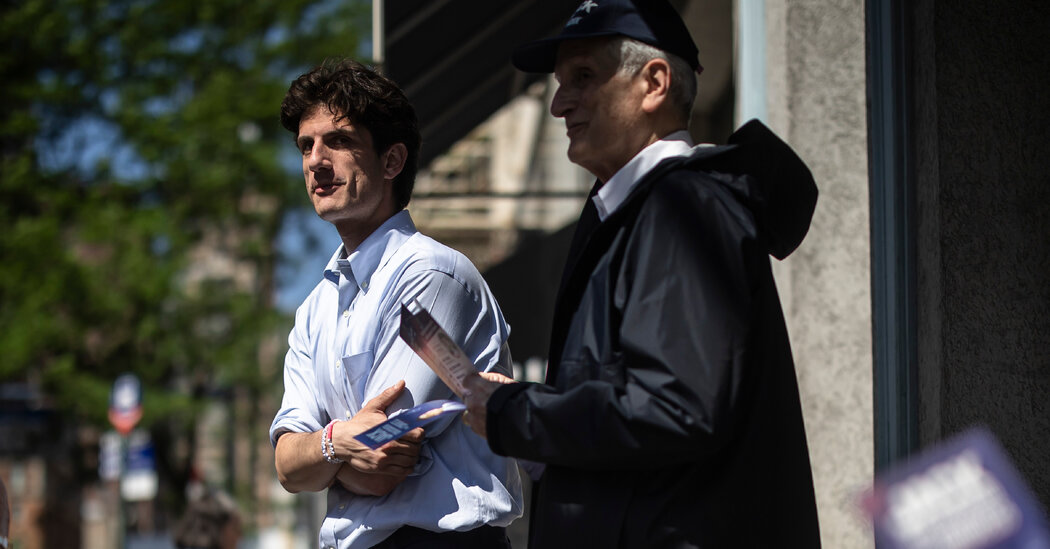
To look at Jack Schlossberg is to confront a ghost of American politics, a living canvas painted with the unmistakable strokes of the nation’s most storied political dynasty. At thirty-three years old, as he embarked on his maiden voyage into elective politics, Schlossberg seemed to carry the weight of Camelot on his young shoulders, possessing the striking, dark-haired handsomeness of his grandfather, John Fitzgerald Kennedy. He was the golden heir to a brand that had once defined the aspirations of the Democratic Party, a scion of old-money privilege who could easily self-fund a run while simultaneously railing against the corrosive influence of wealth in public life. Backed by the institutional weight of Democratic royalty like former House Speaker Nancy Pelosi, and armed with a glittering, eccentric social media presence that made him an online sensation, he entered the race for New York’s 12th Congressional District as the undisputed protagonist. His online persona—a captivating blend of quirky humor, energetic rants, and deeply opinionated declarations—resonated with a generation of younger progressives who had grown exhausted by the sterile, polished scripts of career politicians. When early polling placed him at the front of a crowded and highly competitive field, it seemed that the primary was merely a formality, a pre-ordained step in the inevitable restoration of the Kennedy magic to the halls of Congress. He was the scion of a dynasty that had captured the hearts of modern America, an old-money descendant of a political blueprint built on hope and rhetorical elegance. As he cast himself into the campaign arena, he had to reconcile the heavy historic projections of his ancestors with his own contemporary identity, trying to strike a balance between a revered past and an uncertain future. But as the campaign unfolded under the intense, unforgiving glare of the New York media landscape, the distance between digital adoration and the practical, grueling reality of localized street-level politics began to widen, eventually transforming what should have been a triumphant coronation into a sobering lesson in the limitations of inherited fame.
The crushing reality of election night delivered a stark message to the young candidate: the virtual world of social media enthusiasm does not easily translate into physical ballots in a highly sophisticated, politically engaged urban electorate. When the polls closed in New York’s 12th Congressional District, a sprawling and affluent territory that encompasses the heart of Manhattan’s Upper East and Upper West Sides, Schlossberg was not merely defeated; he was soundly rejected, finishing a distant third in a fiercely contested Democratic primary. The seat, left vacant by the retirement of the legendary progressive champion Representative Jerrold Nadler, went instead to Micah Lasher, a seasoned state assemblyman who carried Nadler’s coveted endorsement and possessed a deep, localized organization. Even second place was out of Schlossberg’s reach, claimed by Alex Bores, another tech-savvy assemblyman who successfully navigated a campaign flooded with outside spending centered on modern issues like artificial intelligence regulation. For Schlossberg, who had invested over a million dollars of his personal fortune and relied heavily on his family’s historical luster, the defeat was a jarring wake-up call to the reality of Manhattan politics, where voters pride themselves on their hyper-local knowledge and demand candidates who have spent years working within the community. While Schlossberg’s eccentric TikTok videos and Instagram posts had entertained hundreds of thousands of followers worldwide, they failed to make an impression on the pragmatic, older retirees and civic-minded professionals who actually show up at the polls on a rainy Tuesday in June. This critical disconnect highlighted a fundamental flaw in his strategy: he had built a national profile for a local race, forgetting that in the cobblestone streets and high-rise co-ops of New York, a candidate must earn trust block by block, rather than expecting it to be handed down through a family tree.
Behind the scenes, Schlossberg’s campaign was reportedly beset by the very eccentricities that had made him a darling of the internet, characterized by local observers as chaotic, erratic, and deeply disorganized. Experienced political operatives watched with growing concern as his campaign suffered from high staff turnover, missed community meetings, and a constantly rotating inner circle of advisers who struggled to channel his boundless, unstructured energy into a cohesive legislative platform. Unlike his disciplined opponents, who possessed deep-rooted local coalitions, Schlossberg struggled to articulate a clear, nuanced message, often falling back on generic anti-corruption platitudes and the vague assertion that it was simply “time to shake up politics.” In a district deeply divided over complex international issues, such as Israel’s military actions in the Middle East, his public statements were seen as evasive and lacking the policy depth expected of a potential representative for one of the country’s most highly educated constituencies. State Senator Liz Krueger, a highly influential political figure in the district who endorsed Bores, noted that Schlossberg was conspicuously absent from the neighborhood streets and community forums where true local campaigns are won and lost. Even when his campaign attempted to project substance, such as peak campaign season interviews like a lengthy sit-down with David Remnick of The New Yorker, his articulations of policy often dissolved into vague generalities. He insisted that he wanted to run simply to “pass laws” that would help people, an admirable but remarkably generic ambition that failed to convince the hyper-intellectual voters of Manhattan who demand highly detailed white papers and rigorous policy proposals. Instead of presenting himself as a serious lawmaker ready to draft complex legislation, Schlossberg often appeared to be running a campaign of vibes and nostalgia, relying on the assumption that the imprimatur of Nancy Pelosi and the memory of his grandfather would be enough to bypass the traditional dues-paying process of New York politics.
To view Schlossberg’s political stumble solely through the cold lens of campaign strategy, however, is to ignore the profound human tragedy and emotional turmoil that shadowed his entire run. Just weeks after he launched his congressional bid, his sister, Tatiana Schlossberg, a highly respected journalist and author, tragically passed away at the young age of thirty-five after a grueling and deeply painful battle with terminal cancer. The loss of his sister cast a heavy, somber pall over the campaign, forcing Schlossberg to navigate the intense public exposure of a political race while privately processing a devastating personal bereavement that echoed the historic tragedies of his family’s past. This intense grief was compounded by a highly public and bitter ideological rift within the Kennedy family, centered around their uncle, Robert F. Kennedy Jr., whose defection to a right-wing administration as President Trump’s health secretary deeply wounded the family’s legacy. Before her untimely death, Tatiana had penned a raw, agonized essay for The New Yorker, which served as a stinging rebuke of her uncle’s anti-vaccine crusade, pointing out the painful irony of his efforts to slash medical research funds while she actively fought for her life. Schlossberg, too, had been forced to publicly denounce his uncle’s alignment with Trump, adding a layer of painful family drama to an already stressful campaign and placing him in the unenviable position of defending the purity of the Kennedy name against one of its own. Running for high office is an exhausting endeavor under the best of circumstances, but for Schlossberg, every stump speech and media interview was conducted under the crushing weight of fresh grief, family betrayal, and the lingering, ghostly pain of an ancestry defined as much by its sudden, violent losses as by its historic achievements.
This painful intersection of personal grief and political ambition also forced a broader, uncomfortable reckoning with the fading power of the Kennedy name in twenty-first-century America. For decades, the “Camelot” myth operated as a potent, almost religious force in Democratic politics, evoking memories of youth, idealism, and an elegant era of public service that captivated the national imagination. Yet, as political observers pointed out, the assassination of John F. Kennedy occurred over sixty years ago, meaning that a vast majority of today’s electorate has no living memory of his presidency and views the family’s legacy as a chapter in a history textbook rather than an active political force. The legendary era of the early 1960s, once viewed as an inspiring high-water mark of national purpose and style, is now a distant historical epoch to a generation of voters who face unprecedented crises of economic inequality, climate change, and systemic injustice. For these younger, highly progressive constituents, the evocative speeches of a long-dead president do not provide solutions to the skyrocketing costs of housing or the challenges of artificial intelligence, rendering the traditional appeal of dynastic inheritance increasingly obsolete in modern campaigns. In a highly progressive district like New York’s 12th, voters are increasingly looking for tangible legislative experience, intersectional representation, and precise policy positions rather than the comfortable nostalgia of a bygone dynastic era. The rejection of Schlossberg suggests that the modern electorate is no longer willing to automatically hand power to the descendants of political royalty, viewing such entitlement with skepticism rather than reverence. This shifting cultural tide has been further accelerated by RFK Jr.’s controversial public positions, which have served to tarnish and complicate the Kennedy brand, transforming what was once an unblemished asset into a complicated, polarizing liability. In the end, Schlossberg’s candidacy could not bridge the massive generational chasm between those who still weep for the lost promise of the 1960s and those who are focused on the urgent, practical crises of the present day, leaving the legacy of Camelot stranded in the archives of history.
Despite the stinging nature of his defeat, those who know Jack Schlossberg well insist that this loss is merely the opening chapter of a long, evolving journey rather than the definitive end of his political aspirations. At thirty-three, he remains a deeply compelling, complex figure who possesses a genuine, if unconventional, desire to serve the public, and his willingness to acknowledge his own idiosyncrasies suggests a level of self-awareness rare among political elites. He has openly embraced his mother Caroline’s advice that he is “a little different than the other guys,” exhibiting a quirky, gregarious charm that, if channeled correctly through more traditional political structures, could make him a formidable candidate in the future. On election night, as the reality of his third-place finish became clear, he stood before his supporters not with a bitter concession, but with a passionate reminder that the fight against democratic corruption remains the central crisis of our time, signaling his intention to stay engaged in the public arena. The path forward for Schlossberg will require him to step out from the long, intimidating shadow of his grandfather’s legacy and build an identity based on his own achievements, deep policy expertise, and authentic community engagement. If he can take the painful lessons of this campaign—the necessity of a disciplined ground game, the importance of policy depth, and the need to connect with everyday voters on their terms—he may yet find a way to write his own chapter in the American story, proving that a family’s greatest legacy is not the offices they inherit, but the resilience they show in the face of defeat.