

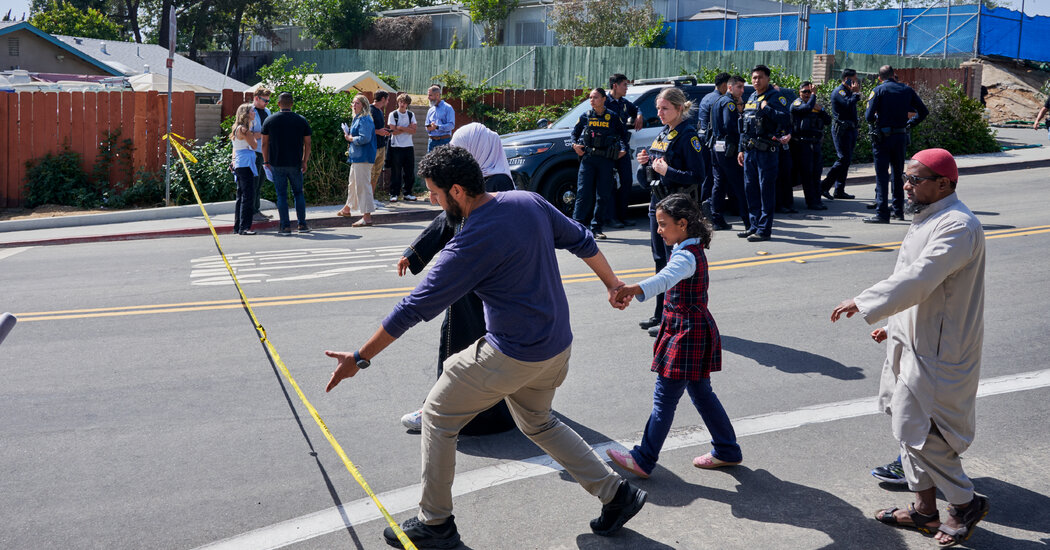
The quiet sanctity of the Islamic Center of San Diego, a spiritual sanctuary and the largest mosque in the county, was shattered in an instant by a senseless act of violence that claimed the lives of three innocent worshippers: Amin Abdullah, Mansour Kaziha, and Nadir Awad. The facilitators of this devastating tragedy were eighteen-year-old Caleb Vazquez and his seventeen-year-old accomplice, Cain Clark. In the immediate aftermath of the horrific assault, both teenagers fled the scene in a white BMW, only to turn their weapons on themselves just blocks away from the mosque, leaving a trail of questions, shattered families, and a community plunged into deep mourning. The local Muslim community, alongside the broader San Diego public, was left to grapple with the painful reality of lives cut short inside a place of worship—a space that should have offered absolute peace. In the wake of the gunfire, as the police and federal agents swarmed the suburban streets, the narrative began to shift from the immediate horror of the active shooter response to a deeply disturbing exploration of the warning signs that had been systematically documented, analyzed, and ultimately bypassed in the months leading up to the massacre. The tragedy has forced a painful re-examination of how society identifies, monitors, and attempts to neutralize the threats posed by deeply radicalized young people, exposing the terrifying gaps that still exist between community surveillance, psychiatric intervention, legal gun restrictions, and the preventable loss of human life.
Long before the deadly confrontation at the mosque, Caleb Vazquez had already established a highly alarming footprint on the radar of local law enforcement, raising critical and painful questions about why system-wide safeguards failed to prevent the tragedy. More than a year prior to the shooting, Chula Vista police officers were so deeply disturbed by the teenager’s escalating behavior that they took the exceptional step of securing a court order to confiscate firearms from his household. In a chilling protective order filed in January 2025, a police officer explicitly detailed how the young man was actively engaged in highly suspicious behavioral patterns that involved the idolization of Nazi ideology and infamous mass shooters. Furthermore, court documents filed in the San Diego Superior Court revealed that Caleb had previously been subjected to an involuntary psychiatric hold, a severe clinical intervention demonstrating that his mental health and potential for violence were already of paramount concern to state authorities. This complex web of legal and psychological red flags existed within the context of California’s progressive gun safety legislation; following a devastating campus mass shooting near the University of California, Santa Barbara in 2014, the state legislature had pioneered Gun Violence Restraining Orders, empowering family members, friends, and law enforcement to seek court-mandated temporary weapon confiscations from individuals deemed a threat to themselves or others. Yet, despite the existence of these pioneering legal mechanisms and the active involvement of local police, the bureaucratic and physical barriers of the system proved unable to contain the violent trajectory of a young man harboring homicidal and suicidal fantasies.
Within the Vazquez family home, the struggle to manage Caleb’s escalating psychological crisis was a daily, agonizing exhausting reality for his parents, Marco and Lilliana Vazquez. Upon being served with the court-ordered firearm restriction, which was formally filed against the elder Mr. Vazquez due to the presence of an extensive household arsenal, the family was forced to confront the extreme danger looming under their own roof. Court records indicate that the household contained twenty-six firearms, including multiple pistols, rifles, and shotguns—a collection so vast that Chula Vista police noted in filings that the father initially refused to allow officers to physically verify if the weapons were being stored safely. In a subsequent court affidavit, a deeply chastened Marco Vazquez insisted he was fully aware of the gravity of the accusations facing his son, claiming he had already taken proactive, voluntary steps to mitigate the danger by transferring his firearms—including three Glock handguns, a Mossberg 12-gauge shotgun, and various rifles—to an offsite commercial storage facility. In a desperate bid to secure their home, the parents also locked away all sharp household knives and significantly escalated their personal supervision of Caleb, placing him in intensive professional therapy while restricting his social circle to a carefully vetted, tiny group of approved acquaintances and family members. Marco wrote to the court that he had absolutely no intention of bringing his weapons back to the residence until a collective consensus was reached between his wife, his son’s therapist, and himself that it was absolutely safe to do so; yet, despite this high level of parental vigilance, the system remained blind to the alternative avenues of weapon acquisition that Caleb would ultimately exploit.
As the fatal day approached, the crisis expanded to involve a second family, culminating in a frantic, high-stakes police search across San Diego in the hours immediately preceding the shooting. Cain Clark, a seventeen-year-old former high school wrestler with his own history of growing up in a home containing firearms, became the catalyst that transformed Caleb’s insular radicalization into an active, coordinated plot. Approximately two hours before the first emergency calls came from the Islamic Center, Cain’s terrified mother contacted the San Diego Police Department to report that her teenage son had gone missing, was actively suicidal, and had fled in her vehicle after apparently stealing several of her personal firearms. This desperate phone call sent shockwaves through local law enforcement agencies, who immediately launched a massive, localized manhunt across California’s second-largest city, utilizing cutting-edge automated license plate reader technology to track the missing vehicle to a local shopping mall. Believing they were closing in on the teenagers, police dispatched tactical units to the retail center while simultaneously deploying officers to secure the local high school that Cain had previously attended, fearing a potential targeted school shooting. Tragically, despite the rapid, technology-driven mobilization of law enforcement and the agonizing warnings provided by a desperate mother, the police were running minutes behind the teenagers, unable to intercept the white BMW before it arrived at the mosque to carry out the premeditated slaughter.
The subsequent federal and local investigation uncovered a deeply disturbing digital ecosystem that fueled the boys’ shared descent into violent extremism, shedding light on the modern pipeline of online radicalization. In the aftermath of the tragedy, the Federal Bureau of Investigation discovered a highly detailed, co-authored manifesto written by Caleb and Cain, which meticulously laid out a comprehensive, deeply bigoted worldview that did not discriminate in its hatred, targeting a broad spectrum of racial, ethnic, and religious demographics. The two teenagers had initially connected through online platforms, finding solidarity in digital echo chambers where extreme hate speech, propaganda, and radical ideologies are frequently packaged as community and counter-culture. In a painful and vulnerable statement released by the Vazquez family following the attack, they revealed that Caleb was on the autism spectrum, a neurodivergence that made his struggle with self-identity and social isolation particularly acute, leaving him highly susceptible to the manipulative forces of online hate. His parents expressed their devastating realization that Caleb’s profound personal insecurities and inability to accept aspects of his own identity were violently weaponized by his exposure to extremist online rhetoric and digital propaganda, showing how vulnerable youth can be systematically radicalized from the perceived safety of their bedrooms, far beyond the reach of traditional parental or clinical oversight.
The aftermath of this coordinated assault has left the city of San Diego, the grieving families of the victims, and the parents of the perpetrators carrying a heavy, permanent burden of sorrow and collective trauma. In their emotional public address, Marco and Lilliana Vazquez bravely sought to center the humanity of those who paid the ultimate price for their son’s actions, writing that while they deeply mourn the child they raised and loved, their grief is far more profound for the innocent lives of Amin Abdullah, Mansour Kaziha, and Nadir Awad. This tragic juxtaposition highlights the agonizing reality of parents who tried, within their limited capacity, to save their child from himself, only to watch him become the instrument of a community’s worst nightmare. For the San Diego Muslim community, the loss of three cherished members represents a profound, permanent wound, emphasizing the ongoing threat of Islamophobia and targeted domestic terrorism against religious minorities. As the investigation winds down and the physical evidence is processed, the legacy of this tragedy remains a stark, urgent warning about the critical intersections of mental health, internet safety, and gun accessibility—a tragic reminder that until society can effectively disrupt the digital pipelines of hate and close the gaps in our preventative safety nets, innocent people will continue to pay with their lives.