




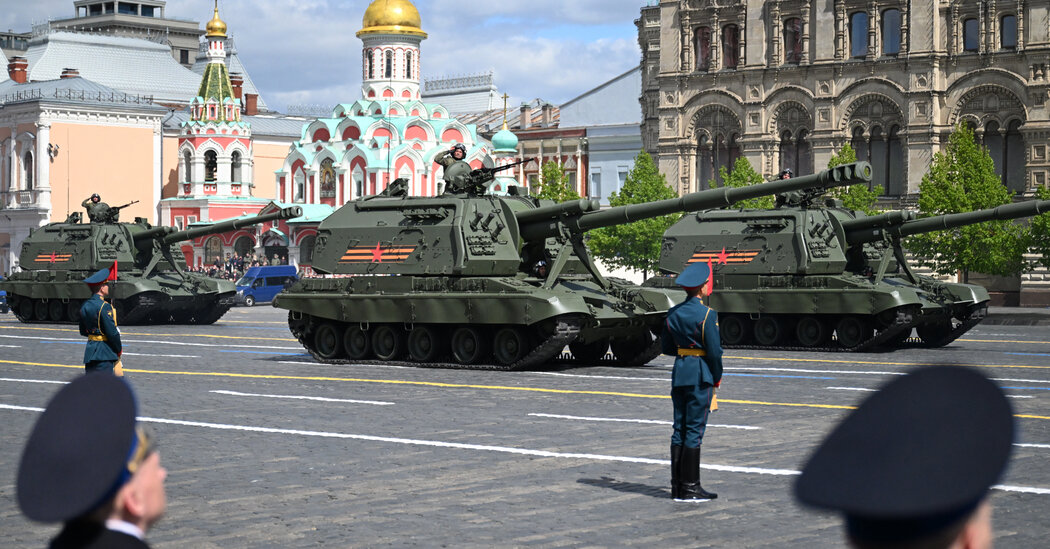
Russia’s Victory Day Parade Scales Back: A Symbol of Shifting Fortunes in the Ukraine War
In a striking break from tradition, Russia’s annual Victory Day parade will unfold on Red Square this May without the thunderous rumble of heavy military equipment, according to officials in Moscow. The Kremlin made the announcement on Wednesday, attributing the downsized spectacle to Ukraine’s escalating long-range strikes that have compelled a tactical retreat from showcasing Russia’s armored might. For decades, this ceremony—marking the Soviet Union’s triumph over Nazi Germany—has been a potent display of national strength, often portrayed as an unbreakable link to a heroic past. Yet, as the shadows of an ongoing conflict lengthen, the parade’s evolution reflects a grim reality: the vulnerabilities exposed in Ukraine are reshaping not just military strategy, but the very imagery of Russian power. This year’s event, streamlined to avoid escalation, serves as a poignant reminder of how far Russia has drifted from its post-Soviet bravado under President Vladimir Putin, who has long leveraged such displays to project invincibility. The shift raises questions about public morale and global perceptions, even as Moscow insists it’s a pragmatic response to operational imperatives. We’ll delve into the historical roots of Victory Day, the parade’s central role in national identity, and the geopolitical forces now forcing its modification, painting a picture of a nation grappling with an unwinnable war that’s already outlasted World War II itself.
Victory Day, observed on May 9th, is more than a commemoration; it’s a deeply ingrained ritual in Russian culture, honoring the millions who perished in the 1945 defeat of Nazi Germany. Stemming from the Soviet Union’s pivotal role in the Allied victory, the holiday evokes memories of resilience and sacrifice that echo through generations. During the Cold War era, parades were modest affairs, but after the Soviet collapse, they ballooned into opulent demonstrations of regained pride. President Putin, ascending in 2000, transformed them into gargantuan showcases of military prowess, inviting world leaders like George W. Bush, who attended in 2005 amid the strains of post-9/11 tensions, and Xi Jinping, whose presence in 2015 underscored China’s growing ties to Moscow. These events weren’t mere pageants; they were choreographed narratives, with tanks like the formidable T-72s and intercontinental ballistic missiles gliding past Red Square, symbolizing Russia’s rebirth as a superpower. Guests of honor, from foreign dignitaries to veterans, watched from elevated stands as the parade affirmed victory against fascism, blending nostalgia with geopolitical messaging. Yet, beneath the fireworks and marching bands, these displays carried a subtext of deterrence, reminding adversaries—and the domestic audience—of Moscow’s unyielding spirit. For many Russians, especially those with family ties to the Great Patriotic War, the parade remains a unifying force, one that transcends political divides and fosters a collective sense of identity in a sprawling, often fragmented federation.
This year, however, the Kremlin has dialed back drastically, opting for a “truncated format” that jettisons the iconic rolling columns in favor of aerial displays and symbolic gestures. According to the Russian Defense Ministry, no heavy equipment will traverse Red Square, nor will military cadets from secondary schools march in formation—a nod to potential risks. The parade will climax instead with a skyward flourish: aerobatic teams performing daring loops and Su-25 ground-attack jets roaring overhead, perhaps evoking the air superiority that Russian forces still claim in parts of Ukraine. But gone are the armored beasts that once intimidated onlookers, their absence a concession to the “operational situation” dictated by the front lines. Dmitri Peskov, the Kremlin’s press secretary, framed the changes during a briefing as necessary precautions against Ukrainian incursions, emphasizing that all measures are in place to safeguard the event in Moscow. To add a modern twist, organizers plan a live broadcast incorporating footage from soldiers in Ukraine, showcasing naval vessels, aerospace units, and nuclear crews—elements meant to highlight Russia’s enduring military capabilities without the logistical burden of moving hardware through the capital. Peskov downplayed the shift, noting that last year’s parade, marking the 80th anniversary of Soviet victory, was exceptionally grand with over 180 vehicles; this iteration, he insisted, is simply more modest, not diminished. Yet, even compared to leaner years like 2023, when a solitary World War II-era T-34 tank headed a modest convoy instead of contemporary armor, the 2024 version feels like a step further into restraint, underscored by the ongoing war’s toll.
The catalyst for this pivot lies profoundly in Ukraine’s strategic bombardments, which have yanked Russia from its comfort zone and into a war of attrition. Ukrainian drones and missiles, often supplied by Western allies, have pierced deep into Russian territory, targeting refineries, ports, and infrastructure far from the battlefront. A salient example unfolded last week at the Tuapse refinery on the Black Sea, where assaults sparked an oil spill and raging fires that spewed toxic fumes for days, disrupting exports and raising environmental alarms. Similarly, in late March and April, strikes on Baltic and Black Sea ports crippled oil shipments, exposing vulnerabilities in Russia’s economic lifelines. Peskov directly tied these assaults to the parade’s downsizing, arguing they necessitate caution to prevent further disruptions. On the ground in Ukraine, tanks—once the backbone of Russian armored divisions—have become liabilities, susceptible to anti-tank weapons, loitering munitions, and precision artillery. Thousands have been obliterated, transforming symbols of invincibility into relics of failure. This erosion hasn’t just altered battlefield tactics; it’s compelled Moscow to rethink ceremonial flaunts that could invite escalation. The war, now stretching over four years and surpassing the duration of the USSR’s grueling struggle against Germany, has exacted a staggering human cost, with hundreds of soldiers falling daily to kills or maimings, yet yielding only marginal territorial gains. Such attrition has chipped away at the Russian military’s aura, making displays of force feel like hollow bravado rather than testament to success.
Far from a mere logistical hiccup, this pared-down parade illuminates Russia’s broader predicament in a protracted conflict. Putin, who has framed the invasion as a “special military operation” to denazify Ukraine and secure Russian borders, has increasingly leaned on Victory Day to align his narrative with the anti-Nazi crusade of 1945. The Kremlin propaganda machine depicts Ukrainian leaders as neo-Nazis, echoing wartime rhetoric, and the parade has served as a stage for this parallel—promoting enlistment and justifying losses through historical analogy. Its dilution now risks undermining that narrative, potentially sowing doubt among citizens who view the holiday as sacred. Internationally, the changes signal Moscow’s defensive posture, amid sanctions that have isolated the economy and forced reliance on allies like China and Iran. As the West ramps up aid to Kyiv, my sources in NATO circles suggest this outlook could herald a longer-term strategic adjustment for Russia, prioritizing airspace and cyber defenses over ground displays. Yet, the event’s persistence, even in scaled form, underscores Putin’s enduring grip, framing the war as a continuation of Russia’s eternal vigil against existential threats. For observers, it begs the question: how long can a nation sustain morale when pride festivities are overshadowed by battlefield retreats and domestic hardships?
Ultimately, the 2024 Victory Day parade encapsulates Russia’s evolving response to a war that has defied predictions, morphing from triumphal marches to cautious reverie. While officials tout safety measures to shield the festivities, the absence of armored convoys whispers of a military boxed into a corner, its traditional markers of strength repurposed for the screens broadcasting from embattled zones. This isn’t just about hardware; it’s about narratives unraveling, as Ukraine’s strikes erode the veneer of dominion Putin has cultivated. For many Russians, the holiday retains its emotive pull—a time to honor ancestors and hope for peace—but the cracks in the facade could amplify calls for reform or, conversely, harden resolve through patriotic fervor. As seasoned journalists covering Moscow for over a decade, I’ve witnessed how Victory Day once rallied the nation; now, it’s a mirror reflecting uncertainties. Whether this scaled-back affair marks a temporary tactical choice or a harbinger of deeper shifts, it serves as a stark chronicle of a superpower contending with the limits of ambition in an unforgiving era. The world watches, noting how Ukraine has not only challenged Russian arms on the field but also redefined the symbols of victory itself. As Moscow gears up for May 9th, the echoes of past glories mingle with the din of present-day strife, leaving historians to ponder if this is the end of an era or merely a chapter in an ongoing saga.