






Rewrite the following content into a 2000-word, SEO-optimized article in English. Write it in the style of a professional journalist or news reporter. The article should be fully humanized, natural, and engaging — not robotic or repetitive.
Focus on clarity, flow, and storytelling while preserving the meaning of the original. Structure the article into 6 well-developed paragraphs with smooth transitions, strong headlines, and a professional tone. Use varied vocabulary, sentence lengths, and natural phrasing to make it read like human-written journalism.
Avoid keyword stuffing, but naturally integrate important SEO keywords throughout the article. Ensure the final article feels like it was written by a skilled reporter for a reputable news outlet.
Israel said it bombed a Hezbollah site on the southern outskirts of the Lebanese capital, Beirut, on Sunday after the Iranian-backed group attacked northern Israel.
Iran threatened to retaliate over the Israeli attack. The escalation was the latest setback to the Trump administration’s largely stalled efforts to broker a truce in Lebanon, as well as forge a broader peace deal with Iran.
Mohammad Bagher Ghalibaf, the Iranian parliament speaker and chief negotiator in talks to end the war with the United States, said Israel’s attack on Sunday on the southern suburbs of Beirut, known as the Dahiya, had turned “U.S. and Israeli bases and assets in the region into legitimate targets.”
“As always, our armed forces remain free to act,” Mr. Ghalibaf said on social media.
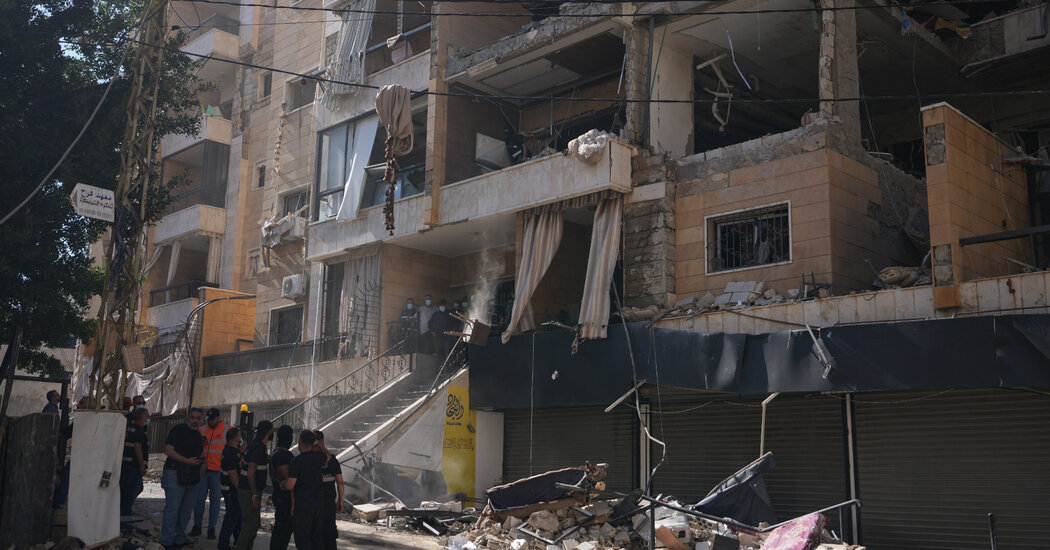
Israel struck at least two apartment buildings in the Dahiya on Sunday, according to Lebanon’s state-run media. The neighborhood on the southern edge of Beirut has long been dominated by Hezbollah and is mostly populated by its Shiite Muslim base.
Avichay Adraee, an Israeli military spokesman, said Israeli forces had attacked a “Hezbollah command center.” Israeli officials sometimes issue warnings to allow civilians time to flee, but did not do so in this case.
At least two people were killed and several wounded, Lebanese state media reported.
Iran has demanded an end to Israeli attacks on its ally, Hezbollah, as part of its negotiations with the United States to end the war. Backed by Iran, Hezbollah’s armed fighters and political clout have long overshadowed the Lebanese government.
President Trump has tried to rein in Israeli attacks on Lebanon, particularly with regards to attacking Beirut, as part of his efforts to end the war with Iran. Last week, Mr. Trump and Mr. Netanyahu held a tense phone call in which Mr. Trump later said he had repeatedly used expletives to convey his frustration over Israel’s military campaign in Lebanon.
“I was a little bit perturbed at his constantly fighting with Lebanon,” Mr. Trump later told The New York Post.
In a television interview with NBC News aired on Sunday, Mr. Trump said that he would prefer for Lebanon to “have a better life.” Asked whether he and Mr. Netanyahu saw eye to eye on the issue, Mr. Trump said they disagreed on “a couple” of things.
“I’d like to see a more surgical attack on Hezbollah. I think it should be more surgical,” Mr. Trump said in the interview, which was recorded Friday.
Israel and Hezbollah’s long running conflict flared up after U.S. and Israeli forces bombed Iran in late February. Hezbollah struck Israel in retaliation. Israel responded with a sweeping ground invasion of Lebanon.
Last week, Israeli and Lebanese government officials reached a new cease-fire deal after talks in Washington. But Hezbollah rejected the agreement as tantamount to a surrender, as it would have to refrain from attacking Israel without immediate concessions from Israel.
Israeli leaders warned last week that if Hezbollah attacked Israeli territory again, they would order military attacks on Beirut.
Then on Sunday, air-raid sirens warning of incoming rocket fire blared in two Israeli communities in northern Israel. Hours later, Mr. Netanyahu said he had ordered the attack on the Dahiya.
Since the war between Israel and Hezbollah began three months ago, Israeli forces have seized swathes of southern Lebanon and systematically razed homes in villages close to the border with Israel.
More than 3,600 people have been killed and one million people displaced in Lebanon, according to the Lebanese authorities.
Israeli leaders have vowed to continue the campaign until Hezbollah is disarmed. But Hezbollah has emerged from the war appearing more formidable than it did before, firing cable-borne drones that are difficult to jam at exposed Israeli soldiers.
Military analysts said the attack on Beirut on Sunday was unlikely to deter Hezbollah or compel it to compromise.
The war appears to have galvanized the group, which has argued that the Israeli attacks prove that only their armed fighters can be entrusted with the protection of Lebanon.
Thirty Israeli soldiers have been killed in the war with Hezbollah, according to Israeli tallies, raising the domestic pressure on Mr. Netanyahu to act forcefully.
Reham Mourshed, Heedo Abu Laban, Johnatan Reissand Sanam Mahoozicontributed reporting.