





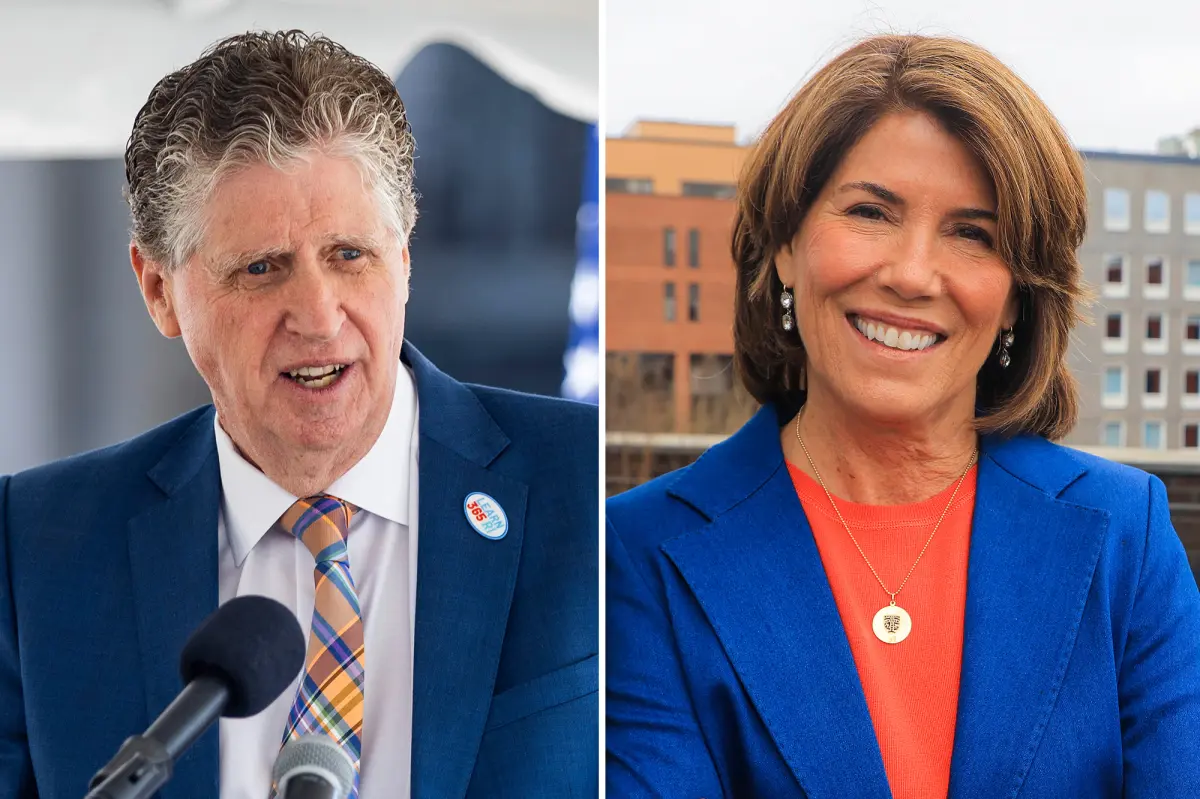
Wednesday night in Rhode Island, the political story of a governor’s long fall from grace reached its final, brutal chapter. Gov. Dan McKee, a Democrat who had spent months insisting that the state was moving in the right direction, was decisively rejected by Democratic primary voters. His challenger, Helena Foulkes, a former CVS executive, had come close to beating him once before, in 2022, when McKee narrowly prevailed. This time, there was no narrow escape. The defeat made McKee the first elected governor since Hawaii’s Neil Abercrombie in 2014 to lose a renomination primary, and the first sitting governor since Kansas’s Jeff Colyer in 2018 to be denied a chance at a full term by his own party. For a state accustomed to small political dramas, this was a seismic event. But the surprise was not that an unpopular governor lost; it was that a governor so out of step with his own state had lasted as long as he did. McKee had never been a commanding political figure. He rose to the governorship by virtue of his position as lieutenant governor, stepping into the job after Gina Raimondo left for Washington. He won a full term in 2022, but barely, and his mandate was weak from the start. In a small state where voters expect to see their leaders at local events, in diners, on the street, McKee often seemed distant and defensive. He was not a man of grand gestures or soaring speeches; he was a manager who seemed permanently on the back foot, reacting to events rather than shaping them. He had a habit of repeating his own talking points, as if saying something often enough would make it true. The more he talked, the more frustrated the public became. By the time the votes were counted, the result felt less like a surprise and more like an inevitability. Rhode Islanders had simply had enough. The reason they had had enough could be summed up in three words: the Washington Bridge.
At the center of McKee’s downfall was the Washington Bridge, a span over the Seekonk River that links Providence to its eastern suburbs and, for many, to Massachusetts. During the summer, it carried a steady stream of beachgoers making their way toward Cape Cod. When McKee ordered the bridge shut down in 2023 over safety concerns, the decision was defensible—even necessary. Engineers had warned that the structure could fail, and the governor presented the shutdown as a tough-but-responsible call. But the months that followed became years, and the partial closure dragged into what felt like a permanent siege of orange cones, concrete barriers, and shifting detours. Commuters were rerouted through neighborhoods not designed for heavy traffic. Small businesses watched their customers disappear. Parents added an hour to school drop-off routines. First responders had to navigate around the delays. What began as an act of safety became, in the public imagination, a symbol of mismanagement. The pace of the repair work quickly became the central issue of the entire campaign, crowding out debates on housing, education, and taxes. McKee argued that he had acted to save lives, that federal funding had been secured, and that the project was on pace to finish ahead of schedule. “The Washington Bridge was a disaster. I shut it down to keep us safe, secured federal funding and we’re on pace to complete the bridge ahead of schedule,” he said in a campaign ad. In those words, he repeated the confident message of a man who believed the facts were on his side. But for many voters, the facts did not match the experience. They saw a bridge that remained partially closed, a schedule that kept slipping, and a governor who seemed more interested in defending his own record than in acknowledging their pain. Foulkes seized on that disconnect during a fiery debate last month, calling the bridge project “a poster child for mismanagement.” It was a phrase that stuck because it felt true. For the people who crossed the river every day, the bridge was not a political trophy or a talking point. It was a test of whether state government could do the basics, and by that test, McKee had failed.
Foulkes was not an ordinary challenger. She came from a family steeped in Democratic politics—her grandfather, Thomas Dodd, and her uncle, Chris Dodd, had both represented Connecticut in the U.S. Senate. She had spent twenty-five years at CVS, rising to a position of corporate power, and she carried herself with the polished confidence of someone who had managed large organizations. That background was both an asset and a liability. McKee tried to paint her as a wealthy, out-of-touch elite, someone who had profited from the very systems she now claimed to reform. He pointed to the opioid crisis and argued that Foulkes, during her long career at CVS, had turned a blind eye to the pain inflicted by prescription painkillers. It was a sharp attack, one that might have wounded a weaker candidate. But Foulkes turned the governor’s criticism back on him. Her campaign did not try to defend CVS; it focused instead on the way state government felt detached from ordinary Rhode Islanders. She spoke about the powerful few who always seemed to get their way, about decisions made behind closed doors, about a sense that the people in charge were not listening. She also brought a corporate manager’s language of efficiency and results to a state that had grown tired of vague promises. “People feel like state government just works with a powerful few,” she told the Associated Press. “They don’t think it’s working for them.” That message resonated because it was broad enough to include the bridge, the economy, and the general mood of institutional distrust that had been building for years. Her family name gave her credibility with old-line Democrats, while her corporate resume made her an outsider to the state’s usual political establishment. That combination proved powerful. She did not have to be the perfect candidate; she just had to be the alternative to a governor they no longer trusted. In the end, that was more than enough.
McKee fought back with the only weapons he had left. He argued that he was the candidate with a real record of working for ordinary people, and he dismissed Foulkes as someone who wanted to buy the office rather than earn it. “The option here is somebody who wants to buy this state office who doesn’t have any credibility with their policy thoughts and someone like myself, who has a strong record in terms of working people,” he said. The implication was clear: Foulkes had the money, but he had the experience. His campaign and his allies tried to hammer that message home in the final weeks, reminding voters of her corporate background and questioning whether she could relate to the struggles of everyday Rhode Islanders. They aired ads that tied her to the opioid epidemic, suggesting that a leader who had helped preside over CVS’s rise had blood on her hands. But the attacks never gained the traction McKee needed. The numbers were simply too damning. A University of New Hampshire poll released the month before the primary gave Foulkes a massive 38-point lead. McKee’s approval rating had collapsed to just 24 percent. That meant more than three-quarters of Rhode Islanders were dissatisfied with his performance—a staggering figure for any incumbent, and a nearly impossible obstacle to overcome. Foulkes’s campaign did not need to convince voters that McKee was a bad person; it only needed to remind them that the state was not working the way it should. The bridge was the proof. The traffic was the proof. The rising anger in local Facebook groups and the resigned shrugs of exhausted commuters were the proof. In the final weeks, McKee tried to shift the narrative, highlighting his administration’s accomplishments and warning that Foulkes would be a risky choice. But the momentum was unstoppable. The voters had already made up their minds. They were not looking for a reason to stay; they were looking for a reason to leave.
When the returns came in on Wednesday, they placed McKee in an unfortunate and exclusive club. Since 2014, no elected governor had been denied renomination by a primary electorate. Neil Abercrombie, the Hawaii Democrat, had been the last to suffer that indignity. And no sitting governor at all had been denied renomination since Jeff Colyer, the Kansas Republican who had ascended from the lieutenant governorship after Sam Brownback left office, lost his own primary in 2018. The parallels between Colyer and McKee were not lost on political observers. Both were men who inherited the top job rather than winning it in a conventional campaign. Both struggled to establish their own mandate. And both were rejected by their own party’s voters when they finally had to face the electorate. McKee’s path had been similar: he became governor when Gina Raimondo resigned to join the Biden administration, and he spent his first years trying to govern in someone else’s shadow. The Washington Bridge, more than any policy debate, came to define his tenure. It was not just a piece of infrastructure; it was the physical embodiment of the gap between what McKee promised and what voters experienced. By the end, he was not running against Foulkes so much as running against the accumulated weight of years of frustration. Incumbency is normally a powerful advantage in American politics. Governors have name recognition, a record to run on, and a network of donors and operatives. McKee had all of those things, and still he lost. That is the true meaning of Wednesday’s result. It is rare for an incumbent to be so thoroughly rejected that the normal rules of politics no longer apply. But Rhode Island in this moment was not in a normal mood. People were not in a mood to hear about what had been done; they were in a mood to see what had been fixed. And what they saw, every day on their commute, was a bridge that was still not finished.
Ultimately, Rhode Island’s Democratic primary was less a verdict on McKee alone than a reflection of the public mood. The bridge was the flashpoint, but the anger ran deeper. People were tired of being told that progress was being made when the evidence was visible every day in the form of detours and delays. Foulkes understood that. She did not offer a detailed infrastructure plan that would magically fix the bridge overnight; instead, she offered something more powerful: an acknowledgment that the government had failed people, and a promise to shake up the way things were done. Whether she will succeed as governor is another question. The bridge will still need to be repaired, the state’s challenges will not disappear, and the same frustrations that carried her into the general election will follow her into office. But the primary sent a clear message to political leaders everywhere: incumbency is not a shield. Voters are watching. They remember the traffic, the broken promises, and the feeling of being ignored. And when they get the chance, they will hold the people in power accountable. On Wednesday night, Dan McKee learned that lesson the hard way. His political career, built on an accidental rise and sustained by narrow margins, had finally hit a wall of public patience. Rhode Islanders had waited long enough—for a bridge, for a state government that worked for them, and for a change that felt real. Foulkes now carries that burden. She inherits a state where trust has been broken, not just in a bridge but in the very idea that government can do what it says it will do. Her corporate background may help her manage the project; her political future will depend on whether she can convince people that this time, the answer is not just another promise. For McKee, the loss ends a chapter that was always marked by struggle. He may point to his record, but the image that will remain is of a governor standing beside a closed bridge, telling people to be patient, while the river flowed beneath them.