






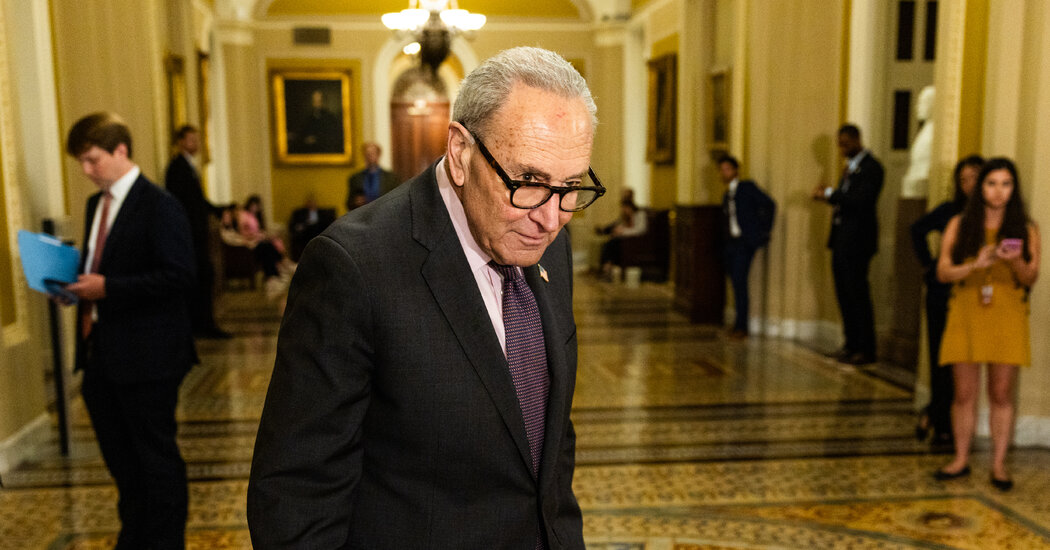
Under the cold, unforgiving light of the Senate chamber, the passage of time is measured not by the ticking of the clock, but by the slow accumulation of physical exhaustion, the mounting clutter of discarded paper coffee cups, and the tense, low-voiced huddles that define Washington’s late-night legislative theater. As Thursday evening dissolved into the silent hours of Friday morning, the nation’s most exclusive club transformed into a grueling battleground where Senate Republicans fought to rescue their signature $70 billion immigration enforcement package. Designed as a triumphant pre-election showcase to demonstrate their commitment to border security and rally their conservative base, the bill instead became a messy, public showcase of internal party friction. At the heart of this parliamentary crisis was a bitter, deep-seated dispute over a highly controversial initiative championed by Donald Trump: an unprecedented $1.8 billion payout fund intended to compensate the president’s political allies and individuals he claimed had been unjustly targeted or victimized by the federal government. To Democrats, and to several uneasy Republicans, this proposed pool of money looked less like a legitimate administrative program and more like a taxpayer-funded political slush fund designed to reward loyalty. The G.O.P. leadership, eager to keep their legislative locomotive on the tracks, found themselves caught in a vice between a demanding president who viewed the party as his personal shield and a handful of moderate lawmakers who feared the electoral consequences of rubber-stamping an obvious ethical liability. As Majority Leader John Thune of South Dakota emerged from behind closed doors near midnight to address a pack of waiting reporters, his exasperated admission that the session would have ended hours earlier if not for the “issues around the fund” laid bare the underlying frustration of a party trying desperately to manage its own leader while projecting an image of absolute legislative control.
The climax of this late-night maneuvering arrived with a razor-thin, fifty-to-forty-nine vote on an amendment introduced by the Democratic Minority Leader, Senator Chuck Schumer of New York. The proposal was a masterfully designed tactical trap, aiming to send the entire immigration package back to committee with a strict, legally binding prohibition against the creation of the President’s payout fund. For the Republican leadership, the vote was a terrifying exercise in mathematical precision, as they could afford virtually no defections if they hoped to preserve their legislative agenda and shield the White House from a humiliating defeat. In the end, three key Republican senators facing incredibly challenging re-election campaigns—Susan Collins of Maine, Jon Husted of Ohio, and Dan Sullivan of Alaska—broke party lines to vote with the unified Democratic caucus. This defiance highlighted the deep cracks in the G.O.P. facade, demonstrating that for some lawmakers, the political risk of being associated with a perceived presidential slush fund outweighed the pressure to fall in line. Even as the Justice Department took the unusual step of publicly stating it would no longer pursue the creation of this controversial fund, the political damage had already been done. Democrats successfully forced their Republican colleagues to go on the record, casting votes that could easily be weaponized in campaign advertisements just a few months down the road. For the moderate Republicans who defected, the vote represented a desperate attempt to signal independence to their moderate constituents back home, proving that they were willing to serve as a constitutional check on executive overreach, even when it meant defying their own party’s standard-bearer on a critical, high-profile vote.
The floor of the Senate became a pressure cooker during this prolonged voting cycle, stalling for hours as the legislative machinery ground to a complete halt and senators congregated in anxious, whispering clusters. This legislative paralysis was precisely the outcome Chuck Schumer had spent days choreographing, openly threatening to use the fast-tracked immigration bill as an anvil to crush Republicans under the weight of the president’s most unpopular and ethically dubious demands. While Senator Collins had cast her dissenting vote relatively early after intense consultations with G.O.P. leadership, others like Bill Cassidy of Louisiana, Jon Husted, and Dan Sullivan chose to withhold their votes for hours, holding the chamber hostage in a high-stakes game of political leverage. Cassidy, in particular, was spotted pacing the floor and engaging in animated discussions with both Democratic colleagues and Senate parliamentarians as he attempted to engineer a compromise that could bypass the standard sixty-vote threshold. Later, speaking to a throng of reporters in the Capitol hallways, Cassidy defended his agonizing delay by stating he was merely trying to “optimize chances for success,” seeking a way to legally block the fund without completely derailing the border security funding his constituents so desperately wanted. Meanwhile, Senator Thom Tillis of North Carolina sought a different escape hatch, proposing a failed amendment that would have redirected the controversial $1.8 billion away from the executive branch and into Justice Department anti-fraud initiatives—a transparent attempt to neutralize the slush fund while still allowing his fellow Republicans to vote in favor of the broader, must-pass immigration package.
As if the fight over the $1.8 billion payout fund were not enough to stretch the party’s unity to its absolute limit, lawmakers were also forced to confront another controversial White House demand: a request for $1 billion in security upgrades and architectural projects tied to the president’s private ballroom. This request had already triggered massive alarm bells among fiscal conservatives who were struggling to explain to their cash-strapped constituents why a billionaire president required nine figures of taxpayer money for a private resort. Although G.O.P. leaders had quietly stripped this funding from the immigration bill before it ever reached the Senate floor, Democrats were determined not to let the issue slip away quietly. Senator Jeff Merkley, a progressive Democrat from Oregon, introduced an amendment that would legally bar any federal funds from being allocated to the ballroom project without explicit, prior congressional authorization. Once again, the vote exposed the fraying edges of the Republican coalition, with a small but significant contingent of G.O.P. senators—including Collins, Husted, Murkowski, Tillis, and Sullivan—voting with the Democrats. Although the amendment ultimately fell short of the sixty votes required for adoption, the public rebellion served as a stark reminder of the mounting frustration among rank-and-file Republicans who felt increasingly weary of defending the president’s highly personalized, non-ideological pet projects at the expense of their own political survival, personal integrity, and long-held principles of fiscal conservative governance. This growing weariness underscored a broader, systemic struggle within the party, as lawmakers increasingly found themselves forced to choose between the populist whims of a demanding leader and the traditional, small-government philosophies that had defined the modern conservative movement for generations.
To understand the sheer desperation of this late-night session, one must look at the arcane, highly technical rules of the Senate that forced Republicans into this corner in the first place. Facing a wall of united Democratic opposition, G.O.P. leadership had bypassed traditional legislative channels, opting instead for a special, highly complex budget process to advance the $70 billion immigration bill. By utilizing this procedural loophole, Republicans could pass the funding package with a simple fifty-vote majority, completely neutralizing the Democrats’ ability to launch a traditional legislative filibuster. However, this shortcut came with a steep price: a grueling, politically punishing process known in Capitol Hill parlance as a “vote-a-thon.” Under these rules, any senator can introduce a virtually limitless number of amendments, forcing the entire body to vote on them in rapid succession with minimal debate. Democrats seized on this opportunity with clinical efficiency, drafting a barrage of politically toxic amendments designed to force Republicans into uncomfortable corners on everything from government ethics and immigration tactics to civil liberties. By midnight, the Senate had already ground through sixteen grueling votes, yet the list of pending amendments seemed endless, transforming the chamber into an exhausting endurance test where physical stamina, political courage, and long-term legislative strategy collided in the dark of night. It was a grueling demonstration of how the Senate’s historic rules can be weaponized in the modern era, turning procedural dry runs into highly visible public trials where every senator’s public vote is permanently etched into the record for future campaign attack ads.
When the dust finally began to settle in the early hours of Friday morning, the immediate political fallout was clear: while the G.O.P. had managed to keep their massive immigration enforcement bill alive, the victory felt pyrrhic, stained by public division and the spectacle of a party wrestling against its own leader’s ethically compromised demands. Senator John Thune took to the Senate floor to deliver a blistering, partisan defense, angrily accusing Democrats of organizing a circus to distract the American public from their fundamental refusal to fund crucial border security agencies like ICE and the Border Patrol. According to the Republican leadership, the endless debate over slush funds and ballrooms was merely a smokescreen designed to hide a progressive agenda that sought to hamstring law enforcement. Yet, despite the fierce rhetoric, the reality of the marathon vote-a-thon painted a far more complex picture of a Republican Party deep in a quiet, simmering civil war over the boundaries of executive power. As weary senators finally drifted out of the Capitol and into the humid night air, they left behind a chamber that of late has felt less like a deliberative body and more like a battleground for a larger struggle over the identity of the nation. With critical elections looming on the horizon, the events of this long, exhausting night made it abundantly clear that the shadow of Donald Trump continues to loom large over his party, forcing his allies into constant, uncomfortable compromises as they struggle to balance party loyalty against their constitutional duties and their own political survival.