





The Architect of Shadows: Ramiro Valdés Menéndez and the Legacy of Cuban Surveillance
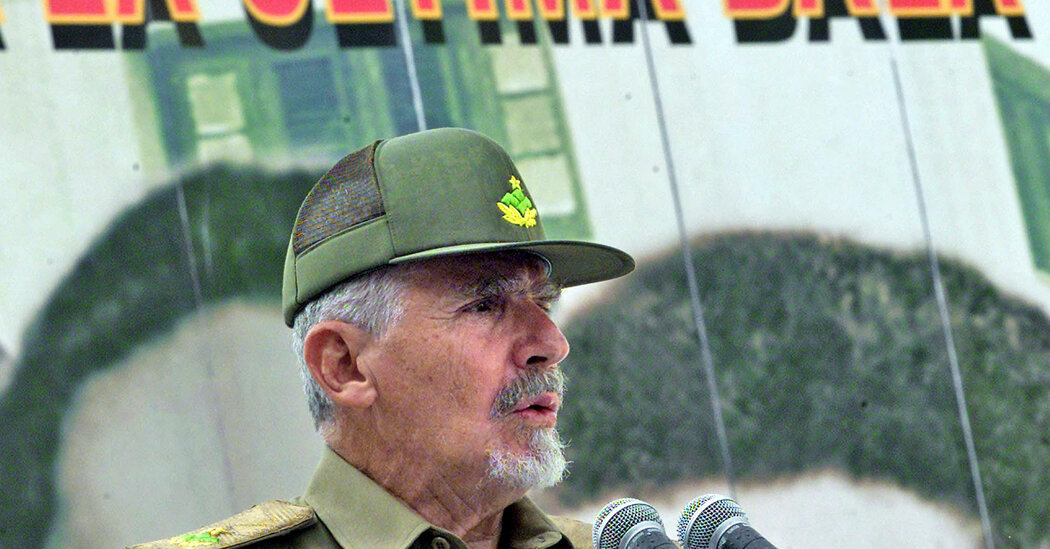
Ramiro Valdés Menéndez, the formidable architect of Cuba’s brutally efficient state security apparatus and a towering, controversial figure who helped shape the island’s post-revolutionary destiny for more than sixty years, has died at the age of 94. His passing, announced on social media by Cuban President Miguel Díaz-Canel Bermúdez, was met with the quiet solemnity reserved for the last surviving guardians of the 1959 revolution, though the official announcement conspicuously omitted details regarding the exact time, place, or cause of his death. Dressed in his trademark olive-drab military uniform and sporting a sharp, silvering goatee, Valdés was a constant, intimidating presence in the upper echelons of Havana’s government, outlasting countless internal purges and global geopolitical shifts. He was not merely a passive participant in Cuban history; he was one of its primary draftsmen, establishing a domestic and foreign intelligence operation so comprehensive that it successfully shielded Fidel Castro from hundreds of assassination attempts, anticipated the catastrophic Bay of Pigs invasion, and neutralized internal dissent before it could ever take root. To his supporters, he was a highly decorated heroic “Commander of the Revolution” who defended Cuban sovereignty against relentless U.S. aggression; to his detractors and the millions of ordinary citizens who lived under his watchful eye, he was simply known by the chilling moniker Charco de Sangre—the “Pool of Blood.” His journey through the corridors of power was a remarkable study in political survival, defined by a recurring cycle of being cast aside by the Castro brothers only to rise again, stronger and more indispensable than before, ultimately securing his place as the second most powerful man in the nation and the defining face of the Cuban state intelligence landscape.
The Spark of Artemisa: From Dirt Floors to the Moncada Assault
The ideological hardening of Ramiro Valdés Menéndez can be traced back to his humble beginnings in the hardscrabble neighborhood of La Matilde, located in the western town of Artemisa, where he was born into deep poverty on April 28, 1932. Growing up with four siblings in a small house with dirt floors, Valdés experienced firsthand the sharp economic disparities of pre-revolutionary Cuba, dropping out of high school to labor beside his father, an aspiring but perpetually unsuccessful entrepreneur. By the age of twenty, Valdés was working as a truck driver’s helper, his prospects bleak and his frustration with the corrupt status quo mounting, when General Fulgencio Batista seized power in a bloodless coup in 1952. The sudden overthrow of Cuba’s democratic constitution ignited a fierce resistance among the island’s youth, and when Valdés and his close friends heard a fiery radio broadcast by a young, charismatic Havana attorney named Fidel Castro calling for armed rebellion, they immediately traveled to the capital to pledge their lives to the cause. This fateful meeting led Valdés directly to the frontlines of the modern era’s most audacious insurgencies, placement in the lead vehicle of the July 26, 1953 assault on the Moncada military barracks in Santiago de Cuba. Valdés displayed a ruthlessness and tactical bravery during the chaotic firefight, managing to force his way into the military fort and briefly disarm and detain fifty sleeping soldiers before overwhelming counter-forces arrived. Though the assault failed spectacularly and resulted in the execution of dozens of rebels, Valdés survived, only to be captured, tried, and imprisoned alongside Fidel and Raúl Castro on the desolate Isle of Pines, cementing a personal and political covenant with the brothers that would endure for the rest of his life.
The Voyage of the Granma and Tactical Baptism in the Sierra Maestra
Following an unexpected political amnesty granted by a confident Batista in 1955, Valdés went into exile in Mexico with the Castro brothers, where they meticulously organized, funded, and trained a small, dedicated expeditionary force destined to overthrow the dictatorship. In late November 1956, Valdés was one of the eighty-two heavily armed rebels who crowded onto the Granma, a leaking, secondhand wooden yacht designed for only twelve passengers, embarking on a grueling and perilous seven-day voyage across the Gulf of Mexico. Upon landing in the muddy mangrove swamps of southeastern Cuba, the rebels were immediately ambushed by Batista’s air and ground forces, leaving only a fraction of the original column alive to retreat into the dense, unforgiving terrain of the Sierra Maestra mountains. Hidden beneath the forest canopy, Valdés quickly proved his worth as an exceptional combat tactician and disciplined commander, displaying a cold, unwavering focus that earned him the respect of his fellow fighters and led to his appointment as second-in-command to Argentine revolutionary Ernesto “Che” Guevara. Under Guevara’s command, Valdés led key guerrilla columns out of the mountain sanctuaries and into the vital central lowlands, cutting off Batista’s retreat and executing coordinated military strikes that eventually broke the back of the national army. When the rebel forces finally entered a triumphant Havana in January 1959, Valdés was no longer a truck driver’s assistant; he was a hardened military commander, uniquely prepared to defend the fragile new government from the counter-revolutionary challenges that were already gathering storm on the horizon.
Designing the Panopticon: The Interior Ministry and the Machinery of Domestic Control
Immediately following the fall of Batista, Fidel Castro recognized that his fledgling government could not survive without a highly centralized and uncompromising security service, prompting him to task Valdés with creating a new state protection network. Appointed as the first director of the newly formed Interior Ministry of Cuba (MININT) in 1961, Valdés set about transforming the island’s security apparatus into one of the most sophisticated and pervasive surveillance systems in the world, heavily utilizing training, funding, and intelligence-gathering techniques provided by the Soviet Union’s KGB. To ensure that no counter-revolutionary activity could occur without the state’s knowledge, Valdés established the Committees for the Defense of the Revolution (CDRs), a neighborhood-by-neighborhood, block-by-block informant network that turned ordinary citizens into the eyes and ears of the regime, monitoring everything from conversations to suspicious visitors. Under his direction, the Interior Ministry expanded its purview to target anyone categorized as an ideological threat, leading to a dark, systematic offensive against political dissidents, religious groups, and gay people, who were rounded up in mass sweep operations and sent to remote agricultural labor camps for mandatory re-education. Valdés operated with an icy, bureaucratic detachment, viewing these severe domestic crackdowns as necessary measures to safeguard the socialist revolution from internal decay and foreign subversion, earning him a terrifying reputation that kept both his political rivals and the general populace in a state of perpetual obedience.
The Shield of the Regime: Navigating the Bay of Pigs and the Exile of Political Disfavor
The true efficacy of Valdés’ intelligence empire was put to its ultimate test in the spring of 1961, when a brigade of CIA-trained Cuban exiles attempted to launch a covert invasion on the southern coast of the island. Weeks before the actual landings took place, Valdés’ intelligence collectors had successfully intercepted warning signs of the impending attack, closely monitoring suspect communications and neutralizing underground support cells within Cuba that the U.S. government was relying on to trigger a popular uprising. When the assault began at the Bay of Pigs, Valdés acted with ruthless speed, ordering his security forces to preemptively round up and detain over twenty thousand suspected dissidents across the country, effectively disabling any domestic support structure for the invaders and helping to secure a historic victory for Castro’s government. Despite his monumental contributions to the regime’s survival, Valdés was not immune to the characteristic paranoia of the Castro brothers, and he was twice stripped of his ministerial duties—first in 1969 and again in 1986—due to ideological disputes and concerns over his expanding personal influence. Rather than wallowing in political oblivion during his periods of exile, Valdés adapted, immersing himself in the emerging fields of computer programming and information technology, which allowed him to return to government favor under Raúl Castro in 2006 as the head of the telecommunications ministry, where he famously sought to restrict public internet access by declaring the web a “wild colt” that required strict government reins.
The Twilight of a Commander: Unrest, Blackouts, and the Loss of Free Will
As the decades marched on, the absolute control that Valdés had spent his lifetime constructing began to fray under the weight of Cuba’s systemic economic decline, leading to a shocking public reckoning during the historic anti-government protests of July 2021. Hoping to restore order through his sheer, mythic presence, the elderly Commander of the Revolution traveled to the municipality of Palma Soriano to confront the crowds, only to be met by a furious wall of citizens chanting “murderer” and forcing his security team to quickly whisk him away—a moment of vulnerability captured on mobile phones and broadcast to the world on the very internet he had tried so hard to control. In his final years, Valdés was pulled into one last desperate campaign, tasked by the Communist Party in late 2024 to oversee the stabilization of Cuba’s failing, archaic electrical system, an effort that ultimately proved futile as the national grid suffered a near-total collapse, leaving millions of citizens in prolonged darkness. His death marks the sunset of a founding generation, leaving behind his wife, Alicia Alonso Becerra, and four children, including his son Ramiro, a composer living in Miami in quiet defiance of his father’s deeply anti-capitalist crusade. In a rare television interview toward the end of his life, Valdés reflected on his relentless, lifelong commitment to the regime with a chilling, fatalistic clarity, stating that while one joins a revolution of their own free will, once the path is chosen, all personal agency is lost to the larger demands of the state.