


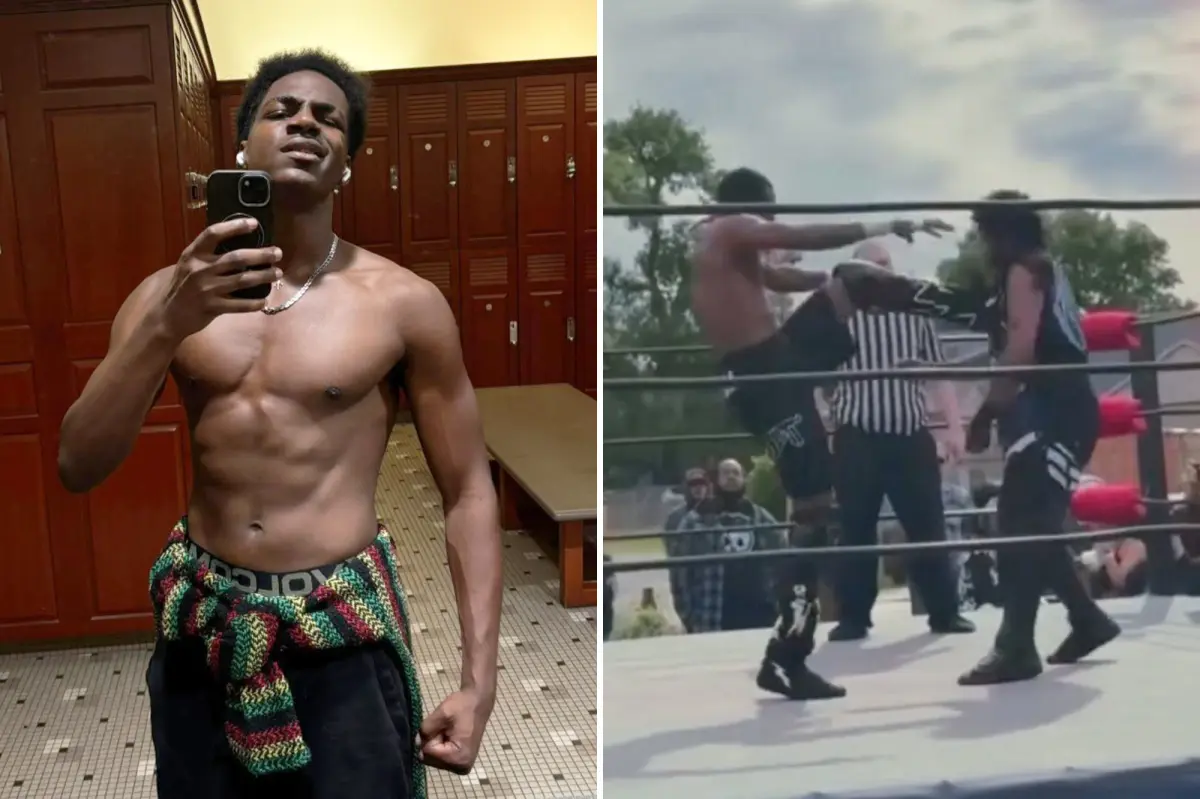
The fragile boundary between a routine morning commute and an unspeakable tragedy was shattered on a quiet Friday morning along the Bethpage State Parkway on Long Island. Jordan Nasir St. Fort Colin, a vibrant 23-year-old athlete known to his fans as “Black Flash” Jordan Saint, was behind the wheel of his 2012 Nissan Altima when disaster struck without warning. An oncoming Hyundai suddenly veered across the median, crossing directly into oncoming traffic and colliding head-on with Jordan’s vehicle. The violence of the impact left both cars severely mangled; while the driver of the Hyundai survived the crash with serious injuries, Jordan’s life was tragically cut short at the scene. New York State Police confirmed that there were no passengers in either vehicle, leaving behind a scene of devastating silence on the asphalt. For those who loved Jordan, the suddenness of the crash was a paralyzing shock, a cruel reminder of how quickly a life brimming with passion, talent, and unyielding ambition can be stolen away in a single, fleeting second.
To understand the weight of this loss, one must understand Jordan’s absolute devotion to his craft, which he openly described as his soul’s true calling. Earlier this year, after a period of absence where “life lifed” and forced him to briefly step away from the canvas, Jordan made a triumphant return to the ring, declaring to his supporters, “Professional wrestling was the only real love of my life.” He refused to let the mundane trials of everyday existence permanently dim his fire, announcing his comeback in January with the simple, determined words: “No fancy promo. I’m back fr.” His return was not just a personal victory but a gift to the independent wrestling scene, culminating in a standout performance at the Shooting Star Fest in Las Vegas this past April. Sharing the stage with other hungry athletes during the high-octane atmosphere of WrestleMania week, Jordan proved that his dedication was unwavering and that his passion for the sport was a relentless force that defined his very identity.
Within the dressing rooms and squared circles of the independent circuit, Jordan was revered as a rare talent who wrestled not for fame, but out of a pure, infectious love for the art form. Promotions like Pandemonium Pro Wrestling in Texas remembered him as a “truly unbelievable human” who stood as the finest example of what it meant to love professional wrestling unconditionally. He possessed an authentic magnetism that could not be manufactured, bringing an overwhelming sense of joy and dedication to every promotion he graced. His colleagues noted that Jordan never folded under pressure, nor did he ever compromise his identity to please others; he was a man who wore his heart on his sleeve at all times. This raw, unfiltered authenticity drew people to him, turning casual acquaintances into lifelong friends who respected his unwavering commitment to staying true to himself in an industry that often demands conformity.
This sentiment of profound respect and heartbreak was echoed by Naptown All-Pro Wrestling, where organizers affectionately described Jordan as a “hardheaded” athlete who was entirely dedicated to mastering his craft. He was a natural student of the game, possessing a lightning-fast ability to absorb knowledge and combine it with a superb, natural athleticism that routinely left audiences and peer athletes in awe. The promotion regarded him as a “diamond-tier prospect,” the kind of generational talent whose potential seemed absolutely limitless. More than just an athlete, Jordan symbolized the very ethos of what Naptown All-Pro aimed to represent: a fierce desire to remain true to oneself, a calling to uplift the surrounding community, and a deep-rooted belief in doing what is right in the world. The crushing realization that the world will never get to see Jordan reach his full potential has left a permanent, aching void in the hearts of his trainers, promoters, and peers.
The outpouring of grief from across the wrestling landscape paints a picture of a young man whose kindness was just as formidable as his physical prowess in the ring. TNA wrestler Bear Bronson shared a touching tribute, describing Jordan as someone who was always smiling, polite, and exceptionally happy to be doing what he loved. In a sport defined by physical grit and intense competition, Jordan’s gentle soul and brilliant smile stood out as a source of warmth and comfort for everyone in the locker room. He approached his peers with humility and a desire to learn, traits that endeared him to veterans and newcomers alike. It is this beautiful, gentle soul—combined with a world-class athletic ability—that makes his sudden departure at such a young age so incredibly difficult for the community to process as they grapple with the loss of one of their brightest stars.
Before his life was so abruptly taken, Jordan was eagerly preparing for his next major milestone, a highly anticipated appearance on the card at Pandemonium’s “Burst and Decay” event in Austin, Texas, scheduled for August 2. Now, instead of cheering for his spectacular maneuvers under the bright lights, the wrestling community is left to mourn a brother, a son, and a dear friend who wrestled with every ounce of his being. Though his journey was cut terribly short at the tender age of 23, the legacy of “Black Flash” Jordan Saint will endure in the memories of those he inspired and the rings he graced. He lived his life with the volume turned all the way up, chasing his dreams with a rare intensity, and leaving an indelible mark of kindness, courage, and passion on a world that is far poorer without him.