

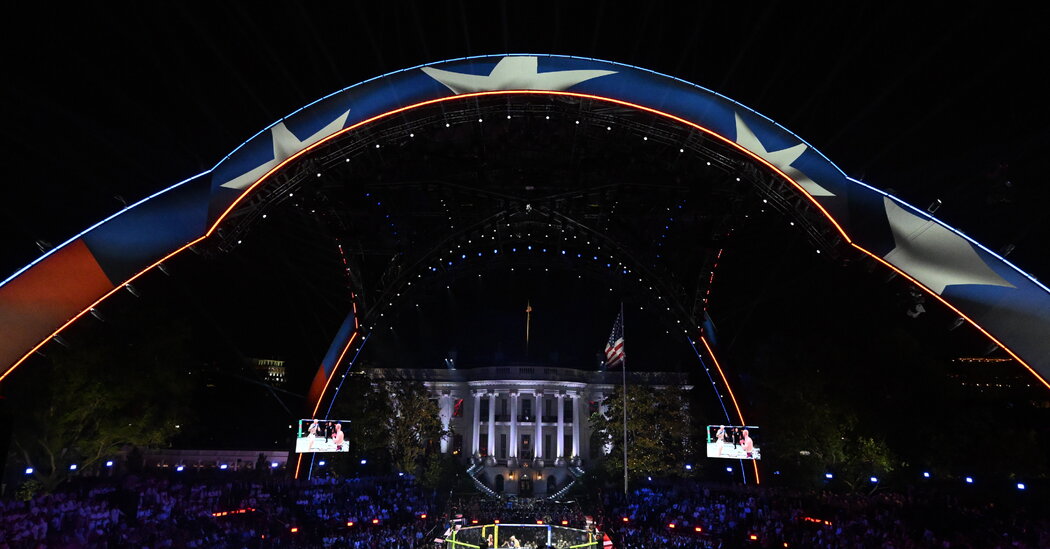
The historic weight of the executive mansion clashed spectacularly with the visceral, modern roar of combat sports as the South Lawn of the White House was transformed into a gladiatorial arena. For Donald Trump’s 80th birthday, the iconic grounds—typically reserved for solemn state arrivals, historical ceremonies, and quiet strolls beneath centuries-old trees—were converted into a high-octane Ultimate Fighting Championship stadium. Underneath a colossal, 600-ton steel archway known as “the Claw,” deep-pocketed high-rollers, powerful politicians, and sports fans cheered as fighters in an eight-sided chain-link cage, loudly papered over with cryptocurrency advertisements, violently clashed just yards from the Oval Office. The contrast was breathtaking and, to many, deeply unsettling. The White House, a global symbol of democratic stability and decorum, served as a mere backdrop for a sport defined by raw, blood-spitting theatricality. From the historic Indian Treaty Room across the way, where barefoot fighters warmed up on executive carpets, to the lawn where sweeping klieg lights pierced the humid night air, the boundaries between public service and private spectacle dissolved completely. It was a production that felt less like a traditional presidential celebration and more like a high-stakes, dystopian Roman arena, demonstrating how thoroughly the culture of showmanship has penetrated the highest echelons of American power. The visual of the commander-in-chief sitting ringside, bathed in the garish glow of neon and corporate branding alongside his wife Melania and his entire family, served as an unmistakable declaration that the old rules of presidential dignity had been permanently rewritten in favor of pure, unfiltered entertainment.
The crowd assembled beneath the towering steel arches of the Claw represented an unprecedented convergence of American power, wealth, and pop-culture notoriety. Rubbing shoulders with first-row billionaires like tech titan Mark Zuckerberg and entertainment mogul David Ellison were the heavy hitters of the Republican establishment, including Senate Majority Leader John Thune and Texas Senator Ted Cruz. The presence of the nation’s top security and economic officials—including the secretaries of defense, treasury, state, commerce, and homeland security, alongside the F.B.I. director—lent the violent spectacle an eerie air of official state business. Mixed into this political elite were cultural icons of a specific, aggressive brand of American celebrity: rock-and-roll rebel Kid Rock, baseball legend Roger Clemens, New York Knicks owner James Dolan, and ultimate hype-man Joe Rogan. The atmosphere hummed with a strange, high-status adrenaline where corporate titans leaned over barriers to pay their respects to the president, and cabinet secretaries cheered on physical domination. This bizarre gathering of the administrative state, Silicon Valley, and the combat sports world highlighted how the Trump presidency has successfully consolidated disparate factions of society under a single banner of strength and defiance. As newborn babies were cradled by mothers like press secretary Karoline Leavitt, who was briefly pausing her maternity leave for the event, and political rivals exchanged warm pleasantries, the boundaries of normal political decorum seemed to vanish into the night air. The event wasn’t merely a party; it was an active demonstration of a new social hierarchy, where loyalty and a shared appreciation for raw, physical assertiveness were the ultimate currency of admission.
To understand how a cage-fighting ring ended up on the lawn of the most famous house in the free world, one must trace the long, glittering thread of Donald Trump’s personal history as a self-made master of ceremonies. Decades before he entered politics, Trump was forging his identity in the smoky, high-stakes arenas of Atlantic City. In the late 1980s, he recognized the magnetic appeal of raw human combat, famously courting a young, terrifyingly dominant Mike Tyson to fight at his properties. These matches were never just about sport; they were cultural magnets that pulled in the era’s biggest superstars, from Frank Sinatra and Jack Nicholson to Madonna and Sean Penn. It was here, ringside, that Trump perfected his signature playbook: a potent cocktail of money, ego, vanity, gore, and relentless media hype. He studied at the feet of legendary promoters like the bombastic Don King and the masterful architect of modern professional wrestling, Vince McMahon, whose wife Linda now serves in his administration. Through these associations, Trump learned that in America, conflict is the ultimate commodity, and the lines between reality and scripted drama are beautifully blurry. His relationship with UFC chief executive Dana White is the natural evolution of this lifelong obsession. White is the modern-day Don King to Trump’s elder statesman, helping him scale this gladiatorial aesthetic to a global, presidential level. For eighty years, Trump has navigated the world not as a traditional administrator, but as a promoter who understands that people will always pay to see a fight, and by transforming the South Lawn into an Octagon, he proved that his greatest lifelong talent remains his ability to turns the presidency itself into the ultimate pay-per-view.
The sensory experience of the evening was a dizzying assault on the eyes and ears, systematically designed to project a message of absolute strength and theatrical dominance. Giant, four-sided screens hanging high above the fighting cage flickered with heavily stylized promotional packages, interspersed with cinematic videos presenting American military power in stark, action-movie terms. In one notable clip, newly appointed Defense Secretary Pete Hegseth joined Trump in discussing the sheer, destructive capability of the U.S. armed forces, as the screens exploded with images of military hardware and battlefield weaponry, all synchronized to the beat of heavy rock music. Overhead, storm clouds gathered with cinematic timing, reflecting the dramatic klieg lights that swept across the historic neoclassical facade of the White House and illuminated the ancient magnolia and willow oak trees planted by past presidents. The silence within the Claw during the tense, circling moments of the rounds was thick with anticipation, only to be shattered by the sickening thud of leather meeting flesh, followed by the deafening roar of pyrotechnics shooting fiery sparks from the steel structure above. Low-flying jet planes occasionally roared across the dark Washington sky, their engines vibrating through the chest cavities of the spectators below, adding a modern, militaristic soundtrack to the ancient spectacle of hand-to-hand combat. This deliberate blending of physical violence, state authority, and highly produced media propaganda created an environment that was both mesmerizing and deeply intimidating, transforming a birthday celebration into an immersive, multi-sensory tribute to the concept of raw power.
Unlike the traditional boxing matches of Trump’s Atlantic City heyday, which possessed a certain classic athletic romanticism, or the highly scripted antics of professional wrestling, the modern UFC is a relentlessly brutal, uncompromising showcase of primal human violence. It is an arena where blood is regularly spilled on the canvas, and where the human body is subjected to extreme, bone-snapping leverage. Between these savage bouts of physical destruction, the transition to traditional showmanship was stark: women dressed in revealing, comic-book-inspired Wonder Woman outfits walked the periphery of the cage holding round cards, while high-tempo music keeping the energy at a fever pitch. The raw, unfiltered nature of the environment also bred moments of casual, highly personalized cruelty that felt shocking even within the loosened boundaries of the modern political era. After securing a violent victory, fighter Josh Hokit took the microphone to deliver a sharp, highly disrespectful remark about former First Lady Michelle Obama—a calculated insult delivered directly in front of the very home where she and her family had lived for eight years. Rather than eliciting gasps of disapproval, the comment was absorbed into the chaotic, rule-breaking energy of the night. Shortly thereafter, Hokit approached the edge of the ring to drape a heavy, celebratory chain around the neck of the smiling president. This moment perfectly captured the transgressive spirit of the entire night, where the traditional codes of respect and civic decency were gleefully cast aside in favor of a culture that rewards the loudest, most aggressive voices in the room.
The climax of the evening arrived during a fiercely contested matchup featuring a resilient, bleach-blond fighter from Philadelphia who spent much of his time on the canvas, desperately attempting to defend himself against the unrelenting ground-and-pound assault of Bo Nickal. As the violence escalated inside the cage and the wind whipped up, rustling the hair of the president as he sat mere inches from the action, the thin line between spectator and active participant seemed to dissolve. When the final horn sounded, a victorious and heavily perspiring Nickal climbed over the chain-link barrier, leaning down to warmly shake the hands of both Donald and Melania Trump. Ring announcer Joe Rogan stepped into the center of the cage, highlighting Nickal’s deep patriotism to the roaring crowd, before Nickal himself took the microphone to express his profound gratitude to the host of the evening. In a candid, unscripted moment that summarized the entire ethos of the event, Nickal praised the president, declaring that it took a truly unique individual with “the balls to do something like this.” This statement, delivered on the historic grounds of the American presidency, served as the ultimate validation for Trump’s lifelong strategy of disruption and spectacle. In the end, the 80th birthday brawl was more than just a party or a publicity stunt; it was a vivid, living metaphor for the current state of American politics, proving that when a nation elects a natural-born fight promoter to its highest office, the grandest stage in the world will inevitably become an arena of conflict, survival, and raw physical power.