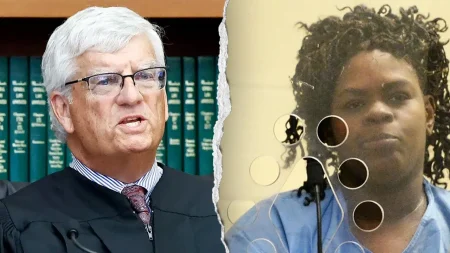






A federal judge has stepped in at the last moment to pause a strict new rule that threatened to reshape how Americans vote by mail. The decision is temporary, but its meaning is profound. It is one of those quiet legal moments that happen in the middle of a busy election cycle, when voting rules are being finalized, when state and local officials are preparing for the flood of mail-in ballots that have become a permanent part of modern democracy. The judge’s order is a reminder that the machinery of elections is not just about candidates and campaign ads. It is about the small, often overlooked details: how many days you have to return a ballot, whether your signature is accepted, whether you need a witness, whether your local election office is allowed to help you fix a mistake. These details might sound like bureaucratic trivia, but for millions of Americans they are the difference between having their voice heard and being silenced. The strict rule in question would have made it significantly harder for many people to vote by mail, and the timing could not be more consequential. With battleground states expected to be decided by razor-thin margins, any barrier to voting can tip the outcome of an election. The judge’s order is not a permanent victory, and it is not a full rejection of the rule. But it sends a clear signal: the law must protect the right to vote, not burden it, especially when so many people depend on the mailbox to make their voices count.
At first glance, the new rule probably sounded to many people like common-sense election hygiene. It was framed as an attempt to prevent fraud, clean up the rolls, and ensure that every mail ballot was legitimate. But the devil was in the details. Under the rule, ballots would face stricter requirements: shorter return windows, more rigid signature matching, fewer opportunities for voters to correct mistakes, and greater restrictions on who could help voters return their ballots. Some provisions would have required voters to provide additional identification information that they might not have readily available. Others would have limited the use of secure drop boxes, which have become a lifeline in communities where mail delivery is slow or unreliable. Even the wording on the ballot envelope itself could become a trap. A small error, a smudged signature, a missing checkmark, a date written in the wrong format, and the ballot could be rejected entirely. The people who write these rules often describe them as neutral and reasonable. But voting is not a test of bureaucratic precision. Real people are not always able to fill out forms perfectly. They have jobs, children, disabilities, language barriers, and unpredictable lives. When a rule is strict enough to punish honest mistakes, it stops being about security and starts being about exclusion. The judge’s block on this rule means that, at least for now, those barriers will not take effect. But the legal battle is far from over, and the same arguments will likely return in other forms, other states, and other courtrooms.
The human cost of such a rule is not abstract. Think about a veteran living in a rural county who has to drive forty minutes to the nearest post office, and who relies on mail voting because a service-related injury makes standing in long lines painful. Think about an older woman who has been voting for sixty years, whose hands tremble when she signs her name, and whose ballot might be flagged by a signature-matching algorithm that compares her current signature to one from decades ago. Think about a young mother working two jobs, who barely has time to vote in person on Election Day, and who returns her ballot in a drop box on the way to the night shift. Under the strict new rule, these voters could find their ballots thrown out because of a delivery delay, a signature discrepancy, or a technicality they never knew existed. The rule would not have caught criminals. It would have caught busy people, tired people, elderly people, people with disabilities, people who are already marginalized and overburdened. Mail voting is not a luxury convenience for people who cannot be bothered to show up. It is an essential method for millions of Americans who otherwise could not participate in elections. When you make mail voting stricter, you are not making elections safer. You are making them smaller. You are drawing a tighter circle around who gets to decide, and shutting out some of the most vulnerable members of the community.
This is why the ruling has so much significance for Democrats and for battleground elections. It is not because one party owns the right to vote by mail. It is because the practical effect of such rules falls unevenly on different communities. In recent elections, Democrats have been more likely to vote by mail than Republicans, a trend that emerged strongly during the pandemic and has not fully reversed. But the deeper issue is about which voters depend most on mail voting. Black and Latino communities, young voters, urban residents, and people with lower incomes often face longer distances to polling places, stricter identification requirements at the polls, and less flexible work schedules. For many of them, voting by mail is not a choice but a necessity. When a state imposes a strict new rule that makes mail voting more difficult, those voters are the ones most likely to be disenfranchised. And when a battleground election is decided by a few thousand votes, every rejected ballot matters. A discarded mail ballot is not just an individual tragedy; it is a shift in the collective power of a community. That is why the rule attracted such passionate opposition. It is why voting rights organizations, civil liberties groups, and ordinary citizens came together to challenge it. The judge recognized that the rule likely violated voting rights protected by law, and blocked it to prevent harm before it was too late. But the underlying question remains: will elections be designed to include all eligible voters, or only those who find it easiest to comply with ever-tightening restrictions?
The legal battle over this rule is a reflection of a much larger tension in American democracy. On one side is the belief that election integrity requires strict rules, that any possibility of fraud is unacceptable, and that the system must be so tight that nothing can slip through. On the other side is the belief that the true test of integrity is whether every eligible voter can participate, that fraud is extraordinarily rare, and that the real threat to democracy is not too many people voting but too many people being barred from voting. The judge’s temporary block is a practical decision, not a philosophical one. It does not solve the debate. It simply stops a policy that would likely have caused irreparable harm while the courts examine its legality. The agency that tried to implement the rule will have to go back and reconsider. Lawmakers may try again with different language. New rules may appear in different states. This is the reality of the slow, grinding, often frustrating work of protecting democracy. It happens in hearings, in legal briefs, in emergency motions, and in rulings issued late in the evening with minimal public attention. But these decisions shape who gets to vote, which voices get heard, and which issues get addressed. The temporary injunction is a reminder that the courts can sometimes serve as a guardrail, catching the most damaging changes before they reach the ballot box. But it is also a reminder that the guardrails are not permanent. The fight for fair elections is never finished.
In the end, this is not just a story about a legal ruling. It is a story about what we value as a country. Democracy is not a building. It is not a slogan. It is the way we treat one another in the voting booth, in the ballot line, and in the mailbox. When a rule is written with such strictness that it punishes people for ordinary human mistakes, we have to ask ourselves what we are really protecting. Are we protecting the integrity of elections, or are we protecting the convenience of those who already have every advantage? The judge who blocked this rule offered a small but powerful act of resistance to the slow erosion of voting access. He said, in effect, wait a minute, not so fast. There are real people behind these ballots, and they have rights. But the future remains uncertain. The rule could come back in another form. It could be replaced by an equally strict policy with different language. The only way to ensure that mail voting remains accessible to everyone is for ordinary people to stay engaged, to speak out, to vote, and to demand that elected officials remember something basic: the point of an election is not to make it hard to vote. The point is to make it possible for every citizen to be heard. In a democracy, the mailbag carries more than letters. It carries the will of the people. And in a battleground state, where one vote can decide the fate of a nation, even a single rejected ballot is one too many.