




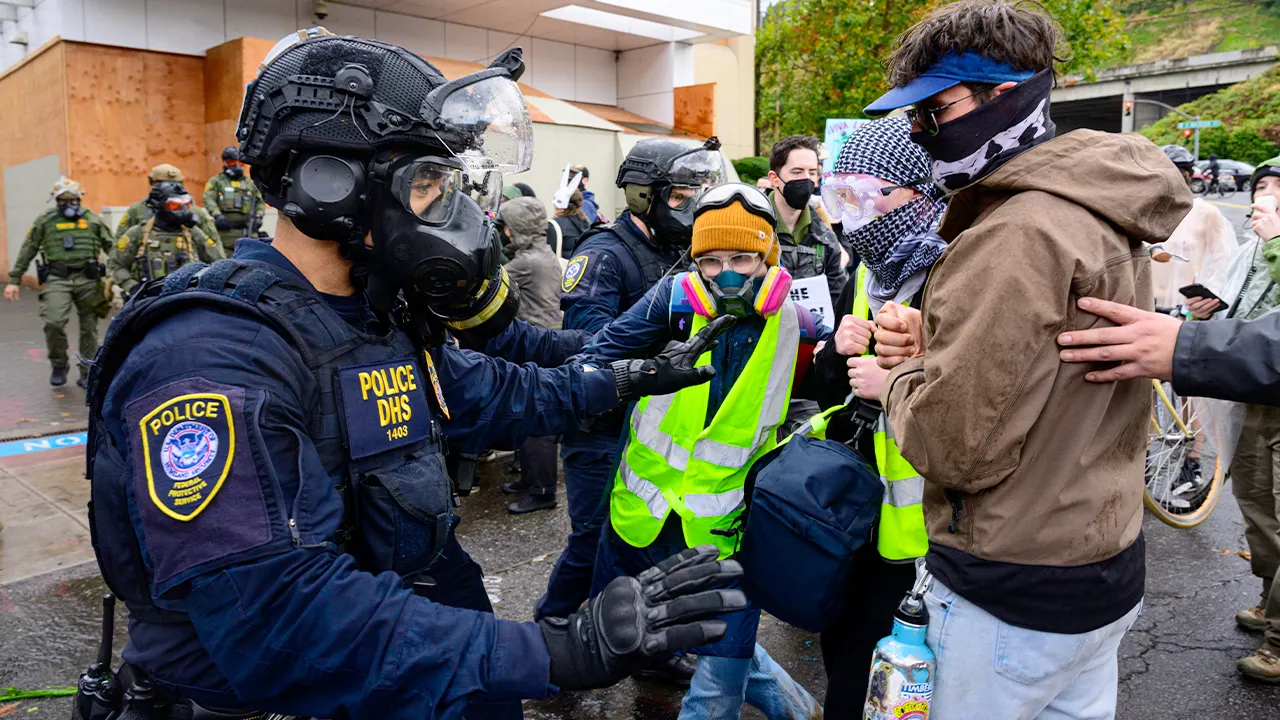
The boundaries of political dissent in America have become increasingly fraught, punctuated by flashpoints where passionate activism deteriorates into direct, physical confrontation. Such was the case in Portland, Oregon, where a highly charged demonstration outside a U.S. Immigration and Customs Enforcement (ICE) facility culminated in a life-altering sentence for a young protester named Robert Jacob Hoopes. On a recent Thursday, a federal judge sentenced Hoopes to thirty months in federal prison, followed by three years of supervised release and a mandate to pay more than $8,000 in restitution. Having previously pleaded guilty to the felony charge of aggravated assault on a federal employee with a dangerous weapon, Hoopes now faces the stark reality of confinement. The ruling represents a sobering conclusion to an incident that began as a protest against federal immigration enforcement but quickly crossed the line into violence, forever changing the trajectory of both the young man who threw the stone and the officer who stood in its path.
Behind the legal terminology of the indictment lies a harrowing story of physical trauma suffered by an ICE Enforcement and Removal Operations officer, whose identity remains protected but whose injuries paint a vivid picture of the hazards faced by federal personnel. During the chaotic June demonstration, Hoopes hurled a rock that struck the officer squarely in the face. The impact was immediate and devastating, shattering the officer’s composure and causing deep, heavily bleeding lacerations that rapidly obstructed his vision as blood poured down his face. The severe nature of the injury required immediate and ongoing medical treatment far beyond basic first aid, leaving lasting physical and psychological scars. In the aftermath of the sentencing, Scott Bradford, the U.S. Attorney for the District of Oregon, delivered a stern reminder of the government’s boundary-line, stating unequivocally that violence is not a form of protected protest. His words highlighted a fundamental principle of the American legal system: while the right to petition the government and express dissent is sacrosanct, the moment that expression turns into physical harm against another human being, it becomes a criminal act that the state will pursue with the full weight of the law.
The investigation that led to Hoopes’ arrest serves as a chilling testament to the power of modern digital surveillance, demonstrating how quickly anonymity can evaporate in the age of facial recognition. In the chaotic environment of a crowded street protest, suspects often mix into the crowd, believing they are shielded by numbers and anonymity. However, FBI investigators bypassed traditional dead-ends by utilizing commercial facial recognition software to analyze a photograph published by the local news outlet OregonLive.com. The technology scanned the image of the suspect against vast, publicly available databases, generating approximately thirty potential matches. Federal authorities then painstakingly cross-referenced these leads, eventually discovering a high-resolution, publicly accessible image of Hoopes on a Reed College digital archive titled “Canyon Day April ’23.” What sealed the identification was not just his facial structure, but a unique, highly visible forearm tattoo that perfectly matched the distinctive markings seen on the individual throwing the rock during the June 14 protest. This high-tech dragnet illustrates an era where our digital footprints, preserved in lighthearted collegiate photo albums, can become the primary evidence used by federal agencies to build an airtight criminal case.
This case also exposes a deep and painful familial tragedy, highlighting the agonizing rift that can occur when a young person’s socio-political passions clash with their foundational upbringing. Following the arrest, Hoopes’ father, Tom Hoopes, spoke out in an interview, describing his son not as a violent agitator, but as a lifelong Quaker who is deeply and fundamentally committed to the principles of pacifism. The elder Hoopes did not dispute his son’s presence at the volatile Portland demonstration, but he wrestled openly with the allegations of violence, stating that while he could not speak to the specifics of his son’s actions on that fateful day, he knew him to be a person profoundly dedicated to the pursuit of social justice. This intimate family perspective humanizes the defendant, presenting a complex psychological portrait of a young man raised in a tradition of peaceful coexistence who somehow found himself swept up in the adrenaline and anger of a mob, ultimately making a split-second decision that betrayed his family’s deeply held pacifist faith. It depicts the profound grief of a father watching his son go to prison, caught in the cognitive dissonance between the gentle child he raised and the violent image captured by investigators.
The violent incident in Portland does not exist in a vacuum, but is rather a symptom of a larger, systemic friction point occurring at immigration detention facilities across the United States. For years, Portland has been a primary battleground for intense demonstrations against ICE, with local activists expressing fierce opposition to federal immigration policies. These facilities have become powerful symbols of a deeply divided nation, serving as lightning rods for those who feel the immigration system is fundamentally unjust. The Justice Department has aggressively pursued suspects accused of assaulting federal officers during these demonstrations, signaling a zero-tolerance policy toward physical interference with federal duties. This national tension is further evidenced by ongoing, volatile clashes between demonstrators and law enforcement outside other facilities, such as Delaney Hall in Newark, New Jersey, which have similarly resulted in dozens of arrests. These compounding events underscore how local protests are increasingly turning into dangerous combat zones where federal officers, tasked with enforcing highly controversial national policies, find themselves in direct, physical conflict with communities demanding systemic reform.
Ultimately, the sentencing of Robert Jacob Hoopes serves as a tragic and cautionary tale about the volatile nature of ideological anger and the high cost of abandoning peaceful dialogue. It leaves behind a wake of brokenness: an officer recovering from painful, traumatic facial injuries, a young man entering a federal cell with his future compromised, and a family left to pick up the pieces of a fractured life. While the desire to fight for justice and advocate for marginalized communities is a noble impulse, this case illustrates the destructive futility that occurs when that desire is channeled through violence. As Hoopes begins his thirty-month prison sentence, the community is left to contemplate the immense chasm between peaceful advocacy and violent action. In a society grappling with profound political division, this outcome stands as a stark, sobering warning that when violence replaces voice, the message of reform is lost in the wreckage, leaving only victims, convicts, and a deeper sense of societal estrangement.