







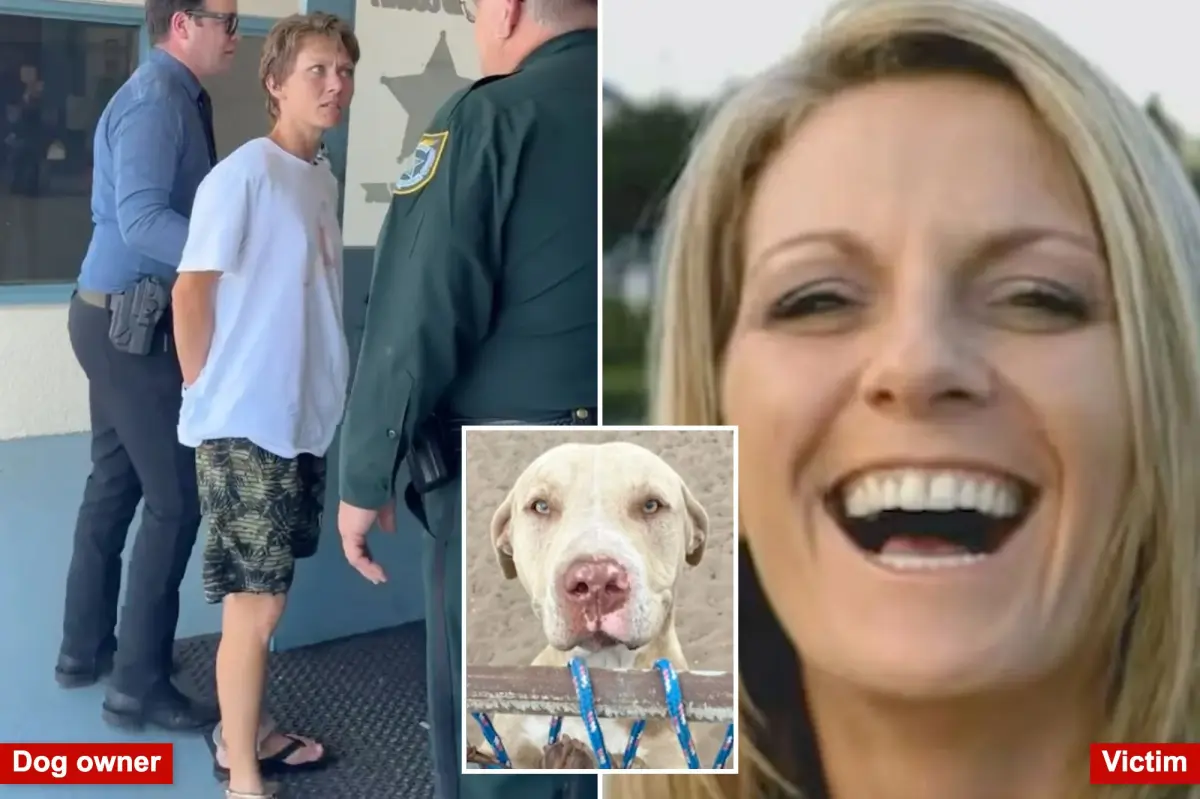
In the quiet, pre-dawn hours of May 19, the peace of a Brevard County neighborhood was permanently shattered by a tragedy that serves as a gut-wrenching reminder of the catastrophic consequences of irresponsible pet ownership. It was nearly 2:00 a.m. when 50-year-old Jodi Cowan stepped outside to walk her beloved small dog—a simple, routine act of care that would tragically be her last. Within minutes, her partner of three decades, Donnell Smith, heard her desperate screams piercing the darkness. Rushing outside into the shadows, Smith was met with a horrific scene: two powerful pit-bull-and-Catahoula-leopard-mix dogs, Max and Mako, were savagely mauling Cowan. Armed with only a knife and fueled by sheer panic, Smith fought desperately to force the dogs away while frantically calling 911. During an agonizing eight-minute phone call, the background audio captured Cowan’s heartbreaking final words, “I’m dying. Can’t breathe,” as Smith tried in vain to stem the severe bleeding from her neck, where her carotid artery and jugular vein had been severed. Though a medical helicopter rushed her to a trauma center, Cowan tragically succumbed to her extensive injuries, leaving behind a grieving partner and a community paralyzed by shock and grief.
What makes Cowan’s untimely death even more heartbreaking is the revelation that it was entirely preventable, foreshadowed by months of mounting terror and unheeded warning signs. Just five weeks prior, on April 14, the very same dogs had launched a vicious attack on another neighbor, John Argila, who was walking down the road pushing a bicycle with a flat tire. Despite Argila’s attempts to use his bike as a shield, the dogs bit his arms repeatedly before a passing motorist intervened to save his life. Smith himself had helped pull the dogs off Argila during that incident and had directly warned the dogs’ owner, 29-year-old Linda Cutler, about their increasingly dangerous behavior. Over the course of several months, the Brevard County Sheriff’s Office had received eleven distinct complaints regarding Cutler’s animals, painting a harrowing picture of a neighborhood under siege. Callers reported the dogs roamed free daily, chased terrified pedestrians, acted aggressively, and had even killed a neighbor’s cat. Yet, despite these numerous red flags and the community’s growing dread, the volatile situation was left to fester until it culminated in a senseless loss of life.
A closer look into the domestic life of these animals reveals a tragic narrative of behavioral neglect and inherited violence, shedding light on the psychological deterioration of the dogs themselves. Following the fatal incident, an animal care veterinarian examined one-year-old littermates Max and Mako, finding no signs of physical abuse but diagnosing them with “Littermate Syndrome.” This psychological condition occurs when two puppies are raised closely together without developing individual independence, leading to severe anxiety, lack of confidence, and intense aggression toward unfamiliar people and environments. Furthermore, the dogs descended from a lineage steeped in violence. Cutler admitted to investigators that the puppies’ mother had previously attacked her, resulting in Cutler’s boyfriend strangling the mother dog to death to protect her. Additionally, the puppies’ father, Boomer, had a documented history of biting, which had previously earned Cutler a formal citation from Animal Services. Despite witnessing a steady escalation of hostility in Max and Mako, Cutler failed to implement sufficient security measures, acknowledging to deputies that she knew they frequently escaped their flimsy four-foot chain-link fence but shifting the blame by claiming someone was secretly tampering with her dogs to alter their behavior.
In the wake of the tragedy, the legal and emotional fallout has deepened, taking an unexpected and highly bizarre turn. Cutler was arrested on May 27, eight days after the fatal mauling, and charged with manslaughter, presently being held without bond in the Brevard County Jail while her dogs await euthanasia. However, on June 11, the narrative took a strange and grim detour when sheriff’s deputies responded to reports of a foul odor emanating from the travel trailer where Jodi Cowan had resided with Donnell Smith. Upon investigating, authorities discovered the decomposing bodies of three dogs inside the home, which was currently under the control of Smith. The Sheriff’s Office has launched a separate criminal investigation to determine the cause of death for these three canine victims, awaiting necropsy results before deciding whether to file additional, unrelated charges. This morbid discovery has cast a dark cloud over an already devastated household, leaving the community to grapple with a multi-layered tragedy of neglect and death that spans across neighboring properties.
Beyond the immediate criminal proceedings, the tragedy has reignited a fierce national debate regarding how society should handle dangerous dogs and prevent future fatalities. Statistics compiled by the National Center for Health Statistics reveal a sobering reality: between 2011 and 2021, there were 468 dog-bite-related deaths in the United States, with pediatric studies frequently identifying specific breeds, including pit bulls, German shepherds, and Rottweilers, as those most commonly involved in severe attacks. In response to these numbers, some voice passionate support for breed-specific legislation, advocating for bans on certain types of dogs to protect public safety. However, many animal welfare experts strongly oppose these measures. Holly Sizemore, chief mission officer of the Best Friends Animal Society, argues that breed bans are a waste of valuable public resources that fail to make communities safer, noting that nearly half of U.S. states, including Florida, now restrict local governments from enacting breed-specific bans. Instead, advocates argue that public safety laws must pivot to focus strictly on the specific behavior of individual dogs and the accountability of their owners.
Ultimately, the heartbreaking loss of Jodi Cowan underscores the critical need for systemic reform in how local governments and law enforcement agencies manage dangerous animals. Dog bite expert and former NYPD Canine Unit member Michael Gould asserts that protecting the public from known aggressive animals is an overarching duty of law enforcement, suggesting that officials should have stepped in to impound Max and Mako long before their aggression turned fatal. Gould argues that breed bans are merely an archaic, band-aid solution that fails to address the root of the problem, which is invariably human in nature. When puppies are properly socialized, trained, and humanely secured, they do not become lethal threats; dangerous dogs are almost always the product of human failure, whether through neglect, poor training, or a refusal to contain them. By shifting the legal framework to enforce strict owner responsibility and empowering authorities to act swiftly when warning signs appear, society can begin to prevent these horrific incidents, ensuring that no other family has to endure the agonizing grief of losing a loved one to a preventable tragedy.