





As the summer travel season descends upon us with its trademark mixture of eye-watering ticket prices, unpredictable flight cancellations, and overcrowded terminals, it is impossible not to feel a creeping sense of nostalgia for a time when transit was even slightly more humane. Yet, my yearning does not stretch back to the far-off, heavily mythologized “Golden Age of Aviation” in the mid-twentieth century—an era of white-glove cabin service, carving stations in the sky, and enough legroom to actually stretch out without performing low-grade geometry. Frankly, my bar for survival is much lower; I find myself fantasizing about the distant, idyllic paradise of 2023. Just three short years ago, the logistics of standard flight felt remarkably benign compared to today’s chaotic gauntlet. We lived in a world where checking a standard suitcase on a domestic flight might set you back a mere thirty dollars, a time when the inner workings and staffing shortages of global air traffic control centers were not common knowledge, and civilians could wander through terminal gates in relaxed athleisure without fear of public scrutiny or political commentary. Back then, arriving at the airport four hours before a domestic flight was viewed as the eccentric hallmark of someone suffering from a severe anxiety disorder; today, it is simply the pragmatic calculus of a well-adjusted human being trying to ensure they actually board their plane before the cabin doors seal shut.
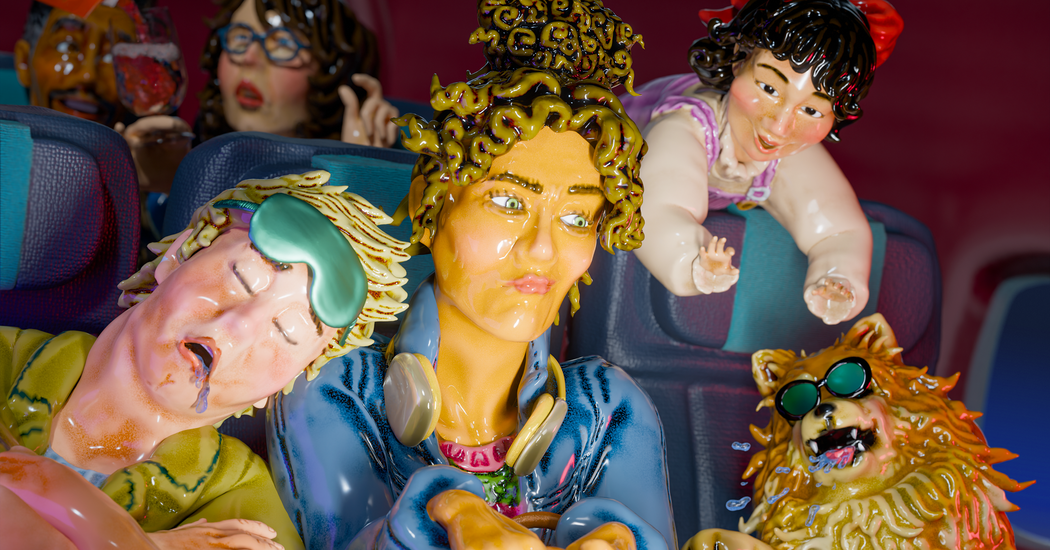
Adding to this modern psychological toll is the drastic evolution of our fellow passengers, which has shifted from standard human nuisances to a full-blown airborne menagerie. There was a time when the primary dread of any economy traveler was the prospect of being seated next to a screaming infant—especially if that child belonged to you. Today, that anxiety has been thoroughly upstaged by the distinct possibility of sharing your personal space with a screaming, hyperventilating dog. The democratization of pet travel has turned aircraft cabins into high-altitude kennels, achievable for anyone willing to pay a pet fee that suspiciously mirrors the current cost of a single lukewarm sandwich and a bottled water at LaGuardia Airport. On a recent flight back from Miami, I found myself acting as an impromptu therapist to a frantic Pomeranian occupying Seat 21D while his owner stepped away. As I patted his fluffy, vibrating head and whispered empty promises that his human would return soon, I tried desperately to ignore the mysterious liquid dripping onto my designer purse, convincing myself it was merely runoff from his water bowl. It made me realize how upside-down our priorities have become: while this small canid was permitted to voice his existential dread at thirty-five thousand feet, I was forced to suppress my own mounting panic, self-medicating quietly with a seven-dollar bag of stale Doritos while contemplating the precarious nature of global geopolitics and modern aerodynamics.
This sense of individual isolation highlights a deeper, more polarizing shift in the skies: the stark rise of modern perk inequality. There was once a comforting, egalitarian solidarity in the misery of commercial air travel; we were all trapped in the same pressurized aluminum tube, navigating the same inconveniences together. Now, however, the aviation industry has systematically segregated us, creating an elaborate Caste system of exclusive security lines, private luxury lounges, lie-flat suites, and heavily curtained first-class sanctuaries designed to insulate the wealthy from the unwashed masses. The rest of us are forced to perform the humiliating “walk of shame” past these pampered, pre-departure-champagne-sipping elites to claim our narrow, bone-crushing seats in the back of the bus, silently questioning every career and financial choice that brought us to this moment. I recently listened to a friend recount, with genuine culinary distress, how a flight attendant cleared away her premium business-class champagne only to replace it with an even more exclusive first-class vintage—an upgrade privilege I didn’t even know existed. Meanwhile, my greatest physiological triumph at thirty thousand feet is when a flight attendant generously hands me the entire can of tomato juice instead of rationing out a mere plastic cup’s worth. If the airline industry refuses to grant those of us in economy an upgrade, I propose they at least equalize our suffering; a shared baseline of mild discomfort would do wonders for national solidarity and, at the very least, make my own cheap seat feel slightly less penalizing.
If we could somehow dissolve this class divide and unite as a single, frustrated collective of travelers, perhaps we could direct our shared energy toward solving the systemic logistical catastrophes that plague modern aviation. Today, the entire civil aviation network operates on such a knife-edge that the slightest disruption—be it a coding glitch in an outdated airline scheduling software or an unannounced military deployment—can send thousands of vacations into an absolute tailspin. In recent months, countless travelers have found themselves indefinitely stranded in tropical destinations like Puerto Vallarta or Puerto Rico, left holding astronomical hotel bills, useless boarding passes, and a rapidly diminishing supply of clean underwear. Given that even the federal government seems to have very little oversight or control over the operational whims of major airlines, expecting a sweeping structural overhaul seems naive. However, if we cannot realistically reduce the frequency of national flight cancellations by a modest twenty percent, we should at least strive to make the experience twenty percent less traumatic. We could easily look to our European counterparts, whose consumer protection laws mandate that airlines provide stranded passengers with hot meals, hotel accommodations, and monetary compensation; instead, American travelers are left to fend for themselves on cold terminal floors.
The brutal reality of this systemic negligence hit close to home during my journey back from Florida—the very same trip where I served as a therapy companion to the distressed Pomeranian. When a sudden winter storm blanketed the Northeast in snow, our flight was abruptly canceled, leaving my husband and me stranded in the humid sprawl of Miami. When we politely inquired at the customer service desk if there was any hope of getting routed home the following day, the representative let out an audible, mocking chuckle—a stark contrast to the unamused reaction of my in-laws when we called to inform them they would have to continue babysitting our young children for an indefinite period. What followed was a desperate, manic ritual of digital survival: my husband spent the next several hours frantically refreshing the airline’s mobile application with the obsessive, hollow-eyed intensity of a sports gambler chasing a devastating loss at one o’clock in the morning. By some miracle, he managed to secure two seats on an unadvertised 6:30 AM emergency recovery flight, added at the last minute to clear out the backlog of stranded passengers. Boarding that aircraft felt less like embarking on a standard flight and more like a high-stakes scene from a political thriller, with a cabin full of jittery, sleep-deprived travelers looking at one another with quiet desperation, wondering if we were truly going to escape our sunny purgatory.
Our collective anxiety was hardly alleviated when the pilot decided to walk down the aisle to personally apologize for the grueling delays, only to casually add that he and his entire flight crew were “all really, really tired too.” While I appreciate transparency in leadership, learning that the person piloting your multi-ton metal aircraft through turbulent winter skies is physically exhausted is not particularly comforting, a sentiment clearly shared by the passenger next to me, who immediately produced a pocket Bible and began whispering urgent prayers. Whether we safely reached LaGuardia due to her divine intervention or my own hyper-vigilant adrenaline, we ultimately touched down on the tarmac intact. Debarking into the terminal, I was greeted by the familiar, chaotic symphony of modern travel: furious crowds of passengers besieging empty gate desks, a tiny dog yapping hysterically from a designer sage-green carrier, and an overwhelming atmosphere of shared exhaustion. I was physically spent, entirely starved, and deeply aware that I was wearing the same clothes for the second consecutive day—far from the glamorous jet-set ideal of yesteryear. Yet, as I breathed in the stale airport air, I felt a strange sense of accomplishment; it was not a golden age of travel by any stretch of the imagination, but against all odds, we had survived the gauntlet and made it home.